
Lieferung heute & morgen

Qualitätsgarantie

Willkommens-Angebote freischalten: KOSTENLOSE Lieferung | Bis zu 80 % RABATT | Kostenlose 30-Tage-JoyPlus-Testphase
App herunterladen
An LED outdoor wall light with a motion sensor should automatically provide light when movement is detected, without staying on permanently. In practice, however, poor purchases are often caused not by the LED technology itself, but by unclear information about weather resistance, sensors and power supply. It is therefore worth checking the technical specifications before buying, rather than relying on marketing claims.
The IP44 rating means that an enclosure is protected against solid foreign objects measuring 1 mm or more, as well as splashing water from various directions. An IP44 LED wall light is therefore suitable for many sheltered outdoor areas, such as a covered entrance, balcony or patio. However, it is not automatically designed for prolonged heavy rain, standing water or pressure washing.
Important: The light must not be immersed in water or exposed to direct high-pressure water jets. For unprotected façades, buyers should check whether the manufacturer specifies a higher rating, such as IP54, IP65 or another suitable version.
An outdoor floodlight with sensor producing 1,700 or 1,800 lumens illuminates a larger area than a compact battery-powered light producing 300 lumens. This is useful for a driveway, garage or courtyard, but may feel excessive on a small balcony and disturb neighbours or passers-by.
Light distribution is also important for paths, steps and entrances. Two lights with identical lumen values can appear to have different brightness levels because of their different beam angles. With an outdoor security light, installation height, positioning and detection range are therefore just as important as the light output itself.
A solar-powered and battery-operated outdoor light can be installed flexibly, but requires regular charging or sufficient sunlight. With mains-powered models, recharging is not necessary, but the electrical connection must be planned as a permanent installation. Work on a fixed electrical connection must only be carried out by a suitably qualified professional.
When choosing a motion sensor, buyers should look at the available adjustment options: detection angle, range, stay-on time and, where applicable, a dusk sensor. If this information is missing, it is difficult to assess whether the outdoor light with motion sensor will work reliably at the intended installation location.
3,000 Kelvin is considered a warm white colour temperature. Warm white outdoor lighting is often suitable for patios, balconies and entrance areas when a softer, less clinical lighting effect is preferred. 4,000 Kelvin appears more neutral white and may be suitable for paths, courtyards or work areas.
Light output is measured in lumens. 300 lumens may be sufficient for a compact orientation light. Models with a significantly higher light output are relevant for larger areas. An LED outdoor floodlight 3000 K combines a warm white colour temperature with stronger illumination, while models with 4,000 K offer a more neutral lighting effect.
An integrated battery is practical if there is no socket at the installation location. When choosing a model, consider the charging connection, charging time and expected operating duration. A USB cable can make charging easier, but does not replace checking the actual operating time.
A permanently connected outdoor light provides continuous operation. However, cable routing, wall condition and professional installation must all be taken into account. Tenants should also check whether the landlord’s permission is required for drilling or permanent electrical installation.

Why this product suits this profile: The compact battery-powered light is designed for locations without a socket and provides warm white light with 300 lumens. A USB cable, toggle switch and integrated magnet support flexible use.
The product specifications explicitly state the light output, colour temperature, battery, USB connection and IP44 rating. This makes it easier to compare the light with the intended installation location.
4 watts, 300 lumens, 3,000 Kelvin, integrated battery, motion sensor and IP44.
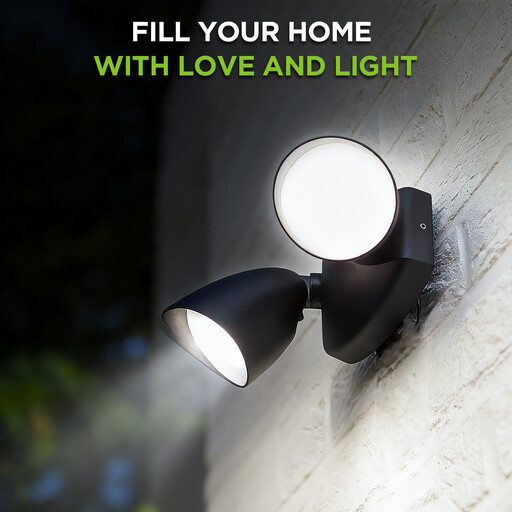
Why this product suits this profile: The two-way positioning and specified light output of 1,800 lumens are designed for larger outdoor areas such as courtyards, garages, gardens or driveways.
The high light output is clearly specified. Before buying, you should still check whether the strong illumination is suitable for your property and the desired beam area.
20 watts, 1,800 lumens, 4,000 Kelvin, dual-head design and metal construction according to the product name.

Why this product suits this profile: This permanently installed light is described as suitable for entrances, paths, balconies, patios, garages and stairways. Motion and light sensors support automatic operation.
The product description states the intended outdoor use, aluminium housing and both sensor functions. The specific IP rating should also be checked before ordering.
24 watts, 3,000 Kelvin, U-shaped design, aluminium housing, plus light and motion sensors.
Before installation, test the sensor’s detection area. Many sensors detect movement across the detection field more easily than movement directly towards the light. Branches, reflective surfaces, pets or passing vehicles can trigger false alarms.
With a battery-powered light, an easily accessible installation location is recommended so that charging does not become unnecessarily inconvenient. After installation, screws, seals and cable entries should be checked regularly. Damaged lights must not be used. Integrated batteries must be disposed of through the electrical and electronic waste or battery collection system in accordance with local requirements.
We have put together a complete, regularly updated list of products that fully meet these strict selection criteria and the safety regulations applicable in the EU.
The ideal height depends on the sensor range, beam angle and local conditions. As a starting point, choose a position where the sensor clearly detects the access route, but does not point directly towards a busy road or neighbouring property. The installation instructions for the individual model are the key reference.
Consumption depends on the wattage and the daily operating time. A 4-watt light uses 0.004 kilowatt hours when operated for one hour. With sensor operation, it usually stays on for less time than a light that remains illuminated continuously. To calculate the exact cost, you need the electricity tariff, power consumption and actual operating time.
IP44 may be sufficient for many sheltered outdoor areas, but it does not protect against every weather condition. For an unprotected wall, exposed location or areas subject to frequent heavy rainfall, check the IP rating recommended by the manufacturer. Pressure washers and immersion must also be avoided with IP44 lights.