
Lieferung heute & morgen

Qualitätsgarantie

Willkommens-Angebote freischalten: KOSTENLOSE Lieferung | Bis zu 80 % RABATT | Kostenlose 30-Tage-JoyPlus-Testphase
App herunterladen
An LED outdoor wall light can illuminate your entrance, make paths easier to see or provide security lighting outdoors. In practice, choosing the right light involves more than just wattage or a modern design. The key factors are where you’ll use it, its light output, IP rating, power supply and installation requirements.
For integrated LEDs, wattage mainly tells you how much energy the light uses. Luminous flux, measured in lumens, is what determines its actual brightness. A 4-watt light with 300 lm will give a very different amount of light from a 20-watt floodlight with 1,800 lm. If you only look at the wattage, you could end up with too little light for a courtyard or unnecessarily bright lighting for a small entrance.
An IP44 outdoor light is protected against solid objects 1 mm or larger and splashing water from various directions. This makes it suitable for many sheltered entrances, patios and covered walls. However, IP44 doesn’t mean the light should be exposed to heavy driving rain, standing water or a pressure washer for prolonged periods.
For exposed façades, open courtyards or areas subject to direct weather, check that the manufacturer’s stated IP rating is suitable for the installation location. Cable entries, seals and correct installation also affect how well the light is protected in everyday use.
An outdoor light with a motion sensor can make life more convenient, but it needs to be positioned so the sensor points in the right direction. Depending on the sensor, branches, passing vehicles or pets could trigger the light unnecessarily. With solar lights, operating time also depends on the sun’s position, shade, time of year and charge level. A solar garden light is often suitable for decorative garden lighting, but it isn’t necessarily a reliable choice for security lighting that needs to be available at all times.
The beam angle matters too. A wide beam spreads light over a larger area. An outdoor dual-head spotlight with two adjustable heads can illuminate two separate areas, such as a garage door and a side path.
Warm white outdoor lighting at around 2,700 to 3,000 K usually creates a subtle effect on patios, balconies and in gardens. It helps create a cosy atmosphere and works well for decorative garden lighting.
Neutral white light at around 4,000 K gives a more practical feel and can be a good choice for a courtyard, garage or entrance. Daylight white at 5000K looks much clearer and more defined. This colour temperature can work well for security lighting or an outdoor LED floodlight, but may feel too harsh in a small seating area.
Mains-connected lights should only be installed in accordance with the applicable regulations and by a suitably qualified person. Before carrying out any electrical work, switch off the circuit at the fuse box and make sure it cannot be switched back on.
For a portable LED outdoor lamp with a rechargeable battery, check the charging connection, battery capacity and permitted outdoor conditions. A magnet makes it easier to attach the light to suitable metal surfaces, but it isn’t automatically a substitute for permanent, storm-resistant wall mounting.
Mains voltage is another important consideration: a product marked AC 120 V, 60 Hz is not necessarily suitable for the German 230-volt mains supply. So before you buy, check the voltage, frequency, protection class and specified installation method.
The models below vary in light colour, power supply, brightness and intended use. Check the product details on the relevant product page again before placing your order.
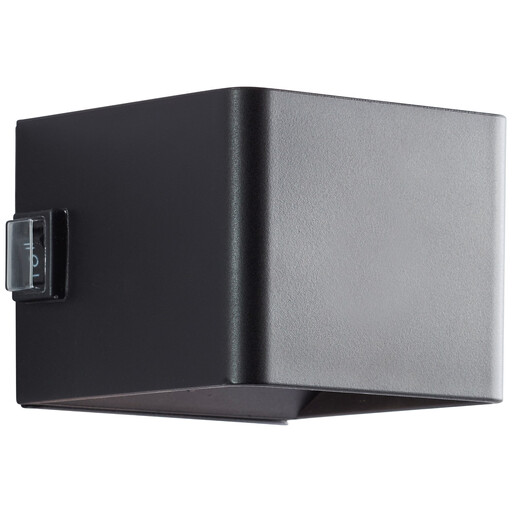
Why it suits this profile: This portable light has a built-in rechargeable battery, USB charging and an output of 300 lm at 3,000 K. It’s suitable for smaller patios, entrances or places without a fixed power supply.
The stated output of 300 lm, power consumption of 4 W and IP44 rating give you a clearer idea of what to expect than a vague claim about brightness. However, the light isn’t designed for prolonged exposure to high-pressure water or for underwater use.
Rechargeable battery, USB connection, motion sensor and magnetic attachment; warm white light at 3,000 K.
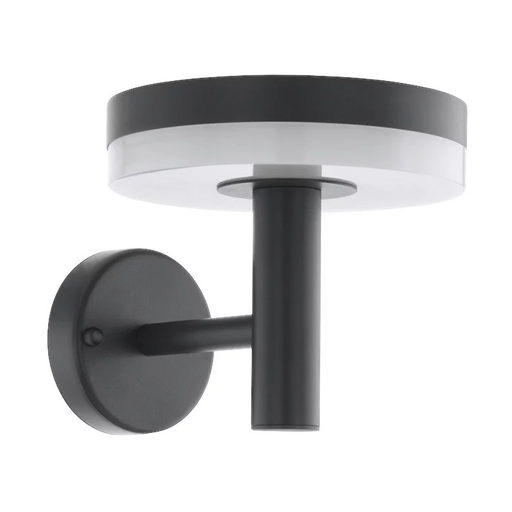
Why it suits this profile: This mains-connected model combines an anthracite metal and plastic housing with an integrated 11 W LED module. Its 950 lm output and 3,000 K colour temperature are designed for entrances, patios and paths.
The combination of lumen output, wattage and colour temperature makes it easier to assess the light objectively. According to the product details, the integrated LED module can’t be replaced, so bear this in mind when planning for the long term.
950 lm, warm white light at 3,000 K and a permanently integrated 11 W LED module for wall mounting.
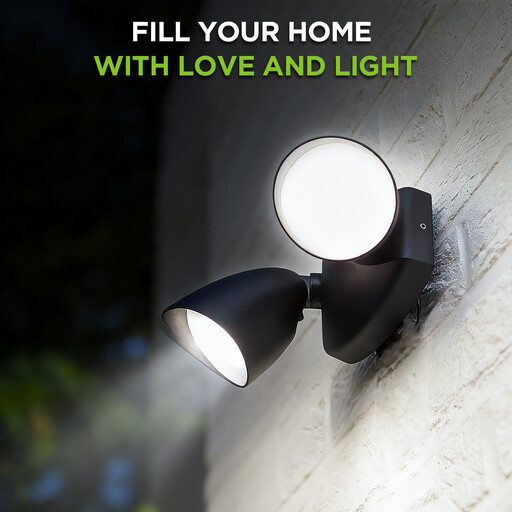
Why it suits this profile: With a stated output of 1,800 lm and a dual-head design, this light is intended for larger areas such as courtyards, garages, gardens or driveways where broad coverage is needed.
The lumen rating means you don’t have to judge brightness by the 20 W figure alone. Before installation, check the product page for details of the IP rating, voltage and sensor function.
1,800 lm, 20 W, two light heads and a stated focus on outdoor and security lighting in the product name.
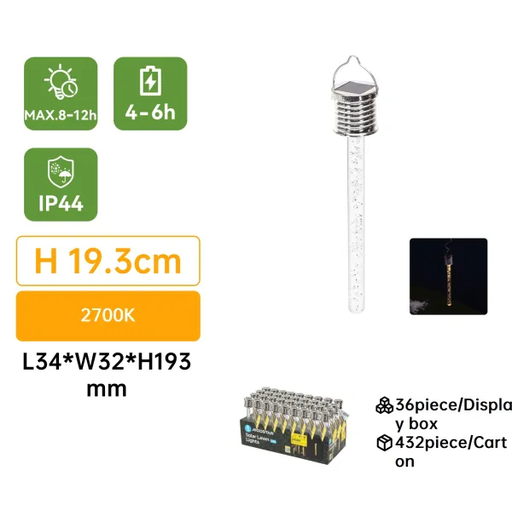
Why it suits this profile: This lightweight solar garden light is designed to add decorative touches to your garden. Its 2,700 K colour temperature, stated battery life of 8–12 hours and weight of 40 g make it easy to position wherever you like.
The stated charging time of around 4–6 hours and its reliance on sufficient sunlight are clearly taken into account. This makes it easier to assess the light realistically as decorative garden lighting rather than as your main light source.
Solar-powered, 2,700 K, IP44, stated operating time of 8–12 hours and compact dimensions.
We’ve put together a complete, regularly updated list of products that meet these strict selection criteria and fully comply with the safety regulations in force in the EU.
Around 300 to 500 lm may be enough for a small entrance. For a larger wall, courtyard or garage, 800 to 1,800 lm is often a better choice. The brightness you need also depends on the mounting height, beam angle and the way you want the light to spread.
IP44 can be suitable for many sheltered outdoor areas and covered walls. For locations exposed to heavy weather, check the installation site against the manufacturer’s guidance. Don’t submerge the light in water or clean it with a high-pressure jet unless it’s specifically designed for this.
Energy use depends on the wattage and how long the light is on each day. A 4 W light running for five hours uses around 20 Wh; a 20 W light uses around 100 Wh over the same period. A motion sensor can reduce the time the light is on. Solar garden lights don’t use mains power, but how well they work depends on the charging conditions.