
Lieferung heute & morgen

Qualitätsgarantie

Willkommens-Angebote freischalten: KOSTENLOSE Lieferung | Bis zu 80 % RABATT | Kostenlose 30-Tage-JoyPlus-Testphase
App herunterladen
An LED outdoor wall light with motion sensor can switch on exactly when illumination is needed—at the front door, garage or terrace, for example. However, not every model automatically delivers the right solution. Product listings often emphasise high lumen values, decorative designs or broad claims about weather resistance, while important details remain hidden in the small print.
This buying guide from the Joybuy Product Recommendation Officer explains which specifications matter when choosing an outdoor light with a motion sensor and which models suit different use cases.
The designation IP44 means that a product is protected against solid foreign objects measuring 1 mm or more and against splashing water from different directions. This is sufficient for many covered entrances, balconies and terraces. However, an IP44 outdoor light should not be installed where it is permanently exposed to heavy rain, standing water or a high-pressure water jet.
For unprotected façades, the manufacturer’s specific installation instructions are crucial. The IP rating alone does not replace proper installation.
Lumens indicate luminous flux, or the amount of light emitted. A high value is not automatically suitable for every application. Moderate brightness may be sufficient for decorative garden lighting, while a driveway or larger courtyard requires broader and brighter illumination.
Beam angle, installation height and orientation are equally important. A 300-lumen light may be perfectly suitable for a small entrance, whereas a more powerful LED security light is likely to be better suited to a garage.
A motion sensor responds to detected movement. A light sensor activates the light based on ambient brightness. Some outdoor lights combine both functions, while others feature only a motion sensor or rely solely on manual control.
Before buying, check the following:
For entrance and terrace lighting, warm white light at 3000 K is a popular choice. Outdoors, it appears less stark than neutral white light at around 4000 K. Paths, courtyards and work areas may benefit from higher light output or a more neutral light colour.
At a minimum, the product specifications should include:
An integrated LED can save space. However, on some models the LED module cannot be replaced. This should be taken into account when planning for long-term use.
Hard-wired LED outdoor lights require professional electrical installation. In Germany, work on outdoor electrical circuits should be carried out by an appropriately qualified person. Battery-powered models do not require a fixed connection, but their batteries need to be recharged regularly.
Solar outdoor lighting offers particular independence from mains sockets. However, charging performance depends on the position of the solar panel, the amount of daylight and the level of shade. Solar lighting is therefore not equally suitable for every location if consistently bright illumination is required.
Metal housings can provide a sturdy construction, while plastic diffusers help distribute light evenly. An anthracite finish often complements modern façades, but the colour alone says nothing about the product’s actual durability.
In many cases, a lightly dampened cloth is all that is needed for cleaning. Avoid abrasive products, harsh cleaners and direct jets of water. For permanently installed lights, corrosion-resistant screws and properly sealed cable entries are also important.
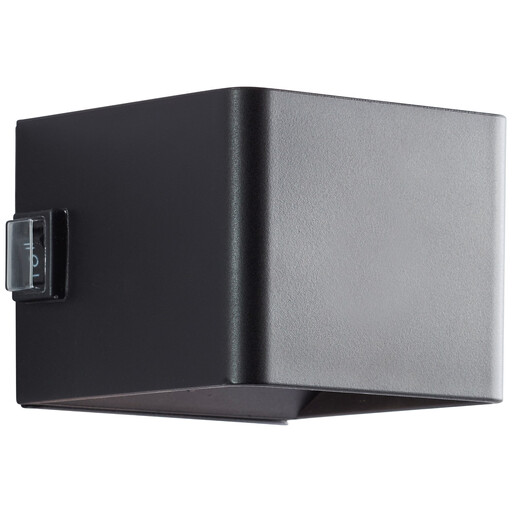
Why it’s a good fit: Ideal for tenants, balconies and small entrance areas without an existing power connection. The light can be used flexibly and charged via USB.
The integrated battery and USB cable eliminate the need for a mains connection. However, the IP44 rating should not be interpreted as protection against powerful water jets.
300 lm, 3000 K, integrated battery, magnetic mounting, USB connection and motion sensor; power consumption of 4 W.
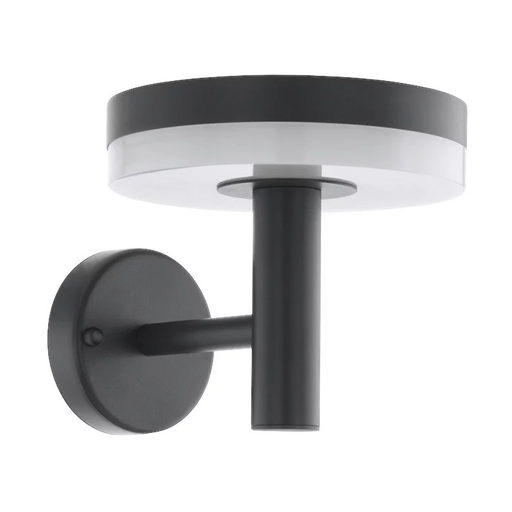
Why it’s a good fit: Designed for fixed entrance lighting, pathways or covered terraces where a permanently installed light point with a warm white tone is preferred.
The specifications of 950 lm, 11 W and 3000 K make it easier to assess the product. A motion or light sensor is not listed in the available product data.
Integrated LED module, 950 lm, warm white light at 3000 K, metal-and-plastic construction, and dimensions of 24.5 × 18 × 24.5 cm.
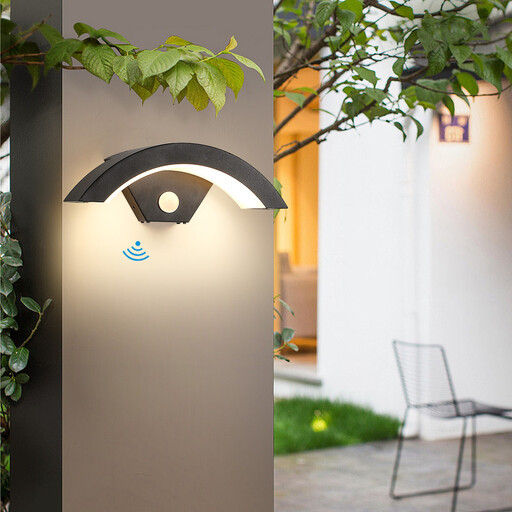
Why it’s a good fit: For homeowners with several outdoor areas, such as a porch, driveway, garage, staircase or garden path. According to the product description, this model features both a light sensor and a motion sensor.
The sensor functions are explicitly stated in the product description. Before making a final choice, you should also check the IP rating, installation instructions and desired light coverage.
24 W, warm white light at 3000 K, matt aluminium housing, and suitable for porches, pathways, gardens, balconies and garages.
Annual electricity costs can be estimated using this simple formula:
Watts ÷ 1,000 × operating hours × electricity price per kilowatt-hour
For example, an 11 W light operating for a total of 500 hours per year consumes 5.5 kWh. With a sensor light, actual consumption depends heavily on how often the sensor is triggered and how long the light remains on.
For lights with integrated LEDs, you should also check whether the manufacturer states that the module can be replaced. For battery-powered and solar lights, battery capacity and charging method are important. A solar panel requires a location with as little shade as possible; on a north-facing façade or beneath a dense canopy, illumination time may be reduced.
The ideal height depends on the sensor’s detection range, the geometry of the façade and the installation location. The sensor should cover the relevant path or entrance area without pointing directly towards busy roads or moving branches. The manufacturer’s specific instructions for installation and alignment should always take priority.
IP44 can be suitable for many partially protected areas because this rating covers splashing water. For completely exposed locations or areas subject to severe weather, the specific installation conditions should be assessed and a light with a higher IP rating selected if necessary.
A solar-powered light does not consume additional electricity from the household supply during operation and requires no fixed connection. Its performance, however, depends on available daylight and the installation location. A hard-wired LED outdoor light generally provides more predictable illumination, but it requires professional installation and draws mains power whenever it is activated.
We have put together a complete, regularly updated selection of garden lights that takes the key considerations for outdoor areas into account.