
Lieferung heute & morgen

Qualitätsgarantie

Willkommens-Angebote freischalten: KOSTENLOSE Lieferung | Bis zu 80 % RABATT | Kostenlose 30-Tage-JoyPlus-Testphase
App herunterladen
An LED outdoor wall light with a motion sensor can help you find your way, light up your front door and avoid unnecessary running time. In practice, though, wattage and an eye-catching product image aren’t the only things that determine whether a light is right for you. For homeowners, tenants and garden owners, sensor performance, light distribution, weather protection and the mounting position are all important.
A high lumen figure tells you the total light output, but doesn’t necessarily mean the light will be evenly distributed. A narrow beam can make a small area look very bright, while the nearby path or driveway remains in shadow. That’s why you should also consider the beam angle, adjustable light heads and mounting height.
Terms such as “outdoor”, “waterproof” or “weatherproof” don’t tell you much unless a specific IP rating is clearly stated. Check the technical product details to see whether the model you’re considering is suitable for the intended location, whether it’s partially covered or fully exposed. If no specific rating is given, check with the retailer before buying.
A sensor can be triggered by passing vehicles, pets, warm air from an extractor or paths that run very close to the light. Poor positioning can also mean people aren’t detected until they’re nearby. Look for details on the detection range, run-on time, sensitivity and sensor angle. A dusk sensor is useful if you don’t want the light to come on during the day.
A 20 W LED outdoor light can produce different levels of brightness, depending on its light output. The lumen figure is therefore more useful than wattage alone. Lower output is often enough for finding your way at the front door, garage or patio. For a courtyard, driveway or wider wall, a more powerful outdoor floodlight with a motion sensor may be a better choice.
Colour temperature affects how the light looks:
A twin-head outdoor floodlight can cover two directions at once. Adjustable heads help you direct the light more precisely towards an entrance, steps, bin area or driveway. Before buying a fixed wall light, check that the mounting surface is wide and sturdy enough.
A metal housing may feel robust, but that’s no substitute for checking the technical details. Look for clear installation instructions, suitable fixings and details of the mains connection, voltage and protection rating. Fixed-wired lights should be installed in line with the applicable electrical regulations. If you rent your home, get your landlord’s permission before drilling or arranging permanent electrical work.
The products below aren’t ranked as a one-size-fits-all selection. Instead, they’re grouped by typical needs for outdoor LED security lights, colour temperature, sensors and coverage.
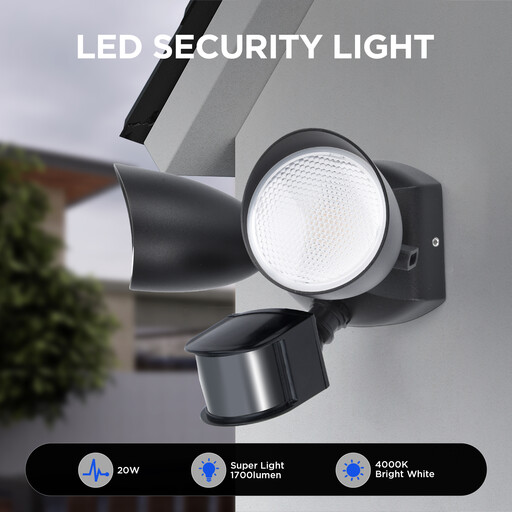
Why this product suits this profile: This model combines 20 W of power with 1700 lumens, 4000 K neutral white light and two light heads. It’s a good option if you’re looking for clearly specified essentials for a courtyard, garage or driveway.
The product details specify light output, power, colour temperature and twin-head design. You can compare these features with your intended mounting area before you buy, rather than relying on general claims about brightness.
1700 lumens, 20 W, 4000 K and integrated sensors, according to the product name; two light heads for wider coverage.
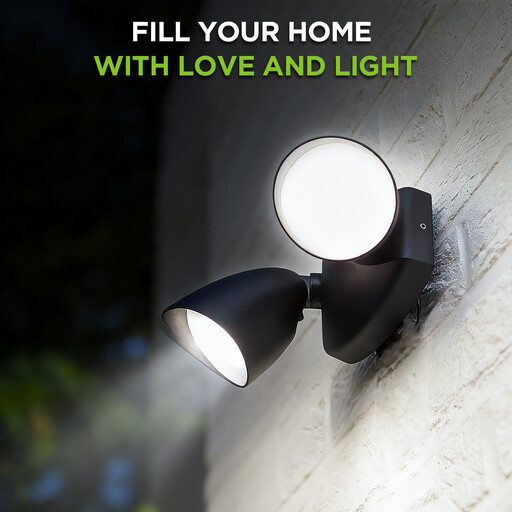
Why this product suits this profile: With 1800 lumens, 20 W, 4000 K and a full metal design, this light will appeal if you’re looking for a clearly defined construction and wide coverage for outdoor areas.
Details of the metal construction, light output and colour temperature make it easier to compare. Before installation, you should still check the full product details for the specific IP rating and sensor settings.
1800 lumens and 20 W; two adjustable heads and a full metal design, according to the product name.

Why this product suits this profile: This black, U-shaped outdoor wall light combines a light sensor and motion sensor with 3000 K warm white light. It’s suited to entrances, patios, balconies, garages and paths where you’d prefer a less utilitarian colour temperature.
The stated combination of a light sensor and motion sensor makes it easier to assess whether the automatic operation suits your needs. If you’re fitting it in a fully exposed area, check the protection rating before you buy.
24 W, 3000 K, black aluminium housing and combined light and motion sensors, according to the product description.
We’ve put together a complete, regularly updated list of products that meet these strict selection criteria and fully comply with the safety regulations in force in the EU.
Annual costs depend on the light’s power, how long it’s switched on and the price of electricity. A simple calculation is:
Power in kW × operating hours × electricity price per kWh = electricity costs
A 20 W light is equivalent to 0.02 kW. If it runs for a total of 300 hours a year, for example, it will use 6 kWh. A motion sensor can reduce the actual running time if the run-on time and sensitivity are set appropriately. Frequent false triggers, on the other hand, increase energy use and can affect the light’s lifespan.
It depends on the sensor angle, light head and conditions at the property. A light mounted by a front door or garage should cover the detection area without pointing straight at a busy road. Follow the manufacturer’s recommendations for mounting height and direction.
Its lifespan depends on several factors, including operating hours, heat dissipation, mains quality, moisture and switching cycles. A general lifespan claim won’t necessarily apply to every model. Check the LED lifespan stated by the manufacturer and the warranty terms.
3000 K gives a warm white light and is often a good choice for patios, balconies and front doors. 4000 K neutral white is often better for courtyards, garages, paths and driveways when you want clear, neutral-looking definition. Choose a colour temperature that suits your existing outdoor lighting and the effect you’re after.