
Lieferung heute & morgen

Qualitätsgarantie

Willkommens-Angebote freischalten: KOSTENLOSE Lieferung | Bis zu 80 % RABATT | Kostenlose 30-Tage-JoyPlus-Testphase
App herunterladen
An LED outdoor wall light with a motion sensor can automatically illuminate your entrance, patio, garage or driveway. However, brightness and design should not be the only considerations before buying. Unclear IP ratings, unsuitable power supplies or incorrectly positioned sensors often lead to disappointment.
This buying guide from the Joybuy Product Recommendation Officer explains which technical specifications matter and which models suit different usage scenarios.
An LED outdoor light with 1,800 lumens provides significantly more illumination than a 300-lumen model. That makes it suitable for a driveway or larger courtyard, but it may feel unnecessarily bright at a small entrance. Beam angle, mounting height and orientation also affect the actual distribution of light.
For paths, doors and smaller patio areas, 300 lumens may be sufficient. For garage entrances, courtyards or larger garden areas, higher output and, where appropriate, multiple light sources are more practical.
The level of protection is defined by the IP code. A waterproof outdoor light rated IP44 is protected against solid foreign objects measuring 1 millimetre or more, as well as splashing water from various directions. However, it is not automatically suitable for prolonged heavy rain, standing water or high-pressure cleaning.
At exposed installation locations, buyers should follow the mounting position specified by the manufacturer. An IP44 light should not be installed in a recess where rainwater can collect.
A sensor responds to changes in thermal radiation and movement within its detection area. If the light points directly towards a busy road, it may switch on more frequently. If it is installed behind an obstruction or too high up, the usable detection range is reduced.
Before installation, detection direction, mounting height and potential obstructions should therefore be checked. Specifications for detection angle, range and activation duration are more important than a general advertising claim such as “intelligent security lighting”.
Brightness is measured in lumens (lm), not solely by wattage. With integrated LEDs, wattage primarily indicates electrical consumption. As a guide:
Colour temperature is measured in kelvin. Warm white light at 3000 K generally creates a more discreet ambience and is well suited to patios, entrances and seating areas. Daylight white at 4000 K provides functional illumination for paths, garages and work areas. A colour temperature of 5000 K can appear very crisp, but not every model is suitable for connection to the German power grid.
A solar-independent LED wall light with an integrated battery can be installed where no mains connection is available. This reduces installation effort, but requires regular charging. When comparing models, check the battery capacity, charging port and charging accessories.
An outdoor light powered by a rechargeable battery and USB cable is a flexible choice for rental properties, sheds or temporary installation locations. For permanently installed security lighting, a hardwired LED outdoor light with a motion sensor is often more suitable. In Germany, electrical connections may only be carried out by a suitably qualified person.
In addition to the IP code, the material, mounting system and orientation are important. Metal housings can offer a robust construction, but must be adequately protected against corrosion for outdoor use. Corrosion-resistant screws should be used during installation.
Also check:
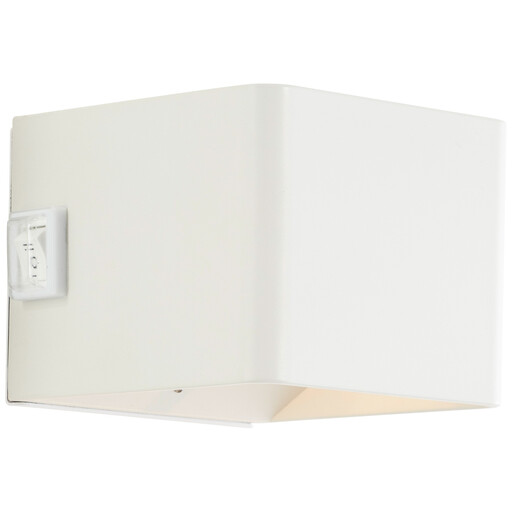
Why it suits this profile: This portable LED wall light is ideal for smaller entrances, patios or sheds without an existing power outlet. The integrated battery is charged via USB.
The technical specifications list 300 lm, 3000 K and IP44. This gives a more realistic indication of the areas for which the light is suitable.
4 W, integrated battery, USB connection, magnetic mounting, toggle switch, motion sensor and IP44.
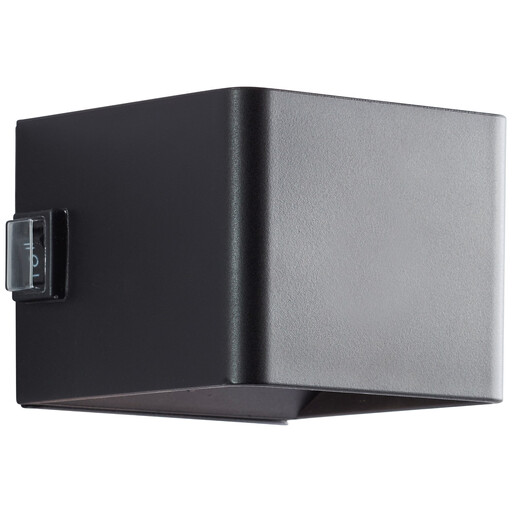
Why it suits this profile: This compact, battery-powered outdoor light can be positioned in suitable locations without fixed wiring. The magnet is designed for attachment to metal surfaces.
The IP44 rating should not be confused with complete waterproofing. Direct high-pressure water jets and immersion must be avoided.
300 lm, warm white light at 3000 K, USB charging cable, integrated battery and motion sensor.
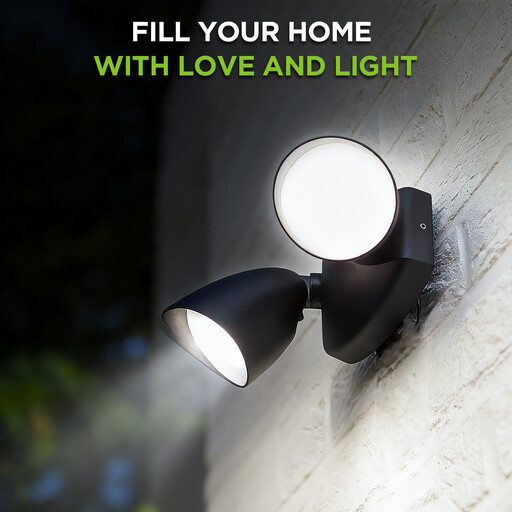
Why it suits this profile: This dual-head LED outdoor floodlight is designed to illuminate larger patios, gardens, courtyards or driveways. The colour temperature is 4000 K.
The higher light output should not be mistaken for a small entrance light. Before buying, ensure the installation location is far enough away from windows and neighbouring properties.
20 W, 1,800 lm, 4000 K, two light heads and metal construction according to the product description.
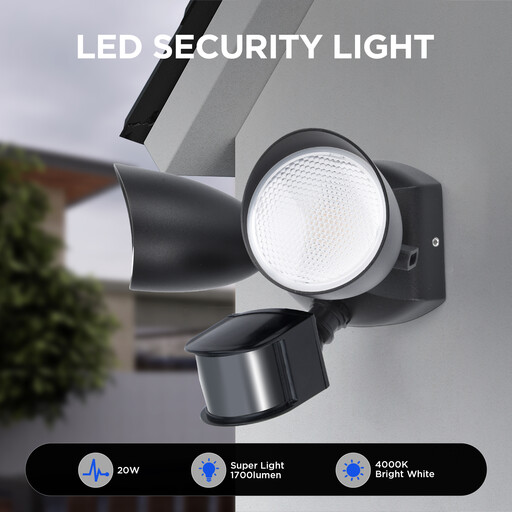
Why it suits this profile: With its integrated dual head, this LED security light is aimed at users seeking practical outdoor illumination with a motion sensor for larger areas.
Before ordering, check the IP rating, mains voltage and installation instructions in the complete product listing.
20 W, 1,700 lm, 4000 K and integrated twin heads according to the product name.
An outdoor wall light should be mounted so that rainwater can drain away and the sensor is not blocked by projections in the wall. For battery-powered models, an easily accessible charging location is helpful. The battery should be charged according to the manufacturer’s instructions and should no longer be used if it is damaged or becomes unusually hot.
For running costs, a 4 W light operated for a total of one hour per day consumes approximately 1.46 kWh per year. Under the same conditions, a 20 W light would consume around 7.3 kWh. Actual consumption depends on how often the motion sensor activates the light.
The complete selection includes products for entrances, patios, gardens, garages and other outdoor areas. Before buying, check the specifications for IP rating, power supply and installation.
This depends on the detection angle, range and local conditions. Mounting the light at a moderate height on the wall can provide good coverage of the entrance area. The key is to ensure that the sensor is not obstructed by doors, canopies or plants. The manufacturer’s specific instructions always take precedence.
Service life depends on the LED module, electronics, ambient temperature, humidity and operating duration. For battery-powered models, battery ageing is also a relevant factor. As the LEDs are permanently integrated in many lights, buyers should check in advance whether individual components can be replaced.
For partially sheltered outdoor areas, IP44 may be suitable, as this rating protects against splashing water. Fully exposed installation locations or particularly demanding weather conditions may require a higher IP rating. Suitability should always be assessed based on the specific installation location and the manufacturer’s specifications.