
Lieferung heute & morgen

Qualitätsgarantie

Willkommens-Angebote freischalten: KOSTENLOSE Lieferung | Bis zu 80 % RABATT | Kostenlose 30-Tage-JoyPlus-Testphase
App herunterladen
An LED outdoor wall light with a motion sensor should provide light when needed without staying switched on continuously. In practice, however, poor purchases are often caused not by the LED itself, but by unclear information about the IP rating, battery life or installation. So when choosing an outdoor light for a balcony, garage or entrance, you should look beyond the lumen rating.
A weatherproof IP44 outdoor light is protected against solid foreign objects measuring 1 mm or more, as well as splashing water from various directions. However, this does not automatically make it suitable for prolonged heavy rain, standing water or a direct high-pressure water jet.
The installation location is therefore crucial. IP44 can be suitable beneath a porch roof. On a completely unprotected exterior wall or an exposed garden post, a higher IP rating may be more appropriate. Always follow the manufacturer’s instructions for the specific outdoor installation.
Lumens describe the total luminous flux, not how evenly an area is illuminated. A compact light with 300 lm may be sufficient for an entrance or a short patio area. For a wide garage drive or a longer path, a wider beam angle and higher luminous flux are more important.
An outdoor LED security light should also be positioned so that it does not shine directly into windows or at eye level. A motion sensor cannot replace careful positioning.
A battery-powered outdoor wall light does not require a fixed power connection, but it does need to be charged regularly. With a solar-free outdoor light, operating time depends, among other things, on the detection range, activation time, ambient temperature and charge level. A USB connection is convenient, but the charging interval is not determined solely by the LED’s rated power.
Before buying, consider whether the light is to be permanently installed, occasionally repositioned or used as a portable LED wall light.
The IP44 rating is generally suitable for areas exposed to splashing water, provided the light is installed according to the instructions. Screws and mounting materials for outdoor use should be corrosion-resistant. In rented accommodation, magnetic or low-residue mounting solutions may be worth considering, provided the surface is suitable.
Electrical connections to a property’s wiring must only be carried out by a suitably qualified professional. Battery-powered models do not require a fixed mains connection, but you must still follow the instructions on charging, moisture and safe use.
A magnetic wall light with USB charging can be quickly attached to and removed from suitable metal surfaces. This is practical for seasonal use, recharging or flexible positioning. On plastered, wooden or brick surfaces, however, a magnet alone is not sufficient.
For a fixed installation with a power cable, you need to take the wall construction, cable routing and existing connections into account. For tenants or remote garden areas, a battery-powered outdoor wall light can be a less complicated alternative.
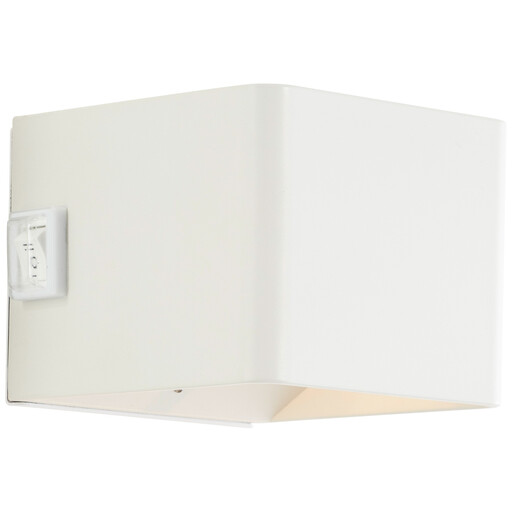
Why this product suits this profile: This compact white light combines 300 lm, 3000 K, an integrated battery and USB charging for smaller entrance or patio areas without a socket.
The product details explicitly state the IP44 rating, battery and USB connection. This makes it easier to assess whether it is suitable for a sheltered outdoor area.
Integrated motion sensor, magnetic mounting, USB-A connection and 4 W power consumption.
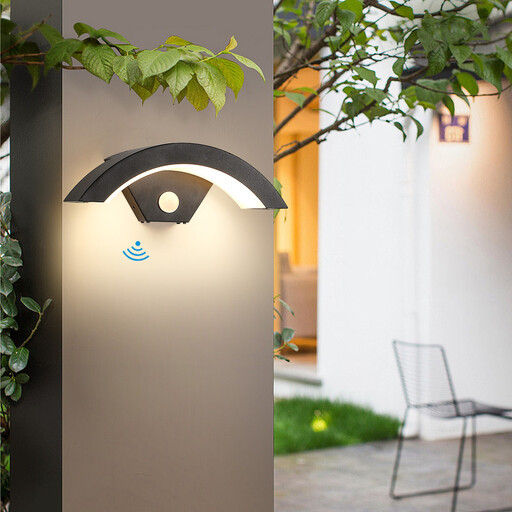
Why this product suits this profile: This U-shaped model, made from matt aluminium, is designed for entrances, balconies, patios, paths and garages where a more permanent outdoor installation is preferred.
The light and motion sensors are listed separately in the product details. This makes it easier for users who want to combine automatic activation in darkness with motion detection.
24 W, 3000 K, matt aluminium housing and a design suitable for several outdoor areas.
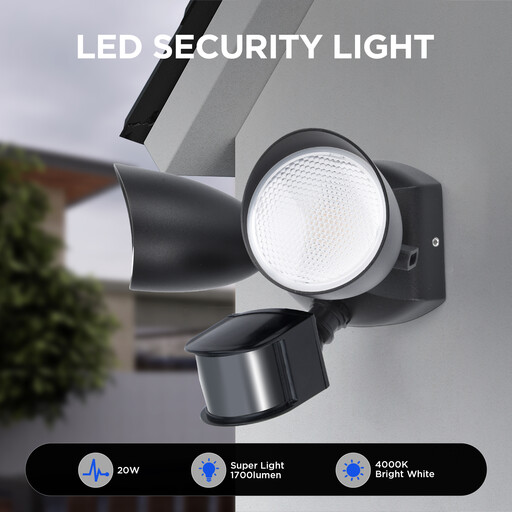
Why this product suits this profile: The two adjustable light heads and 1,700 lm are designed for larger outdoor areas such as courtyards, driveways, gardens or garages.
The light output of 1,700 lm and colour temperature of 4000 K are clearly specified. This means the light is not judged solely by general terms such as “security light”.
20 W, 1,700 lm, 4000 K, motion sensor and integrated twin-head design.
We have put together a complete, regularly updated list of products that fully meet these strict selection criteria and the safety regulations applicable in the EU.
For a small entrance or balcony, around 300 lm may be sufficient for orientation. For larger areas such as driveways, courtyards or gardens, consider the luminous flux, beam angle and position of the light together. A higher lumen rating does not automatically mean better illumination in every area.
This depends on the stated IP rating and the manufacturer’s instructions. A model with IP44 is protected against splashing water, but should ideally be installed in a partly sheltered location. The battery, charging connection and housing must not be immersed in water.
Running costs depend on the power rating, operating time and electricity price. With a mains-powered light, consumption can be calculated from the wattage and operating time. A battery-powered light instead requires energy for recharging. As the motion sensor limits how long the light stays on, actual consumption can be considerably lower than with continuous operation.