What should you look for when buying?
First, consider whether suitable window light is enough for your photos or whether you want to work independently of it. Then choose a panel to suit how you want to direct the light, the size of your board and where you’ll set it up.
| What you need |
What to check before buying |
Who should consider this? |
| Directional lighting |
Check whether you can position the panel to the side or slightly behind your subject, dim it and use a suitable diffuser. |
If I want to keep the background dark while making the cheese and accompaniments visible, the direction of the main light matters. Around 36% of consumers put lighting direction first. |
| Consistent, reliable colours |
Compare the specifications for the exact model, set the white balance and assess test shots at your preferred colour temperature. |
If I take photos repeatedly in similar lighting conditions, I want to be able to control the colour of the cheese and accompaniments. Around 29% of consumers prioritise colour consistency. |
| Even lighting across the board |
Compare the panel size, footprint and measuring distance. During a test setup, check the edges of the board too. |
With a large cheese board, I want to make sure the outer areas are also lit appropriately in the shot. Around 21% of consumers put coverage first. |
| Setup and power supply |
Check the listing for the specific product to see whether it includes a mount or stand, diffuser, power supply, battery type and batteries. |
If space is limited or there isn’t a socket nearby, I want to know exactly what I’ll need to set up and power the light. Around 14% of consumers prioritise a simple, suitable setup. |
Suitable products at Joybuy
The following Joybuy listings are compact photo boxes or light tents for small tabletop and product shots. They are not standalone LED panels. Their soft, even lighting may limit the directional lighting and visible shadows you’re looking for.
 No image available
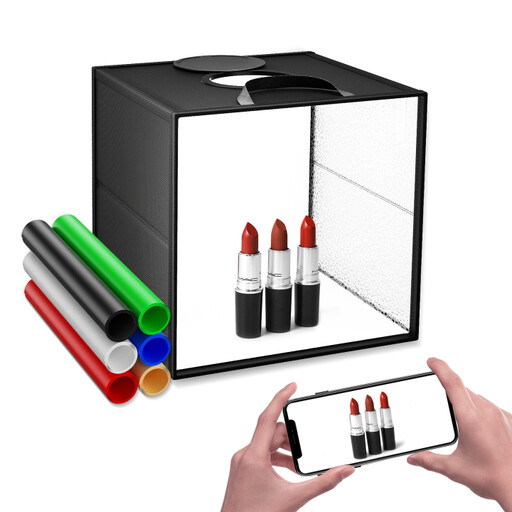
Foldable 30 × 30 cm photo box with dimmable lighting
This compact photo box may suit small tabletop shots where you want a black background and adjustable brightness. Its soft, even lighting may reduce the shadows you want to create.
30 × 30 cm; six coloured backgrounds; foldable; dimmable lighting.
View at Joybuy
 No image available
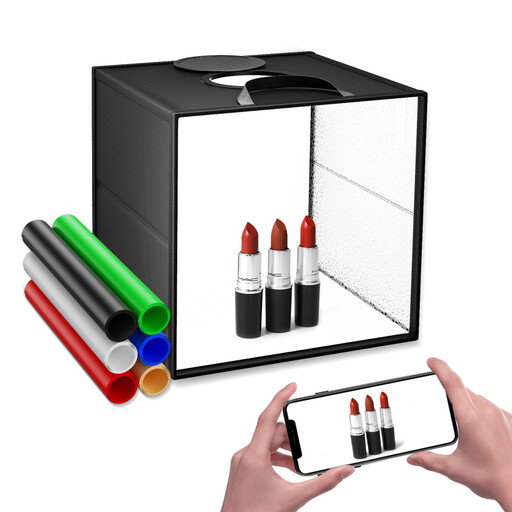
Foldable 30 cm LED photo box
This compact light box is designed for small still-life and product shots. If you want to keep pronounced shadows in your cheese setup, bear in mind that a light box is designed to reduce harsh shadows.
30 cm; 120 LEDs; three colour temperatures; nine dimming levels; six background colours, including black.
View at Joybuy
 No image available
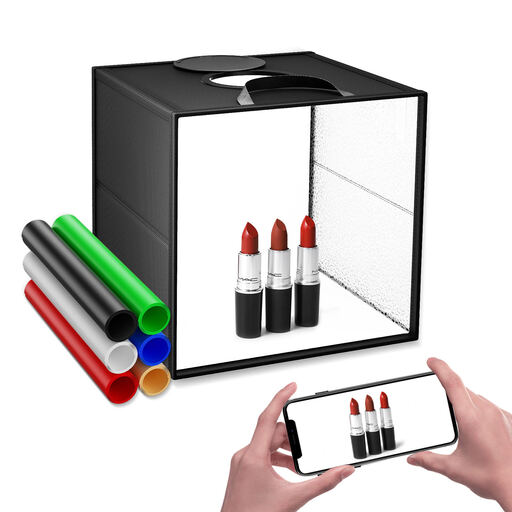
Foldable 40 cm light tent with 120 LEDs
This light tent may suit product shots taken from above or from the front. If you prefer directional lighting and visible shadows for a dark background, bear in mind that its light is diffuse and even.
40 cm; 5600 K; 120 dimmable LEDs; six background colours; soft light panels.
View at Joybuy
Frequently asked questions
Do I need an LED panel for a dark cheese board photo?
No. If you have suitable window light, try filtered light from the side; a white card can brighten shadows that are too dark on your subject. A panel is most useful if you want to work independently of changing daylight.
How can I position the light without brightening the background?
Start with a light positioned to the side or slightly behind your subject, then assess the cheese, accompaniments and shadows in your camera’s viewfinder. Diffusion and sparing use of a reflector card will change how the shadows fall; the result depends on the position, distance and background.
What should I check if I want to use batteries?
Compare the power options for the exact model with what’s included. Rollei lists optional NP-F750/770 batteries for its LUMIS panel, but they’re not included. The NEEWER RGB 660 PRO II two-light kit is listed with power supplies, but no batteries.
Who should I contact if my panel is faulty?
For your statutory warranty rights, the seller is generally your point of contact; a voluntary guarantee is separate. The Verbraucherzentrale explains that, if a product is faulty, repair or replacement may initially be available as a remedy.
Which markings should I look for on an LED panel?
If an electrical panel is covered by EU regulations that require CE marking, the manufacturer must meet the applicable requirements and mark the product accordingly. CE marking is a manufacturer’s declaration, not an independent quality certification. Waste electrical equipment must be collected separately; the EU also explains the crossed-out wheeled bin marking used for this purpose.


