What to look for when buying
First decide on the paper size and framing, then check whether you can position the light, mount and camera sensibly on your small table. A test shot will help you assess the centre and edges of the drawing together.
| What matters |
What to check before buying |
Who is it important to? |
| Even tones |
Compare the centre and edges of the sheet in a test shot; check diffusion and whether you can position a second light. |
If I want to capture the range of charcoal tones across the whole sheet, even lighting is a priority. Around 31% of consumers put even tones first. |
| Space and mounting |
Compare the dimensions of your table and the light, and check where the mount will go; make sure the camera and light won’t block each other. |
If you need to fit your drawing, camera and light on a small table, you’ll need suitable space and a way to mount them. Around 25% of consumers prioritise making the most of limited space. |
| Paper texture |
Check whether the mount allows you to position the light at a shallow angle from the side; plan a separate detail shot if needed. |
If I want to show the paper’s texture as well as the whole drawing, I’ll need to use a different lighting setup. Around 19% of consumers prioritise showing the surface. |
| Consistent paper colour |
Check the colour temperature range of the specific model and choose a suitable white balance for consistent shots. |
If you want the paper to look as consistent as possible across repeat shots, match the light to your white balance. Around 13% of consumers prioritise consistent colour reproduction. |
| Power and what’s included |
Check the listing for the exact variant to see whether it includes a power adapter, battery, charging port and the mount you need. |
If I want to get my setup running without finding that an accessory is missing, I’ll check the power supply and what’s included. Around 12% of consumers prioritise straightforward operation. |
Joybuy products
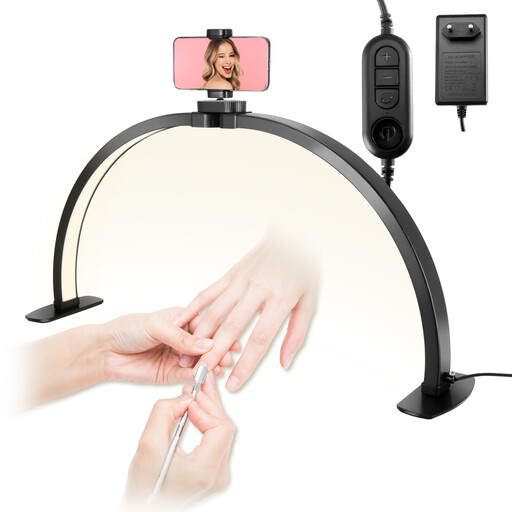
The Joybuy option below is a foldable LED light whose product name also mentions table photography. If you’re documenting a charcoal drawing, check whether the light and mount can be positioned to suit the sheet.
 No image available
30-inch foldable LED light for nail and eye care, with phone holder
The product name mentions nail and eye care, as well as table photography. Before buying it to photograph a charcoal drawing, check whether you can position the light and phone holder correctly over the sheet.
The product name lists three colour temperatures ranging from 3000K–6000K, as well as a phone holder.
View at Joybuy
Frequently asked questions
Do I always need two panels for a documentation photo?
No, not necessarily. The Canadian Conservation Institute describes using two lights positioned at the sides at an angle of around 45° as a way to capture tones evenly. You can judge whether a single panel is enough for your sheet by taking a test shot with the framing you plan to use.
How can I show the paper’s texture without replacing the overall shot?
If you need to, take an additional shot with light falling across the surface at a shallow angle, alongside your evenly lit shot of the whole drawing. According to the Canadian Conservation Institute, raking light emphasises texture, while light positioned on both sides aims to capture tones evenly.
Why does the paper look a different shade of white in different photos?
Different light colours can affect how colours appear. Match your white balance to the lighting you’re using and keep the settings as consistent as possible for comparison shots. A Bi-Color panel doesn’t replace the need for a suitable white balance.
Do LED panels include a tripod, power supply and batteries?
It depends on the model and package option. NEEWER lists a power adapter and diffuser for the single NL660, but no NP-F battery; the NL660 two-light set mentioned includes two tripods. Rollei says that optional NP-F batteries for the LUMIS LED Panel Bi-Color aren’t included.
Which markings should I check on a light?
Check the requirements that apply to the specific product, as well as the manufacturer’s information. The European Union explains that CE marking is only required for products covered by relevant harmonised EU rules that require it. In its buying advice, the Bundesnetzagentur highlights points including product identification, correct manufacturer details and instructions in German.


