Filming thread colours as you explain them
If you film colour combinations or techniques over several sessions, consistent white light and a repeatable camera white balance will help.


Choose an LED panel to suit the size and position of your embroidery space. For clearly visible stitches and hands, a repositionable, dimmable white-light panel with diffusion is a sensible starting point. To keep thread colours consistent, you’ll also need steady lighting and a camera white balance that’s set to match. If space is limited, mounting and power supply matter too. Lux figures are only comparable when measured under the same stated conditions, and you should test for possible flicker bands with your camera.
If you film colour combinations or techniques over several sessions, consistent white light and a repeatable camera white balance will help.
For a top-down or angled overhead camera view, you should be able to position the light so your hands cover as few stitches as possible.
If you only set up your embroidery space temporarily, the panel, mount and cables will need to fit alongside your camera and work surface.
Start by deciding what you want your footage to show. Then choose a panel size, light position, mount and power supply to suit the space you have available.
| Priority | What to check before buying | Who is it most important to? |
|---|---|---|
| Consistent thread colours | Check the white-light adjustment range, whether you can repeat the white balance, and how your own threads look in a test shot. | If I want thread colours to look as similar as possible across several filming days, I look for consistent lighting and camera settings. Around 36% of consumers put consistent thread colours first. |
| Keeping stitches visible despite hand shadows | Check the diffusion, adjustability and mounting options, then test your embroidery technique in the camera frame. | When I embroider, my hands move over the design, but the stitches still need to be easy to see. Around 29% of consumers say controlling shadows is their main priority. |
| Space and a complete setup | Compare the panel dimensions, connector, compatible mount and what’s included with the specific version. | If I only set up my camera and embroidery space temporarily in a spare room, the light, mount and cables all need to fit. Around 21% of consumers give limited setup space their highest priority. |
| Avoiding bands in your video | Test a clip with your own camera, planned recording settings and the dimmer level you intend to use. | If I film longer embroidery tutorials, I want to avoid visible bands in my video. Around 14% of consumers put this first. |
A Kelvin or CRI figure alone doesn’t guarantee accurate colours in your footage. Canon Europe recommends setting your white balance to match the actual lighting in the scene.
The stated measuring distances may differ. The SmallRig P200 is rated at 2000 lux at 0.3 m, while amaran gives figures for the P60x at distances including 1 m. These figures don’t give you a reliable brightness ranking for your embroidery space.
Only compare readings taken under the same conditions, and check the whole embroidery area with the light in the position you plan to use.
With the NEEWER NL660, whether a stand is included depends on the version you choose; NP-F batteries aren’t included.
Check the list of included items for the specific version against your planned mounting and power setup.
Depending on the version, you may need to buy a stand, a compatible power supply or NP-F batteries separately.
RGB modes give you more creative options, but they’re no substitute for controlled white-light settings when explaining thread colours on camera.
Check the white light and camera white balance first. Choose RGB effects if you actually plan to use them in your videos.
LED lighting can still cause bands in your video, depending on your camera and recording conditions. Sony Support suggests adjusting the shutter speed as one possible solution.
Test your planned light and camera setup with a short clip before filming a longer tutorial.
The NL660 is a Bi-Colour panel for an embroidery space where you can position the light separately. According to the manufacturer, it’s available with or without a stand.
The P200 is a compact panel with a USB-C input and mounting threads on the sides, making it suitable for a tight setup.
The P60x combines a Bi-Colour panel with a softbox and grid for shaping the light.
The P260C Pro is a Bi-Colour panel with a side-emitting diffuser. The manufacturer lists USB-C power and app control.
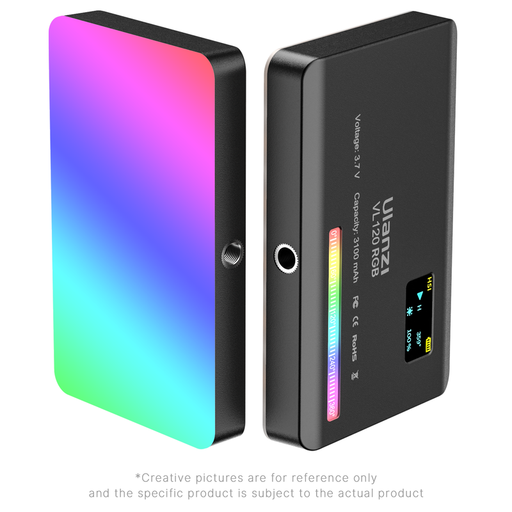
The LUMIS LED Panel 600 RGB is worth considering if you want RGB effects as well as adjustable white light for your videos.
A Joybuy product option for video recording with white light and additional RGB effects.
 No image available
A good option if you want to use RGB or scene effects for your videos as well as white light.
Product details list CCT, RGB and scene effect modes, plus a silicone diffuser.
A cold shoe adapter is provided for mounting on a camera or tripod.
Not waterproof; the instructions advise against using it in wet or very humid environments. Don’t look directly into the LED panel when it’s at full brightness.
Keep the lighting in your embroidery area as consistent as possible, and set your camera’s white balance to match. Adjustable colour temperature makes it easier to get set up, but it’s no substitute for setting the white balance or taking a test shot.
Test your planned camera and lighting setup by recording a video. Sony Support suggests changing the shutter speed as one possible solution; the setting that works depends on your camera and recording conditions.
No, it depends on the model and version you choose. The NEEWER NL660 has different stand options, and NP-F batteries aren’t included. SmallRig lists a USB-C cable for the P200, but no stand or power adapter. Check the specific version on offer against your setup.
According to Verbraucherzentrale, consumers who buy online generally have a 14-day right to cancel; you must notify the seller that you’re cancelling. If an item is faulty, your statutory rights are against the seller and are separate from any voluntary guarantee.