What should you consider when choosing?
For a flat paper print, first decide whether you want the image to look as neutral as possible or whether you also want to show surface relief. The Canadian Conservation Institute describes using light from both sides for general documentation; the Library of Congress covers raking light as a separate method.
| What you need |
What to check before buying |
Who this matters most to |
| Even illumination |
Decide on the sheet size and framing; consider the illuminated area, diffuser and space for separate lights. Test the brightness in the centre and at the edges. |
If I want to capture the sheet and white background as neutrally as possible across the whole image, I check the light distribution right to the edges. Around 36% of consumers prioritise an even overall image. |
| Printing marks and relief |
Check whether you can position the panel low and to the side, independently of the camera; assess shadows and uneven areas on the actual subject. |
To show printing marks, I’d plan a second shot with light falling in at a shallow angle from the side. Around 29% of consumers prioritise showing texture and relief. |
| Consistent paper white |
Check the white-light range of the exact model, keep your settings consistent and set a fixed white balance on your camera. A manufacturer’s CRI figure alone does not prove how colours will appear in the finished photo. |
If the paper needs to look a consistent white across several shots, I’d keep the lighting and camera white balance constant. Around 21% of consumers put reproducible paper white first. |
| Space and a complete setup |
Check the dimensions and mounting options; for the specific version, confirm whether the power adapter, battery, stand and diffuser are included. |
On a small table, there needs to be room for the light, mount and camera, while still allowing you to position the light to the side. Around 14% of consumers prioritise space and a complete setup. |
Photo lights for small tabletop subjects
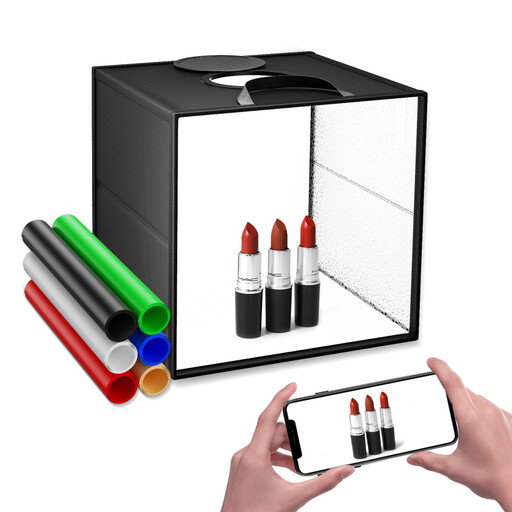
This selection includes a compact photo light box for small tabletop subjects against a white background. It is not a separately positionable LED panel for lighting a large etching.
 No image available
30 cm photo light box with 120 LEDs, 3 colour temperatures and 9 brightness levels
For small tabletop subjects against a white background; the product description says white background paper is included.
The photo light box folds away. According to the product details, it comes with six background papers.
View at Joybuy
Frequently asked questions
Is one LED panel enough to photograph an etching against a white background?
A single panel may work for a small crop or an additional raking-light shot. For the most even, neutral image of a flat paper print, the Canadian Conservation Institute describes using two lights positioned on either side at roughly 45°. Check the lighting right to the edges of your image area.
How can I show printing marks without replacing the overall image?
Start with an evenly lit view, then use a light positioned low to one side for a second shot. This brings out texture, but also highlights uneven areas and damage. The Library of Congress guidance does not prescribe a fixed angle for every home setup.
What should I check about the power supply and accessories?
Check the power adapter, battery type, stand and diffuser against the contents listed for the specific version. For the NL660, NEEWER lists a power adapter but does not include NP-F batteries; a stand is only included with the relevant version. Avoid leaving valuable works on paper under lights for longer than necessary: the Library of Congress notes that light damage can accumulate.
Which marking is important for an electric photo light sold in Germany?
Products covered by relevant EU harmonisation rules must carry the CE marking. This is the manufacturer’s declaration of conformity, not an independent test of light quality. For electrical lighting products, the German Federal Network Agency lists marking, manufacturer details and instructions in German among the points to check; the rules that apply to the specific product are the ones that matter.
Can I return a panel bought online if it doesn’t suit my setup?
For a qualifying distance purchase from a trader, you generally have a 14-day right to cancel, starting from the date of delivery. Exceptions and possible return costs may apply. A longer voluntary returns period only applies if the seller offers one.


