What should you look for when buying?
First decide how you can position and control the light on your subject. Then choose a panel size, mounting option and power supply to suit your table space and subject.
| Criteria |
What to look for when buying |
Who should pay particular attention? |
| Lighting and reflections |
Check the mounting and direction, as well as the diffuser, grid or barn doors included with the specific model. Assess reflections from your camera angle. |
When photographing glossy plates or glazed tableware against a dark background, where the light and reflections appear is key. Around 36% of consumers consider lighting control and reflection management their top priority. |
| Colour consistency |
Check the exact model’s adjustable colour temperature and brightness; compare manufacturers’ figures only when the measurement conditions are comparable. |
If you want to photograph tableware ranges under changing ambient light, you need lighting that you can adjust precisely. Around 29% of consumers prioritise keeping tableware colours consistent between shots. |
| Lighting coverage |
Compare the panel dimensions and recommended shooting distance; lux figures are comparable only when measured at the same distance and setting. |
When photographing several plates or a larger arrangement, the available area of light is an important part of the plan. Around 21% of consumers say their main concern is lighting larger subjects. |
| Space and power |
Check the space needed, mounting, connection and contents of the variant on offer, including the power adapter or battery. |
If there is little room beside the tableware or you need to set up the panel on the move, the mounting and power supply must suit your setup. For around 14% of consumers, this combination of space and power is the top priority. |
Suitable products at Joybuy
This selection at Joybuy includes foldable LED photo boxes for compact product photography; they are not the same as standalone studio panel lights.
 No image available
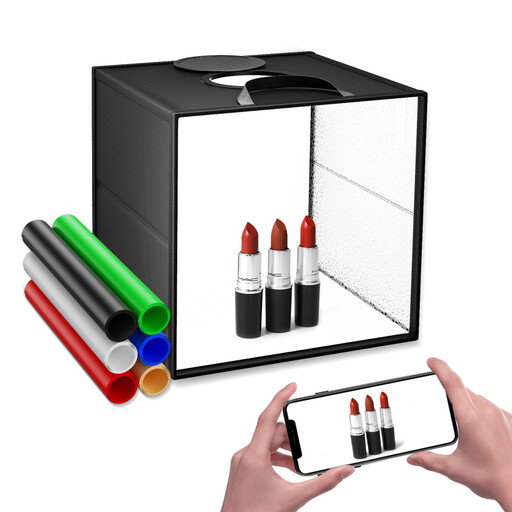
Foldable LED photo box, 30 cm, 120 LEDs
A foldable photo box may suit small tableware arrangements if you’re planning a compact setup with a dark background.
The product name lists 120 LEDs, three colour temperatures, nine brightness levels and six-colour background paper. The description also mentions black background paper and a diffuser.
View at Joybuy
 No image available
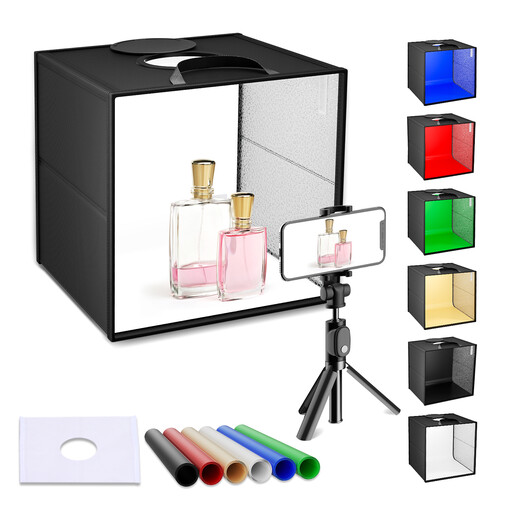
Foldable LED photo box with coloured backgrounds
This foldable photo box is designed for product photography in small setups. Check that its dimensions work for your tableware, camera and available space.
The product name lists coloured backgrounds and adjustable brightness. The product description also includes a black background card and a diffuser cloth.
View at Joybuy
Frequently asked questions
Should I point the LED panel directly at the plate?
Not necessarily. Start with side or slightly back lighting, then check reflections and shadows from your camera angle. Diffusion can help soften harsh light; you can reduce unwanted light falling on the background by controlling it appropriately.
What should I bear in mind when setting up and maintaining the panel?
Follow the instructions for your specific model when mounting it and connecting the power supply. Nanlite requires the PavoSlim 60B to be used in a dry, well-ventilated location with the ventilation openings clear; this manufacturer guidance does not automatically apply to every panel.
Are a stand, battery and power adapter included?
It depends on the model and variant. NEEWER lists the NL660 with and without a stand and states that NP-F batteries are not included. Rollei lists a tabletop tripod for the LUMIS Key Light Pro, but no USB power adapter is included. So check the contents of the exact version you’re buying.
Which product markings and disposal rules apply in Germany?
CE marking is required for products covered by EU harmonisation rules that explicitly require it; it is not a blanket confirmation that every product on offer has been tested. The EU describes the crossed-out wheelie bin as a marking for the separate collection of electrical and electronic equipment. Germany’s Federal Ministry for the Environment explains that waste electrical and electronic equipment must be handed over to an authorised collection operator in Germany.
Is a manufacturer’s guarantee the same as your statutory rights?
No. For consumer purchases in Germany, the seller is generally responsible for statutory claims relating to defects; the Verbraucherzentrale gives a period of two years from delivery. Any additional voluntary guarantee is subject to its own terms. For sales contracts from 31 July 2026, the Verbraucherzentrale also explains a one-off 12-month extension to the statutory period if you choose a repair rather than a replacement delivery for a defect.


