Choose your light according to tile size, glaze and available space. For repeatable shots, an adjustable white-light panel with suitable diffusion is a sensible starting point, but it can’t guarantee accurate colours or reflection-free images. Keep the lighting and white balance consistent, then check a test tile to make sure its colour, sheen, texture and edges remain visible. A larger panel can make it easier to light a bigger area; compact battery-powered lights save space, but you’ll need to check carefully that they cover the entire tile.
Which type of light is right for you?
Comparing tile samples by colour
If you’re comparing designs or batches against a neutral background, even lighting and a set white balance can help keep your shots consistent. Nikon Deutschland recommends setting the white balance before taking your photos.
Photographing glazed tiles
For glossy surfaces, you should be able to adjust the light position and diffusion to control unwanted reflections without losing the glaze’s intended sheen. Check the effect on your own subject.
Working on a small table
If space is tight for your tile, camera and light, a compact light may suit small samples or work as a fill light. For larger tiles, check that the whole surface is lit right up to the edges.
What should you look for when buying?
Start by checking the size of your largest tile and whether it has a glossy finish. Then choose the lighting, power supply and accessories to suit your set-up.
| What you need |
What to check before buying |
Who should pay particular attention? |
| Consistent tile colours |
Adjustable white light; keep the settings consistent throughout the series and test with a set white balance. |
If I’m comparing designs or batches against white, I want to avoid colour casts and keep the shooting conditions consistent. Around 29% of consumers are likely to prioritise consistent tile colours. |
| Reflections and visible glaze |
Adjustable light position and diffusion; check the effect on a glazed subject. |
With glossy tiles, I want to control unwanted reflections without making the glaze look dull. Around 29% of consumers are likely to prioritise reflection control. |
| Coverage of the surface |
Check the largest tile, distance and lighting right to the edges; compare lux ratings only when they’re measured on the same basis. |
If I’m photographing a large tile or several samples, I want the edges to remain clearly visible too. Around 24% of consumers are likely to focus on lighting the entire area being photographed. |
| Space and power supply |
Check the dimensions and secure mounting; confirm the power adapter, stand and batteries for the specific version. |
On a small table or when shooting on location, there needs to be enough secure space for the tile, camera and light. Around 18% of consumers are likely to prefer a compact set-up with a suitable power supply. |
Common mistakes when choosing
-
Assuming a high lux rating means even coverage
A single light reading won’t tell you whether the whole tile is lit evenly right to the edges. Ratings can also depend on distance and colour temperature.
Compare readings only when they’re measured on the same basis, and test the largest tile you plan to photograph at your intended distance.
-
Assuming a white background and bright light will automatically give you accurate colours
A changing white balance can alter how colours appear from one shot to the next. A white background on its own won’t make tile colours comparable.
Keep the lighting and white balance consistent throughout the series. Assess the tile’s colour and edges separately from the background in your test shot.
-
Assuming a stand or batteries are included without checking the version
For the NEEWER NL660, whether a stand is included depends on the version you choose; the manufacturer states that NP-F batteries are not included.
Before buying, check the contents of the specific version against your planned set-up.
Notable brands and models
Godox
The P260C Pro is a larger bi-colour panel for adjustable white light in a positionable set-up.
- Godox lists a colour temperature range of 2800–6500 K for the P260C Pro, along with average CRI and TLCI ratings of at least 98. A diffuser is also included in the specifications.
- These are the manufacturer’s specifications, not proof of colour-accurate tile photos. Check the results with your own tile and camera.
NEEWER
The NL660 is a bi-colour panel for a fixed set-up; the manufacturer offers versions with and without a stand.
- NEEWER lists a colour temperature range of 3200–5600 K, a white diffuser and adjustable barn doors. The listed package contents include a mains adapter and diffuser.
- The manufacturer states that NP-F batteries are not included; a stand comes only with the relevant version. The lighting and colour specifications are provided by the manufacturer.
amaran
The P60c combines white light with RGBWW features and is described as coming with a softbox and grid.
- The manufacturer lists a colour temperature range of 2500–7500 K and a 45° beam angle.
- Colour modes are no substitute for controlled white light when taking neutral tile photos. Check the tile coverage at your intended distance.
Nanlite
The PavoSlim 60C is a slim RGBWW panel designed for set-ups with multiple control and power options.
- According to the manufacturer’s manual, a softbox, diffuser and eggcrate are included; the listed colour temperature range is 2700–7500 K.
- Extra colour and control features aren’t automatically an advantage for neutral tile photos.
Ulanzi
The VIJIM VL120 Bi-Color 2029 is a small battery-powered light for mobile sample photography or as an additional light source.
- Ulanzi lists a built-in battery, USB-C, a silicone diffuser and a colour temperature range of 3200–6500 K.
- These manufacturer specifications don’t tell you whether a large tile will be lit evenly; test the actual area you plan to photograph.
Joybuy products
The Joybuy products listed here are foldable photo boxes for compact product photography, not large LED panels. They may suit photographing ceramic tiles against a white background only if the tile size, background and lighting work for your specific set-up.
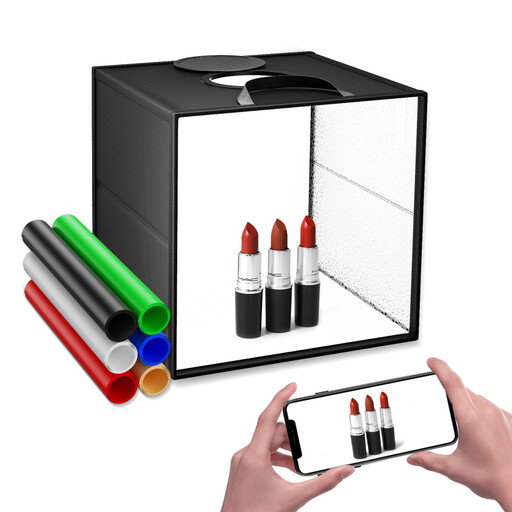 No image available
30 cm photo box with 120 LEDs
Described as suitable for small still-life shots; check that the tile fits in the shooting area and that the background set-up works for your photos.
The product name lists three colour temperatures, nine dimming levels and six background colours.
View at Joybuy
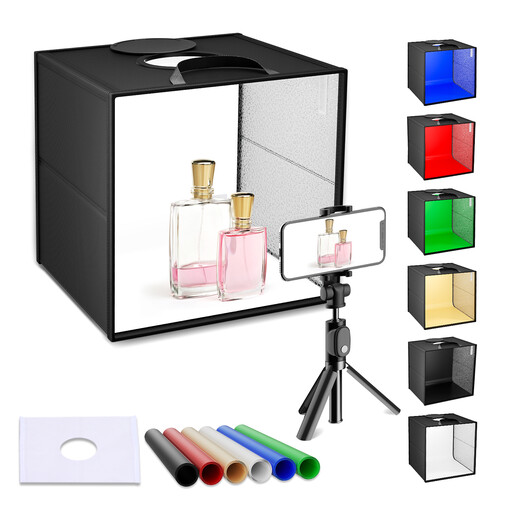 No image available
Foldable LED photo box with coloured backgrounds
Described as suitable for product photos in a compact set-up. Check beforehand that the tile fits inside the box and that the specific background set-up is suitable for shots against white.
The product name mentions coloured backgrounds and adjustable brightness.
View at Joybuy
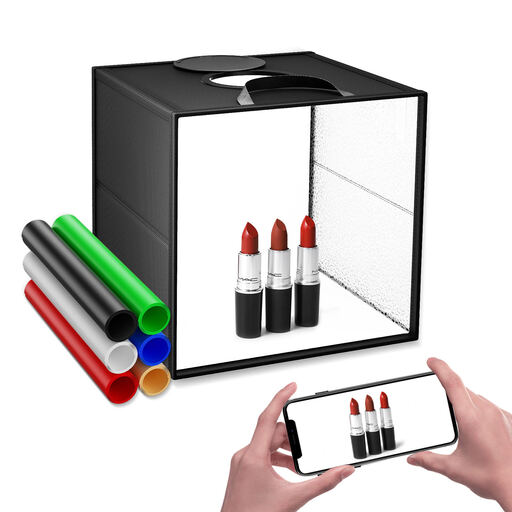 No image available
40 cm mini photo studio with 120 LEDs
This mini photo studio is described as suitable for compact product photography. Check that the tile fits in the limited shooting area.
The product name lists 5600 K, dimmable LEDs, six background colours and soft light cloths.
View at Joybuy
Frequently asked questions
Is a high CRI rating enough for colour-accurate tile photos?
No. A high CRI rating alone doesn’t guarantee colour-accurate tile photos. A panel’s CRI figures are supplied by the manufacturer; Nikon Deutschland also recommends even lighting and setting the white balance in advance. Check the results with your own tile and camera.
How can I control reflections on glazed tiles?
First, adjust the angle of the light and camera, then try diffusion while checking that the surface retains the sheen you want. Nikon Deutschland suggests a polarising filter as one possible way to reduce reflections, but it’s no substitute for positioning the light correctly.
How can I tell whether a panel will light a large tile?
Check the whole tile, including the edges, at your intended distance; a single lux rating isn’t enough. Compare light readings only when they’re measured on the same basis, for example at a suitable distance and the same colour temperature.
Does an LED panel come with a stand and battery?
It depends on the model and the specific version. The NEEWER NL660 comes with a stand only in the “NL660 with Stand” version; the manufacturer states that NP-F batteries are not included. Check the package contents for the model on offer before buying.


