If the window light already illuminates the traditional dress well enough, try changing your position or using a reflector first. An LED panel is most useful when you want to lift shadows selectively or take consistent photos as daylight changes. Choose one based on the area it can illuminate, diffusion, dimming and colour temperature, and check the fabric colours using a fixed white balance: a high CRI figure from the manufacturer alone does not guarantee accurate colour reproduction.
Who is an LED panel suitable for?
Documenting traditional dress
If you want fabric colours to be reproduced consistently, it’s important to set the white balance to suit your photography setup. Canon Europe and Nikon USA explain what to consider in challenging or mixed-light conditions.
Showing embroidery and cut
When switching between close-ups of needlework and full-length views, the angle of the light, diffusion and the area illuminated all matter. Adobe Lightroom Academy explains how factors such as the weather and the direction a window faces can affect window light.
Taking photos beside a small window
If you regularly set up and pack away your lighting at home, the panel’s size, mounting and power supply all affect which option is most practical. NEEWER Europe and Jinbei Deutschland give different specifications for stands, power supplies and batteries that may need to be purchased separately, depending on the model and version.
What should you look for when choosing one?
Start by considering colour matching and the area you want to illuminate. Then you can work out which controls and accessories will suit your space by the window.
| Priority |
What to look for when buying |
Who values this? |
| Consistent fabric colours |
Check the colour temperature range and dimming options; take photos with a neutral grey or white reference under the lighting mix you plan to use. |
When documenting fabric colours, I want to be able to check the white balance for that exact lighting setup. Around 31% of consumers put consistent fabric colours first. |
| Full-length views and needlework details |
Compare the illuminated area, working distance and diffusion options; plan the panel angle for both detail and full-length shots. |
For full-length views and close-ups, I need enough illuminated area and want to shape the light to suit the subject. Around 25% of consumers prioritise lighting the garment and needlework details. |
| Controlled fill light |
Look for dimming and adjustable colour temperature; position the panel to lift shadows created by the window light. |
When the window light changes, I want to lift the shadows gradually without using the panel as the main light. Around 25% of consumers focus on controllable fill light. |
| Space and what’s included |
Check the dimensions, mount and contents of the specific version, as well as the power supply and any batteries that need to be purchased separately. |
When space is limited, I want to set up the panel securely and know in advance what comes with the version I’ve chosen. Around 19% of consumers mainly look for a compact, complete setup. |
Avoiding common misconceptions
-
A high CRI guarantees accurate colours in traditional dress photos
Manufacturer figures describe the light itself, not the final colour result when window light and LED light are used together.
Take a reference photo using the lighting combination you actually plan to use, then check the fabric colours before shooting a whole series.
-
A high lux figure automatically illuminates an entire costume evenly
A reading at a single point doesn’t show how evenly a spread-out garment will be lit.
Only compare lux figures taken under the same measuring conditions, and consider distance, diffusion and the size of the subject together.
-
A stand and batteries are included with every version
What’s included can vary between versions; a stated compatibility with a battery doesn’t mean one is supplied.
Before buying, check the parts list for the specific version, as well as the power supply and battery type.
Relevant brands to consider
NEEWER
The NL660 is a bi-colour panel for a flexible setup; the manufacturer also offers a version with a stand.
- NEEWER Europe lists a colour temperature range of 3200–5600 K for the NL660, along with a diffuser and power adapter. A stand is included only with the relevant version.
- NP-F batteries are not included. The manufacturer’s colour rendering figures are not the same as an independent test on traditional dress fabrics.
amaran
The P60x is an adjustable bi-colour panel for controlled, directional fill light; choosing a light modifier is part of planning your setup.
- Aputure Help Center lists a colour temperature range of 3200–6500 K and a 45° beam angle for the P60x.
- Aputure’s stated average of 5070 lx applies at 1 m and 5600 K. It doesn’t tell you whether an entire costume will be lit evenly, nor does it allow a direct brightness comparison with models measured under different conditions.
Nanlite
The PavoSlim 60B is a slim bi-colour panel that, according to the manufacturer, comes with light modifiers.
- The Nanlite manual lists a colour temperature range of 2700–6500 K, as well as a softbox, diffuser and grid.
- When setting it up, allow for the separate control unit and keep the ventilation openings clear. The manufacturer’s figures don’t demonstrate independently measured colour accuracy for textiles.
Godox
The P260C Pro is a bi-colour panel with a built-in diffuser, for a setup that needs fewer separate light-shaping accessories.
- Godox lists a colour temperature range of 2800–6500 K for the P260C Pro and describes a side-emitting design with a diffuser.
- The softer light described by Godox is a manufacturer claim. The actual effect on shadows depends on factors including the distance and size of the costume.
Jinbei
The P80Bi is a bi-colour panel that can run from a power supply or batteries purchased separately.
- Jinbei Deutschland lists a colour temperature range of 2700–7500 K and a supplied power adapter.
- NP-F batteries are not included. Brightness comparisons with other models aren’t meaningful unless the measuring conditions are the same.
Joybuy products for this photography setup
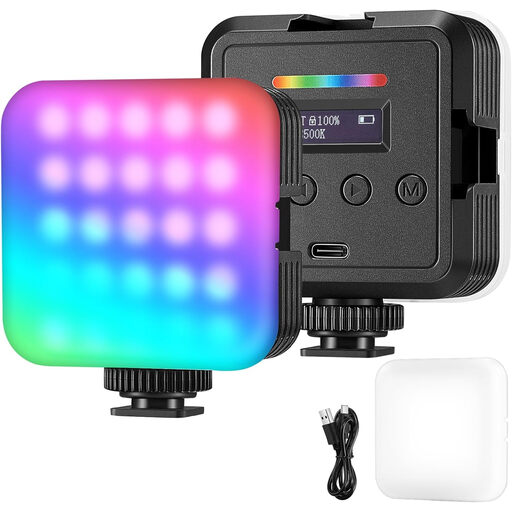
The Joybuy selection below includes a portable RGB camera light for photography, rather than a bi-colour panel.
 No image available
RGB camera light for photography and video
For mobile photography where you want to adjust brightness and colour temperature.
The product description lists RGB, white and warm light modes, as well as adjustable brightness and colour temperature.
The description lists the built-in battery or USB as power options.
View at Joybuy
Frequently asked questions about LED panels for traditional dress photos
How do I get started with window light and an LED panel?
Start by taking photos using only window light, then see whether changing your position or using a reflector lifts the shadows enough. If you add a panel, start with a low level of fill and check the shadow direction and white balance in test shots.
Can I light an entire costume properly using just a lux figure?
No. Lux figures apply only under the measuring conditions stated. Aputure lists an average of 5070 lx for the amaran P60x at 1 m and 5600 K; in your own setup, also check the illuminated area, distance and diffusion.
Are a stand, power supply and battery always included with a panel?
No. The stand included with the NEEWER NL660 range depends on the version; according to NEEWER Europe, NP-F batteries are not included. Jinbei Deutschland lists a supplied power adapter for the P80Bi, but no NP-F batteries are included with that model either.
What does CE marking mean when buying an LED panel in Germany?
CE marking is required when the EU harmonisation rules that apply to the specific product call for it. The European Commission points out that the requirement depends on whether the relevant rules apply; CE is not an independent quality mark.


