
Lieferung heute & morgen

Qualitätsgarantie

Willkommens-Angebote freischalten: KOSTENLOSE Lieferung | Bis zu 80 % RABATT | Kostenlose 30-Tage-JoyPlus-Testphase
App herunterladen
An LED plug-in night light is easy to buy, but not every model is right for every room. A light for the hallway needs to meet different requirements from one for a child’s bedroom or a main bedroom. Buyers often choose based only on design or price, overlooking the sensor type, brightness and suitable surroundings.
An LED night light with a dusk sensor switches on when the ambient light level is low. It usually stays on until the room gets brighter again. A night light with a motion sensor, on the other hand, responds only when it detects movement and switches off again after a set time.
A motion sensor can help reduce energy use in a hallway or on the stairs. In a child’s bedroom, a soft light that stays on may be more comfortable if frequent movement would otherwise keep activating the light.
A night light should help you find your way without creating unnecessary glare. The key factors are luminous flux in lumens, colour temperature in kelvins and the beam angle. A warm white night light at 2,700 to 3,000 kelvins is usually less intrusive in bedrooms than cool white light at 6,500 kelvins. A higher brightness may be useful for work areas or when you need more focused illumination.
An energy-saving night light using 0.4 or 0.5 watts consumes relatively little electricity, even when left on for long periods. Even so, check for 220–240 volts, an undamaged socket, suitability for indoor use and any guidance on heat generation. A product designed for dry indoor spaces should not be used right next to a shower, washbasin or other source of water.
When choosing a night light with a motion sensor, check the detection range and angle. A model with a 3-metre range and a 120-degree angle won’t necessarily cover the whole room. The socket’s position and any furniture can affect detection.
For a night light for a child’s bedroom or a main bedroom, 2,700 to 3,000 kelvins is often a good guide. Cool white light at 6,500 kelvins can make shapes easier to see, but looks crisper and less subtle. Choose a brightness to suit the purpose: 8 to 20 lumens may be enough to help you find your way, while a table or desk lamp needs considerably more light.
A dimmer or several brightness settings make it easier to adjust the light. Keep the device out of reach of young children so they can’t use it as a toy, and don’t cover any cables or plug connections.
A plug-in night light should avoid unnecessarily blocking the adjacent socket. Other points to consider include:
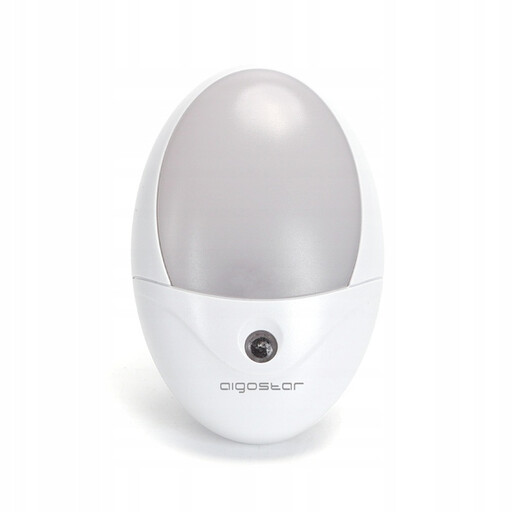
Why this product suits this profile: This compact plug-in night light has a dusk sensor, gives out 20 lumens at 3,000 kelvins and uses 1 watt. It’s designed for dry indoor spaces such as hallways, bedrooms and children’s rooms.
The specified power, luminous flux, colour temperature and IP25 protection rating make it easier to check whether the light is suitable for your intended location.
Automatic day-and-night detection, a 120-degree beam angle and no need for batteries.
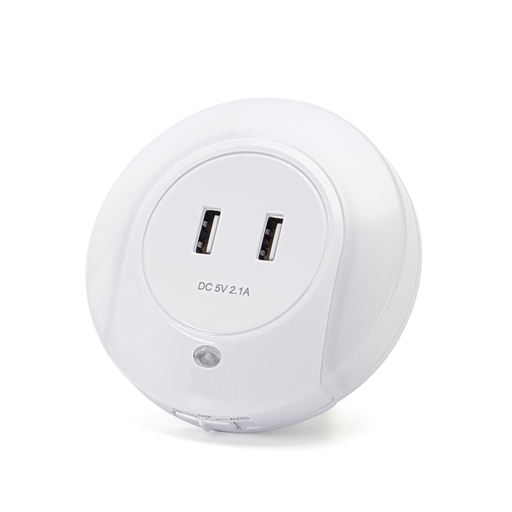
Why this product suits this profile: This warm white night light combines 3,000 kelvins and 8 lumens with two USB ports. It can serve as both a guide light and a compact charging station in the bedroom or hallway.
Its low power consumption of 0.4 watts is clearly stated. The USB function and suitability for dry indoor spaces are also clearly described.
Two USB charging ports, 8 lumens, 3,000 kelvins and stated double insulation in protection class II.

Why this product suits this profile: For hallways and stairs, this model offers motion and dusk sensors, five brightness settings and warm white light at 2,700 kelvins.
It switches off automatically after 60 seconds without movement, helping to avoid unnecessary operating time. The detection range and angle are specified as up to 3 metres and 120 degrees.
Five brightness settings, 0.5 watts of power consumption and automatic activation when movement is detected in the dark.
A plug-in night light won’t suit every situation. A dimmable LED night light or table lamp is a better choice when you need to light a seat or bedside table more directly. The Aigostar LIGHT08 LED desk lamp offers 8 watts, around 400 lumens, touch controls, a dimmer and a USB port. For a decorative touch, you could also consider table lamps with an E27 fitting, fabric shade or several colour temperatures. However, these lights need more space and aren’t necessarily designed to act as guide lights.
We’ve put together a complete, regularly updated list of products that meet these strict selection criteria and fully comply with the safety regulations in force in the EU.
Push the device fully into a suitable, undamaged socket and make sure the sensor and LED are unobstructed. Position it so that furniture, curtains or doors don’t block the detection area. Unplug the night light before cleaning it.
The stated lifespan depends on the model. Product specifications may list figures such as 10,000, 15,000 or 25,000 hours. These are technical figures provided by the manufacturer, not a guarantee for every individual use. Heat, dust, voltage fluctuations and physical damage can all affect the lifespan.
The cost depends on the power rating, how long it’s used and your electricity tariff. A 1-watt light running for 1,000 hours uses approximately 1 kilowatt-hour. A 0.4-watt model uses around 0.4 kilowatt-hours under the same conditions. To work out your own usage: power in watts × operating hours ÷ 1,000 = kilowatt-hours.