
Lieferung heute & morgen

Qualitätsgarantie

Willkommens-Angebote freischalten: KOSTENLOSE Lieferung | Bis zu 80 % RABATT | Kostenlose 30-Tage-JoyPlus-Testphase
App herunterladen
An LED plug-in night light with sensor should light the way at night without staying brightly lit or requiring batteries. However, for families, older people and households with dark hallways or stairs, choosing the right model is not simply a matter of design and price. The sensor type, light colour, brightness, design and intended location are all important.
As a Joybuy Product Recommendation Officer, I filter the relevant product data according to practical criteria and match it to different usage scenarios. This helps you avoid common purchasing mistakes.
An LED night light with a dusk sensor switches on as soon as the ambient light falls below a certain level. It may therefore remain lit throughout the entire dark period. A night light with a motion sensor, on the other hand, only responds when movement is detected and switches off again after a certain amount of time.
A dusk sensor is suitable for a hallway that should remain gently illuminated for orientation. In a bedroom or child’s room, a motion sensor may be more comfortable because the light does not stay active all night.
Higher brightness is not automatically better. Low brightness levels are often sufficient for an orientation light in the bedroom. Light that is too bright or very cool white can be disruptive at night. Warm white night light typically ranges from around 2700 to 3000 Kelvin. Cool white light, such as 6500 Kelvin, appears considerably more neutral or bluish.
The lumen rating describes the luminous flux. In the products presented here, the values range from 8 to 40 lm, for example. 20 lm or more can be useful for stairs and hallways, while more subdued lighting may be preferable in a baby’s room.
Many plug-in night lights are designed exclusively for dry indoor areas. IP20 does not mean that the product is protected against splashing water. Even a higher IP rating does not automatically replace the manufacturer’s approval for use directly next to a sink, shower or bath.
Before buying, you should also check whether the sensor could be obscured by furniture, curtains or a socket cover. With a double socket, the width of the night light is important to ensure that the second socket remains accessible.
A specific measurement makes it easier to assess a product. The Aigostar model with a dusk sensor is specified with a switching threshold of below 20 lux. The Grifema model with motion and dusk sensors also activates at 20 lux or less and switches off after 60 seconds without movement.
For a night light in a child’s room, bedroom or hallway, 2700 to 3000 Kelvin is generally a subtle choice. Products with 6500 Kelvin provide cooler white light and may be suitable for areas where clearer illumination is preferred.
A dimmable night light offers additional adjustment options. However, when buying, you should consider not only the number of brightness levels but also how the light is operated. Touch dimming is convenient, but accidental contact can change the setting. A fixed light level, by contrast, is straightforward and low-maintenance.
The power consumption of the models mentioned ranges from 0.4 to 1 W. A device using 0.4 W consumes 0.4 kWh over 1,000 operating hours in theory. Actual consumption depends on the switching behaviour and duration of use.
For German households, the following points should also be checked:
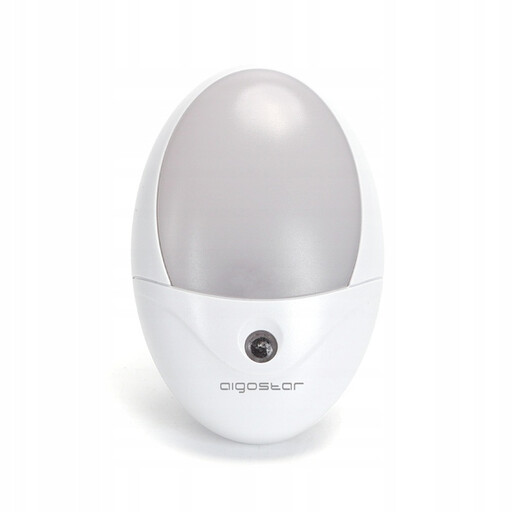
Why this product suits this profile: This plug-in night light operates automatically via its dusk sensor and requires neither batteries nor USB charging. It is suitable for hallways, bedrooms, children’s rooms and stairs in dry indoor areas.
The stated values of 3000 K, 20 lm and 1 W make the light colour, brightness and energy consumption clear, rather than simply advertising an undefined “gentle” light.
Automatic dusk sensor, 120° beam angle and a stated service life of 10,000 hours.
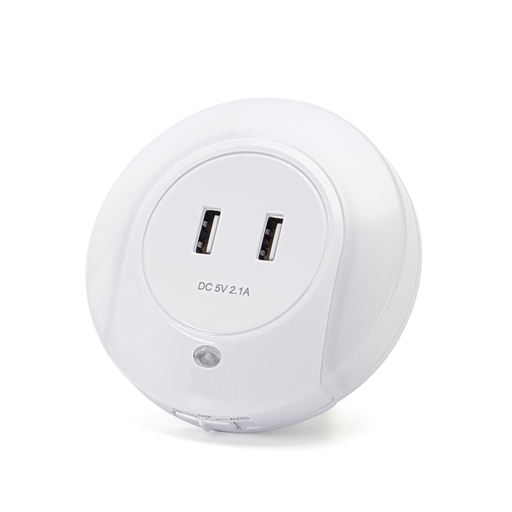
Why this product suits this profile: This model combines a warm white orientation light with two USB charging ports, making it suitable for bedrooms, hallways or work areas where additional charging is required.
The low power consumption of 0.4 W and luminous flux of 8 lm are clearly specified. The USB outputs should be used in accordance with their maximum stated current.
3000 K warm white light, two USB ports, protection class II and a 120° beam angle.

Why this product suits this profile: Five brightness levels and the combination of motion and dusk sensors allow the light to be adjusted for a child’s room, hallway, stairs or bedroom.
Automatic switch-off after 60 seconds without movement limits unnecessary operating time. The detection range of up to 3 m and 120° is clearly specified.
2700 K warm white LED light, five brightness levels and 0.5 W power consumption without batteries.
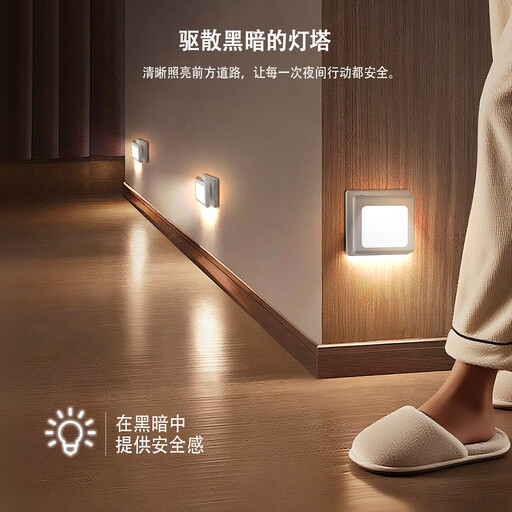
Why this product suits this profile: The 2-pack can be used simultaneously in different areas, such as the stairs, child’s room, kitchen or hallway. The brightness can be adjusted to suit each location.
The product description explicitly states that it has a dusk sensor and adjustable brightness. This helps you avoid choosing a model that is too bright or needs to be switched manually when lighting several rooms.
Two lights in the set, automatic dusk switching and adjustable brightness.
We have put together a complete, regularly updated list of products that fully meet these strict selection criteria and the safety regulations applicable in the EU.
A plug-in night light should be fully inserted into a suitable, intact socket. The housing must not be covered during operation, so that heat can escape. Before cleaning, unplug the device and wipe it with a soft, dry cloth. Avoid liquid cleaners, sprays and immersing the device in water.
For bathrooms or areas near a sink, only use a model whose manufacturer explicitly approves the intended location and the relevant IP rating. Stop using the device if there is visible damage, unusual heating or a malfunction.
A dusk sensor measures the brightness of the surroundings and switches the light on in darkness. A motion sensor responds to movement as well, or exclusively. Depending on the model, the light switches off in daylight or after a set period without movement.
This depends on the power consumption and operating time. At 0.5 W, 1,000 operating hours use 0.5 kWh in theory. A 1 W model requires 1 kWh under the same conditions. With motion sensors, actual consumption may be lower because the light is only activated for short periods.
The stated service life varies by model. Product data may specify 10,000, 15,000 or 25,000 hours, for example. These figures are manufacturer specifications and are not a guarantee of the actual service life in your household. The sensor, electronics, socket and ambient conditions also affect practical operation.