
Lieferung heute & morgen

Qualitätsgarantie

Willkommens-Angebote freischalten: KOSTENLOSE Lieferung | Bis zu 80 % RABATT | Kostenlose 30-Tage-JoyPlus-Testphase
App herunterladen
LED recessed ceiling spotlights create a flush, uncluttered look and are suitable for living rooms, kitchens, hallways, bedrooms and bathrooms. Choosing the right product may seem straightforward at first, but certain details in product descriptions can lead to costly mistakes. It is not just the wattage and design that matter; the key factors are the cut-out size, mains connection, luminous flux, colour temperature and IP rating.
An LED recessed spotlight may, for example, have a diameter of 145 mm but require a ceiling cut-out of 115–135 mm. For installation, only the cut-out diameter is relevant. If the existing opening is too large or too small, the light will not sit securely or the ceiling will need to be modified.
You should therefore measure the following before buying:
Flat LED recessed spotlights can differ significantly. Product specifications may state 25.5 mm, 29 mm or more than 40 mm. Check whether the measurement refers to the height of the light, the visible surface height or the actual installation depth. This distinction is crucial where ceiling voids are shallow.
An IP44 LED recessed spotlight is protected against solid foreign objects and splashing water from various directions. For areas exposed to heavier water contact, an IP65 LED recessed spotlight may be more suitable. Suitability for use in a bathroom also depends on the installation zone and applicable electrical regulations. IP44 or IP65 does not mean that the light may be immersed in water.
An LED recessed spotlight 230 V is generally connected directly to the mains at 220–240 V. Models operating at 12–24 V, on the other hand, require a suitable transformer. This is not automatically included and must not be confused with a 230-volt connection.
One example of an especially flat design is an LED recessed spotlight with an installation depth of 25.5 mm, a direct 230-volt connection and a required cut-out of 95–110 mm. Other models require 120–130 mm or 145–160 mm. Check compatibility with your existing ceiling against the technical data sheet before placing your order.
The mains connection must only be carried out when the power supply is switched off. Work on fixed electrical installations should be carried out by a qualified electrician and must comply with local regulations.
Wattage describes energy consumption, not brightness alone. For comparison, the luminous flux in lumens is more informative. Product specifications of 430 lm, 600 lm, 720 lm or 1,200 lm indicate different areas of use.
A wide beam angle of, for example, 120° distributes light over a broad area. This is suitable for hallways, kitchens and general living areas. A narrower beam angle may be better for targeted lighting of pictures, shelving or work surfaces.
Also pay attention to:
Depending on the design, LED ceiling spotlights with adjustable colour temperature can provide warm white, neutral white or cool white light. Typical values include:
With 3CCT lights, the colour temperature is usually selected using a switch on the housing. Smart models allow you to adjust it via an app. A dimmable LED recessed light must be compatible with the intended dimming system. Some products can only be dimmed via an app, while others are not dimmable. An existing wall dimmer is therefore not automatically suitable.
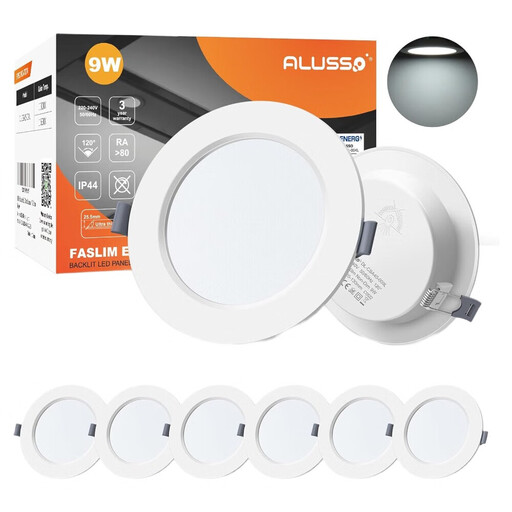
Why this product suits this profile: This set of 6 is ideal for buyers who want to equip several ceiling points with a consistent light colour. The 6500 K colour temperature is designed for crisp-looking indoor lighting.
The specifications state the installation depth, a cut-out range of 115–135 mm and a direct connection to 220–240 V. They also expressly state that the light is not dimmable.
9 W, 720 lm, 25.5 mm installation depth, IP44 and a stated lifespan of 30,000 hours.
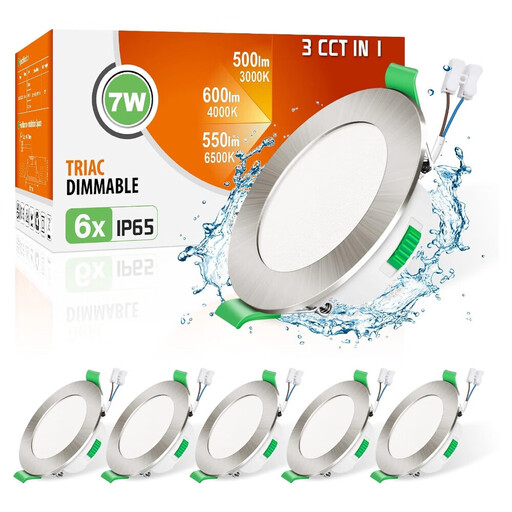
Why this product suits this profile: The aluminium and polycarbonate design, nickel-look finish and 3CCT selection are aimed at renovators who want to combine clear technical specifications with discreet ceiling integration.
The product specifications state an installation depth of 29 mm, a cut-out of 67–75 mm, a direct 230-volt connection and IP65. This makes it possible to check important installation criteria in advance.
3 selectable colour temperatures, dimming from 10–100% with a compatible dimmer, and 500–600 lm according to the product specifications.
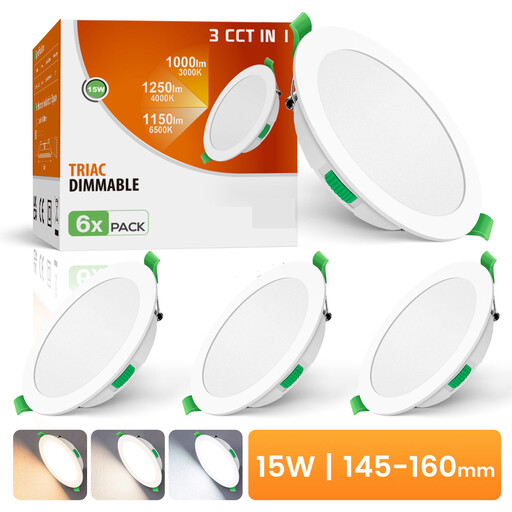
Why this product suits this profile: With 1,200 lm per light, three colour temperatures and a cut-out of 145–160 mm, this set is designed for larger ceiling openings and rooms with higher lighting requirements.
The dimming capability is not merely advertised in general terms; it is specified as 10–100% and requires compatibility with either leading-edge or trailing-edge dimming. IP44 remains limited to protection against splashing water.
230-volt connection, 120° beam angle, 3CCT selection and six lights per set.
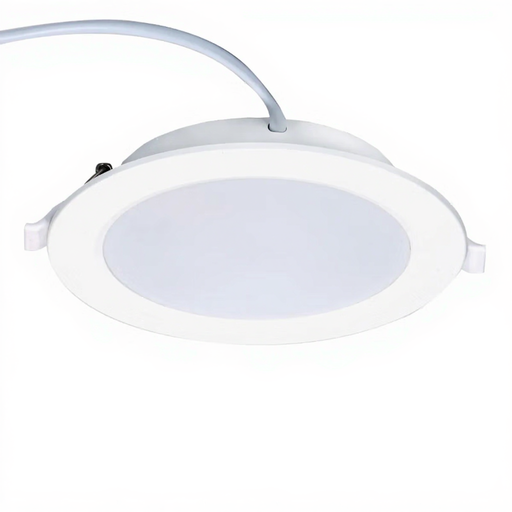
Why this product suits this profile: This smart LED recessed spotlight uses Bluetooth Mesh and lets you adjust the colour temperature via an app. It is suitable for dry indoor areas such as hallways, living spaces or offices.
The IP20 rating is expressly specified for dry indoor areas. Depending on how it is used, remote access and voice control also require a compatible gateway.
780 lm, 9 W, 120° beam angle, 2,700–6,500 K and a stated lifespan of 30,000 hours.
For a bathroom, you should first clarify the installation zone and the installation conditions. An IP44 LED recessed spotlight may be intended for areas exposed to splashing water, while an IP65 model offers greater protection against water. The IP rating must be suitable for the specific installation position; if you are unsure, consult a qualified electrician.
For mirror or work areas, neutral white light is often more practical than 6500 K. Warm white light may feel more pleasant in a bathroom used as part of a living space. This describes typical use and does not imply any medical or therapeutic effect.
Annual electricity costs can be estimated roughly as follows:
Power in kW × operating hours × electricity price = electricity costs
A 9 W light uses around 9 kWh over 1,000 operating hours. The actual amount depends on your individual electricity tariff. Clean, unobstructed lights can dissipate heat more effectively. Insulation material may only be used near the light in accordance with the installation instructions and applicable regulations.
We have put together a complete, regularly updated list of products that fully meet these strict selection criteria and the safety regulations applicable in the EU.
Only models specified as having a 220–240 V or 230 V connection are designed for direct mains connection. 12–24 V lights require a suitable transformer. The connection should be carried out by a qualified electrician.
Many product specifications state 25,000 to 30,000 operating hours. Actual service life depends, among other things, on heat dissipation, switching frequency, ambient temperature and correct installation.
No. Check whether the light is designed for leading-edge dimming, trailing-edge dimming or app control only. A conventional wall dimmer may be unsuitable for a smart model or a light explicitly specified as non-dimmable.