
Lieferung heute & morgen

Qualitätsgarantie

Willkommens-Angebote freischalten: KOSTENLOSE Lieferung | Bis zu 80 % RABATT | Kostenlose 30-Tage-JoyPlus-Testphase
App herunterladen
An LED recessed ceiling spotlight can illuminate rooms evenly, discreetly and energy-efficiently. However, not every model is suitable for every ceiling cut-out or room. Poor purchases are often not caused by the LED technology itself, but by unclear information about installation dimensions, IP rating and control options.
This buying guide from the Joybuy Product Recommendation Officer explains which specifications matter before you buy and which solutions suit different living situations.
The visible trim of an LED ceiling spotlight is not the same as the required ceiling cut-out. For example, a spotlight with an outer diameter of 145 mm may require an opening of 120 to 130 mm. Before renovating, you should therefore always measure the existing opening.
If the cut-out is too small, the light will not fit. If the opening is too large, the spring clips and trim may not provide a secure hold.
An IP44 LED recessed spotlight is protected against solid foreign objects and splashing water from various directions. However, this does not mean that it is suitable for every area of the bathroom or for direct jets of water. For damp areas, the applicable installation zones and local regulations must also be taken into account.
Models with IP20, on the other hand, are intended for dry indoor spaces. They should not be used in areas with high humidity, condensation or direct splashing water.
With smart LED recessed spotlights, brightness is often adjusted via an app, Bluetooth Mesh, Wi-Fi or voice control. An external trailing-edge or wall dimmer may therefore not be compatible. Before buying, check whether your preferred control method is explicitly supported.
Wattage describes energy consumption, not brightness directly. For practical selection, the luminous flux in lumens is the key factor:
The number required depends on the room size, ceiling height, wall colour, furnishings and desired brightness. Lumen values for different models should always be compared under the same conditions.
A warm white LED ceiling light of around 2,700 to 3,000 K generally creates a more subdued atmosphere in living rooms and bedrooms. Neutral white at around 4,000 K can be practical for kitchens, hallways or work areas. Daylight white up to 6,500 K appears noticeably cooler.
CCT lights allow you to select a colour temperature within a range, for example from 2,700 K to 6,500 K. An RGB+CCT LED spotlight adds coloured light to these white tones. For natural colour reproduction, you should also check the stated CRI or Ra value. Several of the models listed here have a rating of Ra ≥80.
Flat LED recessed lights are useful when there is little space above the ceiling. Even so, drivers, cables and heat dissipation must be taken into account. A model with a height of 25.5 mm requires a different installation situation from a spotlight measuring 43.5 mm in height.
With a 230 V LED ceiling light, the connection is made directly to the mains. A 12 to 24 V model, by contrast, requires a suitable transformer, which may be available separately. Work on mains voltage must only be carried out by a suitably qualified person in accordance with the applicable regulations.
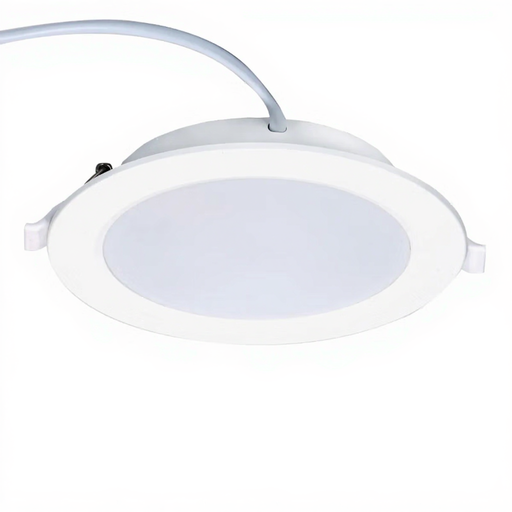
Why this product suits this profile: This spotlight combines 9 W of power with 780 lm, 2700 to 6500 K and a required opening of 120 to 130 mm. This makes it suitable for individual rooms or a group of matching lights.
The specifications for luminous flux, cut-out size, voltage and IP20 make it clear that this spotlight is intended for dry indoor spaces and not for the bathroom.
CCT control, Bluetooth Mesh, a 120° beam angle and a stated lifespan of 30,000 hours.
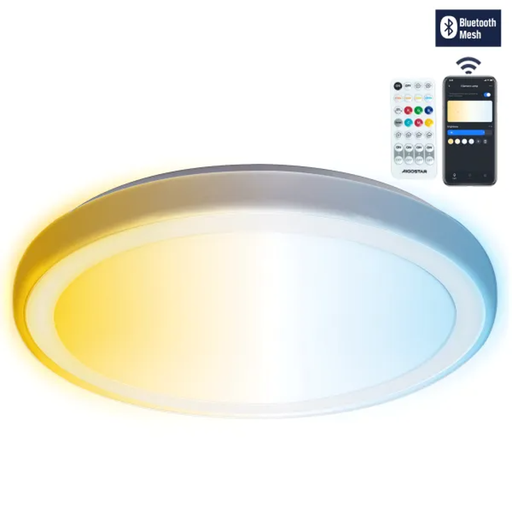
Why this product suits this profile: The 36 W, 3,960 lm ceiling light is designed for larger living areas, offices or open-plan rooms where a central light source is needed.
As a ceiling light, it eliminates the need to find a suitable recessed opening. The IP20 rating limits its use to dry indoor spaces.
3,960 lm, a 120° beam angle, 3000 to 6500 K and Bluetooth Mesh control.
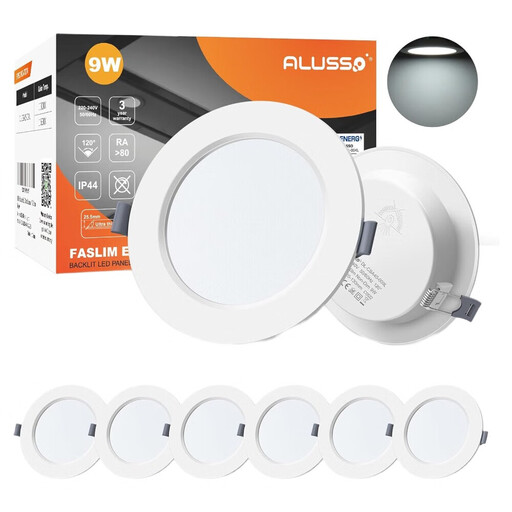
Why this product suits this profile: The six-piece set is ideal for renovations involving several light points. The lights are 25.5 mm flat, designed for 230 V and, according to the product information, require an opening of 115 to 135 mm.
The stated IP44 rating and direct 220 to 240 V design reduce uncertainty during planning. According to the specifications, this model is not dimmable.
Six lights, 9 W per spotlight, 720 lm per light and a slim design for restricted ceiling voids.
We have put together a complete, regularly updated list of products that fully meet these strict selection criteria and the safety regulations applicable in the EU.
Before installation, switch off the relevant circuit breaker and check the existing ceiling structure. A qualified electrician is required when working with mains voltage. Recessed spotlights must also not be covered with insulation or other objects if this could prevent heat from being dissipated.
Annual electricity costs can be estimated as follows:
Power in kW × operating hours × electricity price = electricity costs
A 9 W spotlight uses 9 kWh over 1,000 operating hours in theory. The actual amount depends on your individual electricity tariff. When using several lights, the total power consumption of all spotlights should be taken into account.
For cosy general lighting, 2,700 to 3,000 K is often chosen. CCT lights offer greater flexibility if you also need more neutral or cooler lighting moods.
IP44 may be relevant for certain areas exposed to splashing water, but it does not replace an assessment of the installation zones. The specific installation location, protection zones and local electrical regulations are decisive. Installation should be carried out by a qualified professional.
Many product specifications state a lifespan of around 30,000 hours. This is a manufacturer’s estimate and depends, among other things, on operating time, ambient temperature, ventilation and mains conditions. The light should no longer be used if visible damage or discolouration occurs.