
Lieferung heute & morgen

Qualitätsgarantie

Willkommens-Angebote freischalten: KOSTENLOSE Lieferung | Bis zu 80 % RABATT | Kostenlose 30-Tage-JoyPlus-Testphase
App herunterladen
If you’re looking to buy LED recessed downlights 230V dimmable, it pays to look beyond just wattage and design. The critical factors are cut-out size, dimmer compatibility, colour temperature and IP rating. During renovations especially, unnecessary costs can arise when a downlight doesn’t fit the existing hole or your current dimmer isn’t compatible with LED technology.
This guide is aimed at homeowners, renovators, interior designers, competent DIYers with electrical knowledge, as well as builders and electricians. It highlights what you need to check before buying and which products suit different installation scenarios.
An LED ceiling downlight might have a visible diameter of 85 mm, but require a smaller or larger ceiling opening. What matters is the stated cut-out or installation opening, not just the outer diameter.
Before you buy, check the following:
Slim LED ceiling lights are particularly suitable where there’s limited cavity space. Even so, the stated installation depth must be observed.
Dimmable LED downlights require a compatible dimmer. For the 230V models described here, a trailing-edge dimmer is often required. An older dimmer designed for incandescent bulbs can cause flickering, humming or a limited dimming range.
Look out for:
Installation on a 230V supply must only be carried out by a suitably qualified electrician in accordance with current regulations.
An IP44 LED recessed downlight is protected against solid objects larger than 1 mm and splashing water from any direction. This makes it suitable for many bathroom zones, kitchens and sheltered outdoor areas, but not automatically for direct water jets or continuous moisture.
IP65 recessed lights offer a higher level of protection against dust and water jets. However, the installation location, connection area and local installation requirements must still be considered. In wet zones, the IP rating alone does not provide a complete installation clearance.
A true 230V LED downlight connects directly to the mains AC supply and does not require a separate low-voltage transformer. Ratings such as 220–240V AC or 230V AC describe the intended mains range. Products rated at 12V or 24V are not designed for direct connection to the mains supply.
With a 3CCT recessed downlight, you can select the colour temperature before installation or via an integrated switch:
An LED recessed downlight offering 3000K, 4000K and 6500K makes planning easier when the final room ambience hasn’t been decided. For the products mentioned, selection is usually made before fitting into the ceiling or wall.
Watts describe the electrical power consumption, not directly the brightness. For comparison, the luminous flux in lumens is more relevant. A 7 W model with 600 lm and a 10 W model with 1050 lm differ significantly in light output.
A wider beam angle, for example 120 degrees, spreads the light more broadly. For even general lighting, several LED ceiling downlights can be a good choice. For accent areas or LED stair lighting, a targeted, lower light output is often sufficient.
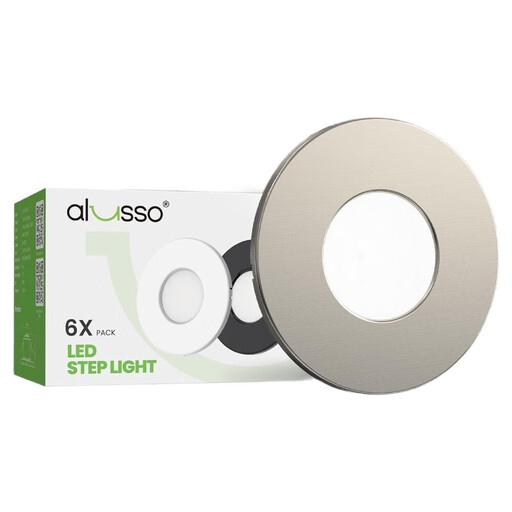
Why this product fits the profile: The six-piece set is designed for stairs, hallways and wall areas requiring multiple identical lights. It offers 3000K, 4000K and 6500K as well as three selectable power levels.
The specifications state the cut-out diameter, installation depth and the required trailing-edge dimming. This allows you to check measurements and your existing installation before buying.
Six lights, IP44, 230V connection, 220 lm per light and a stated dimming range of 10 to 100 per cent.
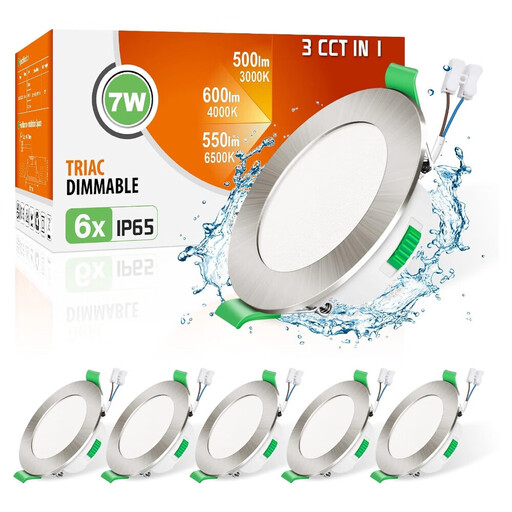
Why this product fits the profile: Aluminium and polycarbonate construction, 29 mm depth and IP65 make this model interesting for more demanding installations in suitable bathroom, kitchen and damp areas.
The IP65 classification and the required opening of 67 to 75 mm are clearly stated. This prevents a blanket assumption that IP44 equals IP65.
7 W, up to 600 lm, three colour temperatures, 230V direct connection and a stated dimming range of 10 to 100 per cent.
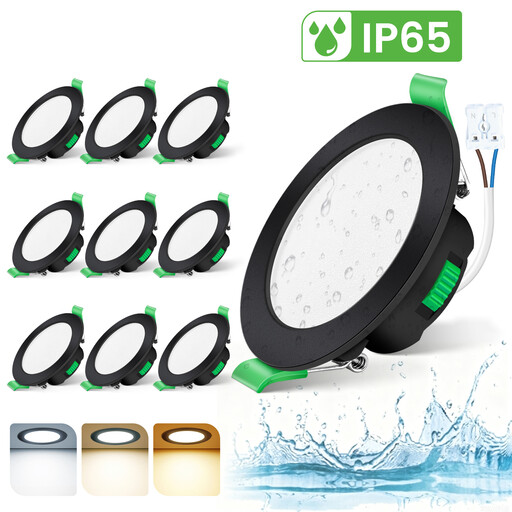
Why this product fits the profile: The black finish suits modern interiors. The six-pack of downlights supports consistent lighting in kitchens, bathrooms, hallways or sheltered outdoor areas.
The 230V connection without a transformer, the 29 mm depth and the specific hole range of 67 to 75 mm make technical pre-checking straightforward.
Aluminium-polycarbonate housing, IP65, 7 W, up to 600 lm and selectable colour temperatures of 3000K, 4000K and 6500K.
We’ve put together a full, regularly updated list of products that fully meet these strict selection criteria and the safety regulations in force across the EU.
For bathroom recessed downlights, choose the IP rating to match the specific installation zone. In kitchens, IP44 models are relevant for areas where splashing water may occur, while IP65 can meet additional requirements in higher-demand situations. Direct water jets and immersion are excluded unless the manufacturer explicitly states otherwise.
For stairs, LED wall lights for staircases are an alternative to recessed downlights. With wall mounting, you need to consider the wall box, installation depth and glare. Too high a light output can create uncomfortable contrasts on steps. For hallways and stairwells, even spacing is more important than maximum lumens.
Before ordering, run through this short checklist:
Models marked 220–240V AC or 230V AC are designed for direct mains connection. No transformer is required for these products. Connection must be carried out by a qualified electrician.
For several of the models featured, the product specifications state an average lifespan of 25,000 to 30,000 hours. Actual operating life depends on factors including heat dissipation, ambient temperature, switching frequency and suitable dimmer technology. A stated lifespan is therefore not a guarantee of a specific service life in every individual case.
With a power consumption of 7 W, one downlight uses approximately 7 kWh over 1,000 hours of operation. The electricity cost is this consumption multiplied by your personal unit rate. For multiple lights, add the wattages together. The dimmer setting can affect power consumption, but the exact value depends on the light and dimmer.