
Lieferung heute & morgen

Qualitätsgarantie

Willkommens-Angebote freischalten: KOSTENLOSE Lieferung | Bis zu 80 % RABATT | Kostenlose 30-Tage-JoyPlus-Testphase
App herunterladen
An LED recessed spotlight can illuminate ceilings, furniture, stairs or worktops while saving space. However, not every model is suitable for every installation. Unnecessary costs often arise because buyers focus solely on wattage, appearance or an attractive set price before purchasing. The crucial factors are the technical specifications, which only become apparent during installation.
A slim LED recessed spotlight may require very little space above the ceiling, but the existing cut-out must still be an exact fit. A model requiring a cut-out of 120 to 130 mm cannot simply be installed in a 90 mm opening. Before buying, you should therefore compare the cut-out, external diameter and installation depth.
An LED recessed spotlight 230 V is operated directly from a suitable mains connection. An LED recessed spotlight 12 V or 12–24 V model, on the other hand, requires a suitable transformer for many applications. This is not always included. A low-voltage spotlight must not be connected directly to the mains voltage. Existing cables, the power supply, connection type and total output must all be compatible.
The IP44 rating protects against solid foreign objects and splashing water from different directions. It is suitable for many bathroom and kitchen areas, but does not replace a precise assessment of the installation zone. A spotlight with IP20 is intended exclusively for dry indoor areas. For outdoor use, low-level installations or locations exposed to direct water, a higher protection rating is often essential.
For homes with an existing mains cable, suitable 220–240 V models are an option. In motorhomes, caravans, boats or certain furniture installations, an LED recessed spotlight 12 V or 12–24 V model may be more suitable. According to the product information, the low-voltage model with 4 W and a 3CCT system requires a separate 12–24 V transformer, which is not included.
Work involving mains voltage should be carried out by a qualified electrician in accordance with the applicable regulations. Before installation, always switch off the power supply and protect it against being switched on again.
A 3CCT LED spotlight usually offers three selectable colour temperatures:
With some lights, the colour temperature is selected using a switch before installation. Smart models, by contrast, can cover a wider range, such as 2700 to 6500 K. The CRI or Ra value describes how naturally colours appear under the light. A value of Ra ≥ 80 is specified for several of the models mentioned here.
A dimmable LED recessed spotlight only works with a compatible dimmer or, for smart lights, with the designated app control. An externally installed wall dimmer is not automatically suitable. When comparing products, you should also consider the luminous flux in lumens, rather than looking only at the wattage.
A 9 W model with 690 to 780 lm is different from an 18 W downlight with 1500 to 1800 lm. The required output depends on the size of the room, installation spacing, beam angle and desired illumination level. Lower outputs are often sufficient for LED stair lighting or furniture lighting; several more powerful spotlights may be needed for general lighting.
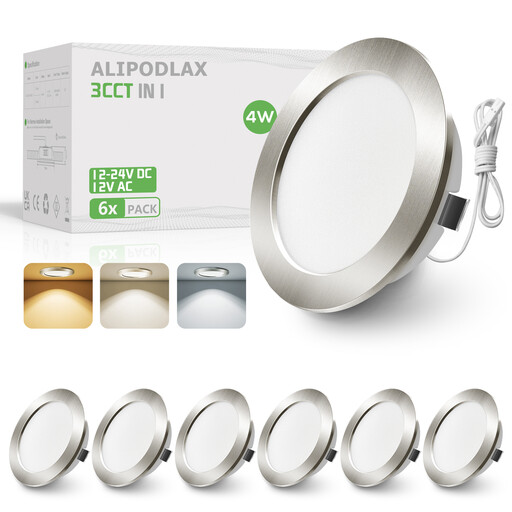
Why this product suits this profile: This compact model is suitable for furniture, shelving, kitchen areas and vehicles with a compatible low-voltage supply.
The required voltage of 12–24 V and the 55–58 mm cut-out are clearly specified. Direct connection to 230 V is expressly ruled out.
4 W, 270 lm, 3CCT with 3000/4000/6000 K and a 14.5 mm installation height; transformer required separately.
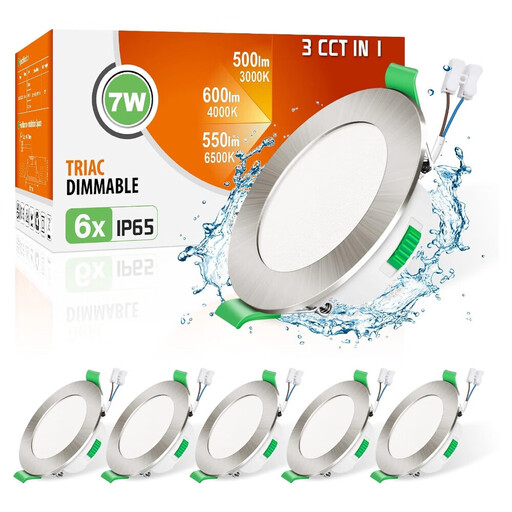
Why this product suits this profile: For uniform ceiling lighting in bathrooms, kitchens or sheltered outdoor areas, this set offers six lights that can be connected directly.
The light is designed for 220–240 V and does not require a separate transformer. The IP65 protection rating is specified for damp areas.
3CCT, 10–100% dimmability with a compatible trailing-edge dimmer, 67–75 mm cut-out and six lights per set.
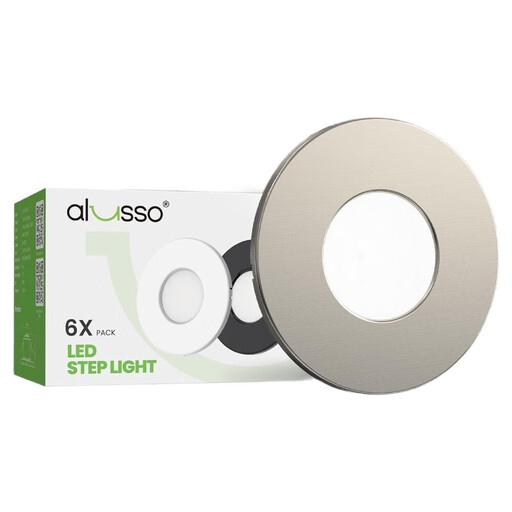
Why this product suits this profile: These compact wall lights are designed for stairs, hallways and sheltered outdoor areas, and can be planned in a series.
The output levels of 0.5, 1.5 and 2.5 W, as well as compatibility with a suitable trailing-edge dimmer, are clearly specified.
230 V connection, 3CCT with 3000/4000/6500 K, 10–100% dimmable, IP44 and six lights in the set.
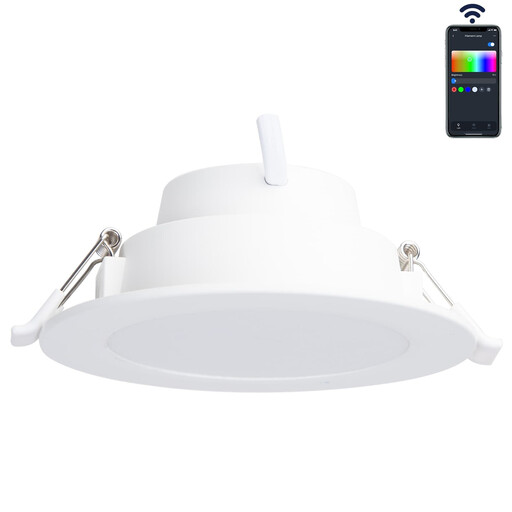
Why this product suits this profile: Bluetooth Mesh control, app dimming and RGB+CCT functions are ideal for indoor spaces with flexibly controlled lighting.
The light has an IP20 rating, clearly indicating that it is intended for dry indoor areas. This prevents use in damp bathroom environments.
9 W, 780 lm, 2700–6500 K, RGB colours, 120° beam angle and Bluetooth Mesh; a gateway may be required for additional functions.
We have put together a complete, regularly updated list of products that fully meet these strict selection criteria and the safety regulations applicable in the EU.
Before buying and installing, tick off the following points:
Several of the models mentioned specify an average lifespan of 30,000 hours. This is a manufacturer’s figure and depends, among other things, on the ambient temperature, switching cycles, ventilation and correct installation. With permanently installed LED modules, it is usually the entire light, rather than just the bulb, that needs to be replaced.
This depends on the protection rating and the specific installation position. An LED recessed spotlight bathroom IP44 may be suitable for appropriate areas exposed to splashing water. IP20 models, by contrast, are not intended for damp or wet rooms. The light must also be installed in a suitable installation zone and connected professionally.
Running costs depend on the output, daily operating time and electricity tariff. A 4 W spotlight uses 0.04 kWh over ten hours of operation. A 10 W model consumes 0.10 kWh over the same period. For your own calculation, use: Wattage × operating hours ÷ 1000 = kilowatt-hours. Multiplying this by your electricity unit rate gives the approximate proportion of the energy costs.