
Lieferung heute & morgen

Qualitätsgarantie

Willkommens-Angebote freischalten: KOSTENLOSE Lieferung | Bis zu 80 % RABATT | Kostenlose 30-Tage-JoyPlus-Testphase
App herunterladen
An LED recessed spotlight can illuminate ceilings, stairs, furniture or outdoor areas while saving space. However, inaccurate product details and incorrectly assessed installation dimensions often lead to unsuitable purchases. The actual installation depth, the appropriate IP rating and whether the light is compatible with the existing electrical installation are particularly important.
This buying guide helps private customers, renovators, interior designers, electricians, campers and motorhome owners compare technical specifications objectively.
The visible cover of an LED ceiling spotlight is not the decisive factor for installation. What matters is the cut-out size or installation diameter and the depth required in the mounting surface. For example, a spotlight with an external diameter of 145 mm may require a cut-out of 120 to 130 mm.
For low ceilings or furniture, a shallow LED recessed spotlight with an installation depth of around 25 to 30 mm is a sensible choice. Existing openings should be measured precisely before buying. A cut-out that is too small or too large makes secure fastening more difficult.
An IP20 LED recessed spotlight is intended for dry indoor areas. It is not suitable for bathrooms with high humidity or for outdoor surfaces. Depending on the installation location, models with IP44 may be suitable for sheltered, damp areas. IP44 protects against solid foreign objects measuring 1 mm or more and against splashing water from various directions, but not against direct water jets or immersion.
Outdoor areas exposed to harsher weather require higher IP ratings. An LED in-ground spotlight with IP67 is designed to provide protection against dust and temporary immersion. Nevertheless, the specific installation situation, drainage and load-bearing capacity of the ground must also be taken into account.
A dimmable LED recessed spotlight requires a suitable dimmer. Some products can only be dimmed via an app, while others are designed for leading-edge or trailing-edge dimmers. These systems are not interchangeable at will.
When renovating a property with existing wall controls, check details such as ‘Trailing Edge’ and the permitted dimmer compatibility. Smart models with Bluetooth Mesh can offer additional features such as timers, group control and voice control. However, remote access may require a separate gateway.
The wattage describes power consumption, not brightness alone. For comparison, the luminous flux in lumens is more informative. A 9 W model may, for example, deliver 780 lm, while an 18 W model can reach around 1,500 to 1,800 lm, depending on the version.
Colour temperature is specified in kelvins:
A 3CCT LED spotlight is practical if you want to decide on the colour temperature after installation. With many products, however, the setting is selected using a switch on the housing rather than through an app.
An LED recessed spotlight 230 V is connected directly to the mains supply at 220 to 240 V. This can simplify installation, but requires electrical work to be carried out properly. In Germany, work on mains voltage should be performed by a suitably qualified person.
Models for motorhomes, boats or furniture often operate with 12 to 24 V DC. They must not be connected directly to 230 V. When used in the home, a separately purchased transformer may be required, depending on the product. Before buying, check whether a power supply, driver or transformer is included.
Spring clips enable quick installation in suitable ceiling cut-outs. During continuous operation, adequate ventilation and the clearance from insulation materials specified by the manufacturer are important. Aluminium housings can help dissipate heat, whereas plastic housings are often lighter.
Specifications such as Ra≥80, a 120° beam angle, a service life of 30,000 hours or 15,000 switching cycles should be understood as technical details provided by the manufacturer. Actual service life depends, among other things, on the ambient temperature, operating time and installation.
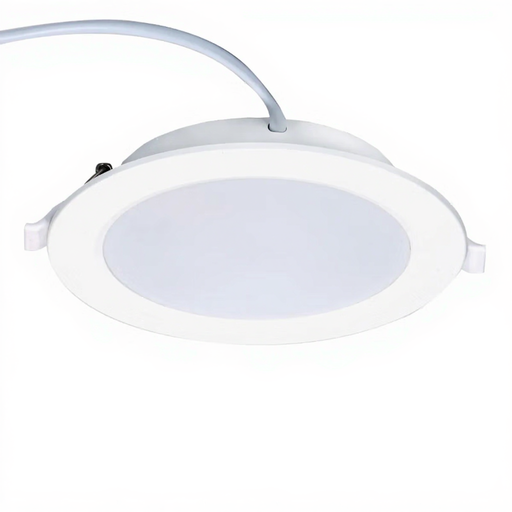
Why this product suits this profile: The 9 W spotlight delivers 780 lm, an adjustable colour temperature from 2,700 to 6,500 K and requires a 120 to 130 mm cut-out. Bluetooth Mesh allows several lights to be grouped together.
The technical specifications clearly state the luminous flux, cut-out size, voltage and IP20 rating. This makes it possible to check in advance whether the light is suitable for dry indoor areas and the existing opening.
CCT adjustment, a 120° beam angle and a stated service life of 30,000 hours.
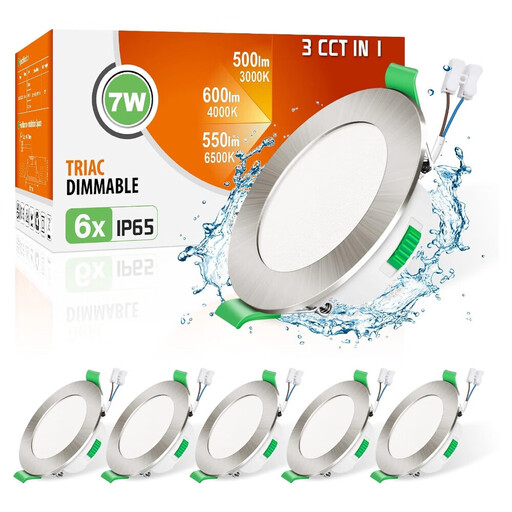
Why this product suits this profile: This LED recessed spotlight is intended for indoor and outdoor areas. It has an IP65 rating, an installation depth of 29 mm and requires a 68 to 75 mm cut-out.
The IP rating is clearly stated. However, the dimming function requires a compatible trailing-edge dimmer, so the existing electrical installation should be checked.
IP65, 3CCT with 3,000/4,000/6,500 K and stated dimming from 10 to 100 per cent.

Why this product suits this profile: This LED recessed spotlight for motorhomes and caravans operates with 12 to 24 V DC, delivers 400 lm and requires a 55 to 68 mm cut-out.
The low voltage prevents confusion with 230 V models. For household use with 12 V AC, a separate transformer is required.
3CCT selection, a 29 mm profile and IP44 for suitable damp indoor areas and use in vehicles.
We have put together a complete, regularly updated list of products that fully meet these strict selection criteria and the safety regulations applicable in the EU.
Consumption corresponds to the stated power rating. A 9 W model used for five hours a day would theoretically require 45 Wh per day. To calculate the ongoing cost, multiply this consumption by your personal electricity tariff. Smart models may also consume a small amount of power in standby mode.
With 12 or 24 V systems, installation is comparatively straightforward, depending on the setup, provided the power supply is correctly configured. For 230 V models, the applicable electrical regulations must be followed. Work on the mains supply should be carried out by a qualified electrician. Always switch off the power at the fuse box before starting any installation.
Many product data sheets state a service life of around 30,000 hours. This is a manufacturer’s specification, not a guarantee for every installation situation. Heat, moisture, frequent switching and an unsuitable power supply can affect service life. The correct cut-out, adequate ventilation and the appropriate IP rating are therefore just as important as the stated service life.