
Lieferung heute & morgen

Qualitätsgarantie

Willkommens-Angebote freischalten: KOSTENLOSE Lieferung | Bis zu 80 % RABATT | Kostenlose 30-Tage-JoyPlus-Testphase
App herunterladen
An LED recessed spotlight can illuminate ceilings discreetly and flush to the surface – provided the model, cut-out size and intended application are compatible. In practice, many poor purchases are not caused by the LED technology itself, but by unclear dimensions, unsuitable IP ratings or smart home functions that are incompatible with the existing system.
This buying guide from the Joybuy Product Recommendation Officer helps private customers, renovators and property developers compare technical specifications objectively.
The most important measurement is not just the light fitting’s external diameter, but the ceiling cut-out. For example, an LED ceiling spotlight with a diameter of 145 mm may require a cut-out of 120 to 130 mm. Other models require 90 to 100 mm or 200 to 220 mm.
Before buying, you should therefore check:
If the cut-out is too large, it cannot always be corrected during renovation without adding a cover.
A dimmable LED recessed spotlight requires a suitable dimmer. Some 230-volt models specifically require a trailing-edge dimmer. Smart lights, on the other hand, are often dimmed exclusively via the app or a compatible hub and are not designed for an external wall dimmer.
Pay attention to the specific manufacturer’s information. An unsuitable dimmer can cause flickering, a limited dimming range or buzzing noises.
An IP44 LED recessed spotlight is protected against solid foreign objects and splashing water from certain directions. This makes it suitable for many indoor areas with increased humidity, but it does not mean that it is suitable for direct jets of water or immersion.
For a bathroom, the installation position is also relevant. The light must be suitable for the particular installation zone and comply with the applicable electrical requirements. A bathroom LED spotlight should be installed by a qualified electrician.
A flat LED recessed spotlight is suitable for ceilings with limited cavity space. Models with a stated installation depth of around 25.5 to 34 mm require less room than deeper lights. Even so, there must be sufficient space behind the light for heat dissipation. Insulation must not simply be placed over the light if the manufacturer prohibits this.
Luminous flux is specified in lumens (lm). Watts, on the other hand, describe electrical consumption and do not directly indicate brightness. For a meaningful comparison, you should consider both values.
Colour temperature is measured in kelvins:
A CCT recessed spotlight allows you to select several shades of white. An RGB+CCT LED spotlight adds coloured light to this function. The colour rendering index, CRI or Ra, indicates how naturally colours appear under the light. Depending on the version, the models listed here have a stated Ra ≥80.
A 230 V LED recessed spotlight is connected directly to the 220–240 V mains supply. You must not connect it yourself to a live cable; the fuse must be switched off before installation.
A smart LED recessed spotlight can be controlled via Bluetooth Mesh, Wi-Fi, an app or voice control. Bluetooth Mesh is particularly suitable for several lights in one room or hallway. Some Aigostar models require a compatible gateway for remote access or voice control. Before buying, you should therefore check:

Why this product suits this profile: The six-piece set is designed for several rooms or even illumination across a hallway ceiling. It has an installation depth of 25.5 mm and requires a ceiling cut-out of 95–110 mm.
The information on the cut-out, 230-volt connection and non-dimmable design is clearly stated. This makes it easier to plan the installation in advance.
6 W, 430 lm, IP44, 6500 K and a stated service life of 30,000 hours.
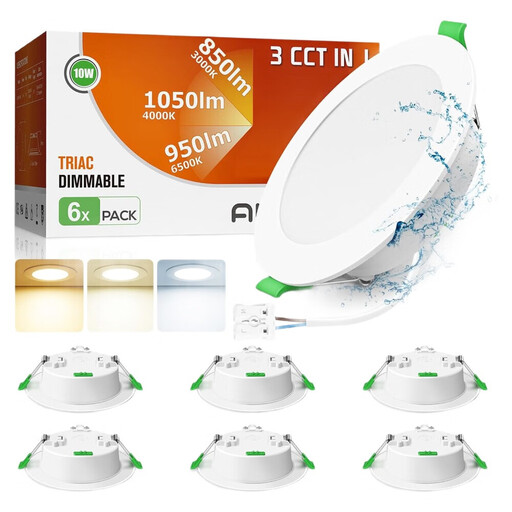
Why this product suits this profile: Aluminium and polycarbonate construction, three selectable colour temperatures and dimming from 10 to 100 per cent offer practical adjustment options for kitchens, hallways and bathrooms.
Dimming requires a compatible trailing-edge dimmer. The IP44 rating also helps prevent incorrect use where the light would be exposed to direct water.
1050 lm per light, 90–100 mm cut-out, 34 mm depth and 3000/4000/6500 K.
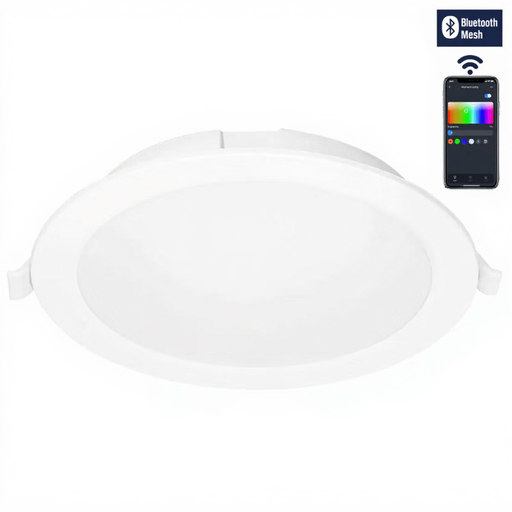
Why this product suits this profile: Bluetooth Mesh, a 120° beam angle and 2700–6500 K make it suitable for grouped lighting in living spaces, hallways or commercial interiors.
With its IP20 rating, the light is clearly intended for dry indoor areas. It is therefore not designed for humid rooms.
1430 lm, RGB plus CCT, Bluetooth Mesh and a stated service life of 30,000 hours.
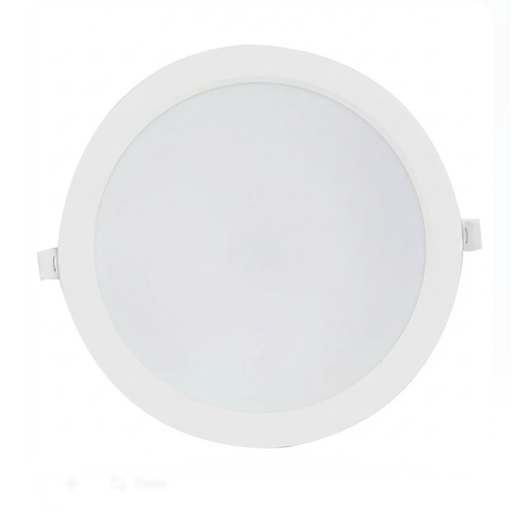
Why this product suits this profile: The stated ceiling cut-out of around 200–210 mm and luminous flux of 1500–1800 lm are designed for larger living areas, open-plan kitchens or offices.
The large cut-out is clearly specified before purchase. The IP20 rating and unsuitability for humid rooms clearly define where it can be used.
CCT from 3000 to 6500 K, Bluetooth Mesh and an aluminium-PBT housing according to the product information.
We have put together a complete, regularly updated list of products that fully meet these strict selection criteria and the safety regulations applicable in the EU.
For all permanently connected lights, the rule is: Switch off the circuit and have it checked to confirm that it is de-energised. Installation on a 220–240 V supply should be carried out by a qualified electrician. The ceiling cut-out must be within the specified tolerance so that the spring clips hold securely.
Power consumption determines running costs. A 6 W model uses less energy than an 18 W light over the same operating period, but it also produces a different level of luminous flux. A simple calculation is:
Power in kW × operating hours × electricity price = electricity costs
A stated service life of 25,000 or 30,000 hours is a product specification, not a guarantee for every installation. Heat, frequent switching and unsuitable installation conditions can affect the actual service life.
It depends on the model. Common ranges are 90–100 mm, 95–110 mm, 120–130 mm, 145–160 mm or around 200–210 mm. The decisive factor is always the specific ceiling cut-out specification, not just the visible diameter.
No. Some models are non-dimmable, while others require a compatible trailing-edge dimmer. Smart LED recessed spotlights may only support dimming via an app, gateway or voice control. The product description should be checked carefully before buying.
Only models with an appropriate IP rating and suitable installation position. IP44 may be relevant for areas exposed to splashing water, but it does not protect against direct jets of water or immersion. IP20 lights are intended exclusively for dry indoor areas. Selection and installation should comply with German electrical requirements.