
Lieferung heute & morgen

Qualitätsgarantie

Willkommens-Angebote freischalten: KOSTENLOSE Lieferung | Bis zu 80 % RABATT | Kostenlose 30-Tage-JoyPlus-Testphase
App herunterladen
An LED recessed spotlight can illuminate a flat ceiling, kitchen, hallway or bathroom while taking up very little space. In practice, however, disappointing purchases are often caused not by the lighting technology itself, but by overlooked installation specifications. A model with the right appearance may be unusable if the ceiling cut-out is the wrong size, the IP rating is unsuitable for the room or the advertised smart-home function requires additional hardware.
Before buying, you should therefore check three common pitfalls:
Before placing your order, measure the existing cut-out in the ceiling or furniture. The specifications can vary considerably depending on the model:
For a new installation, you should also check whether there is sufficient clearance above the ceiling from insulation and whether suitable ventilation is available. Lights must not be covered in a way that conflicts with the installation instructions.
An LED recessed spotlight 230 V is generally connected directly to a 220–240 V mains supply. Mains installation should be carried out by a qualified electrician in accordance with the applicable electrical regulations.
An LED recessed spotlight 12–24 V, on the other hand, is suitable for certain furniture installations, motorhomes, boats and other low-voltage applications. A suitable transformer may be required and is not included with every product. A 12–24 V model must not be connected directly to the mains voltage. Therefore, check the following:
Colour temperature is measured in kelvin:
A CCT LED spotlight allows you to select different shades of white. RGB+CCT recessed spotlights add coloured light to this selection. As well as wattage, pay attention to the luminous flux in lumens and the colour rendering index, CRI or Ra. A higher Ra value can reproduce colours in the room with greater differentiation, but it should always be assessed using the specific product data sheet.
With a dimmable LED spotlight, the type of control is crucial. Bluetooth Mesh, Wi-Fi, a manufacturer’s app and a separately available hub are not interchangeable. Also check whether voice control only works with a gateway. With multiple lights, a Bluetooth Mesh ceiling light may allow them to be grouped on the same network, while an individual light may instead be set up directly via Bluetooth.
The IP code describes protection against solid foreign objects and water. An IP20 recessed spotlight is intended for dry indoor areas and is not suitable for areas exposed to splashing water or high condensation.
An IP44 recessed spotlight offers greater protection against splashing water. Depending on the installation zone and requirements, this may make it more suitable for certain areas of the bathroom or kitchen. However, the IP rating alone does not replace checking the installation zone, local regulations and the manufacturer’s specifications. For a recessed spotlight in the bathroom, you should therefore have the exact position and electrical installation checked by a qualified professional.

Why this product suits this profile: The six-light set is ideal for users who need several matching spotlights for indoor areas and prefer a direct 230 V connection.
The required cut-out of 95–110 mm and installation depth of 25.5 mm are clearly stated. According to the product data, this model is not dimmable, so there is no risk of wrongly assuming that it will work with a wall dimmer.
6 W, 430 lm, 230 V and IP44; compact design for specified indoor areas.
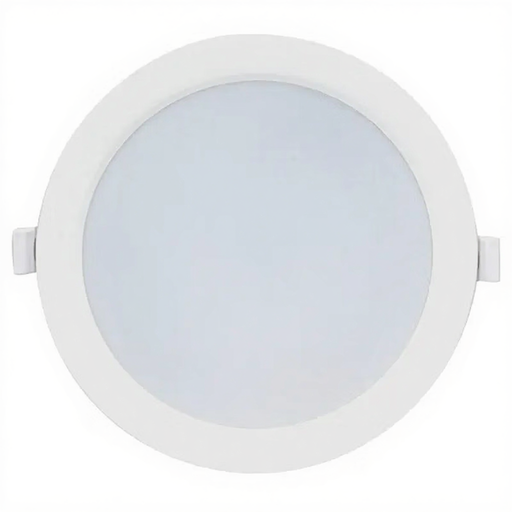
Why this product suits this profile: For living rooms, hallways and kitchens, this smart LED recessed spotlight offers adjustable shades of white, with control via Bluetooth and Wi-Fi using the Haodeng app.
The technical limits are clear: IP20 means it is intended exclusively for dry indoor areas, the cut-out is 150–160 mm and the power supply is 220–240 V.
15 W, 1430 lm, 2700–6500 K, app and voice control; slim installation depth of 25.5 mm.

Why this product suits this profile: This spotlight is designed for motorhomes, vans, caravans and boats. It may also be suitable for certain low-voltage indoor installations.
The required voltage of 12–24 V DC is clearly distinguished from 230 V models. According to the product information, a separate transformer is required for 12 V AC domestic applications.
400 lm, selectable 3000/4000/6500 K, IP44 and a 55–68 mm installation opening.
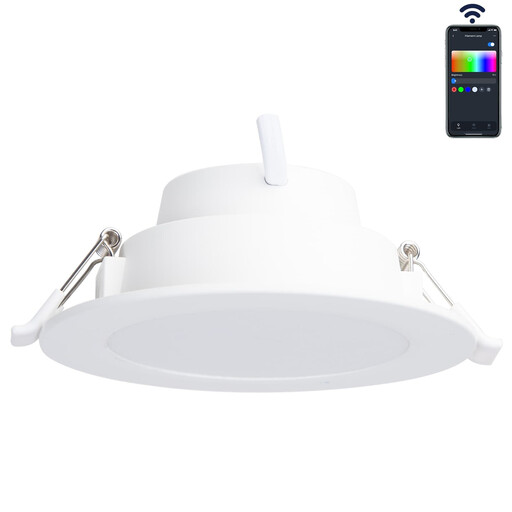
Why this product suits this profile: This model is designed for users who want to combine RGB colours, CCT settings, dimming and voice control in a connected lighting system.
Bluetooth Mesh and gateway control are explicitly specified. In addition, the IP20 model is intended exclusively for dry indoor areas and is not suitable for the bathroom.
9 W, 780 lm, RGB plus 2700–6500 K, 120° beam angle and app-based dimming.
Before installing an LED recessed spotlight, you should check the following:
When working with 230 V, the power supply must be switched off at the circuit breaker, and the installation must be carried out in accordance with the applicable regulations. A qualified electrician can also check whether the connection, cable cross-section and installation location are compatible.
We have put together a complete, regularly updated list of products that fully meet these strict selection criteria and the safety regulations applicable in the EU.
The consumption generally corresponds to the stated power rating. A 6 W model used for five hours a day would theoretically require 30 Wh per day. Smart lights may also consume a small amount of power in standby mode. Wattage, daily usage time and your electricity tariff therefore determine the running costs.
That depends on the IP rating, installation zone and mounting position. IP20 models are not intended for damp areas. An IP44 recessed spotlight may be suitable for certain indoor areas exposed to splashing water, but it must be installed in accordance with the relevant installation zone. The final choice and connection should be checked against the applicable regulations.
Many models list a lifespan of up to 30,000 hours in their product data. This is a manufacturer’s specification and depends, among other things, on operating temperature, ventilation, switching cycles and correct installation. Good heat dissipation and the prescribed installation clearance therefore remain important, even with slim lights.