
Lieferung heute & morgen

Qualitätsgarantie

Willkommens-Angebote freischalten: KOSTENLOSE Lieferung | Bis zu 80 % RABATT | Kostenlose 30-Tage-JoyPlus-Testphase
App herunterladen
A 6-pack of dimmable 230 V 3CCT LED recessed spotlights can give you flexible lighting in living rooms, kitchens, bathrooms, hallways or stairwells. However, unclear product specifications often lead to unsuitable purchases. The key considerations are not just colour temperature and price, but above all the cut-out size, dimmer compatibility and IP rating.
Recessed spotlights are often selected by their outer diameter. However, it is the cut-out size that matters for installation. Depending on the model, openings of 67–75 mm, 90–100 mm, 115–135 mm or 145–160 mm may be required. If the opening is too large, the spring clips may not hold securely enough. If it is too small, the light cannot be fitted.
You should therefore measure the existing opening before buying and compare it with the manufacturer’s specification. If you are renovating and creating new ceiling cut-outs, the installation depth is also important. Flat LED recessed spotlights measuring around 25 to 34 mm deep are suitable for ceilings with limited cavity space, but they still need enough room for the connection and heat dissipation.
A dimmable recessed spotlight will only work reliably if the light and dimmer are technically compatible. Some of the 230 V models featured here require a trailing-edge dimmer. An existing dimmer from an older halogen installation may therefore be unsuitable.
Possible consequences of an incompatible combination include flickering, humming, a restricted dimming range or delayed start-up. Check the approved dimmer types before installation, and have the connection to the 230 V mains carried out by a qualified electrician.
IP44 recessed lights are protected against solid foreign objects measuring 1 mm or more and against splashing water from various directions. This makes them suitable for many bathroom areas, kitchens, utility rooms and sheltered outdoor areas. Direct jets of water and immersion are not covered.
For areas exposed to higher levels of moisture, an IP65 recessed spotlight may be more suitable. However, you must always take the specific bathroom installation zone, distance from water sources and applicable installation regulations into account.
With a 3CCT LED spotlight in warm white, neutral white and cool white, the colour temperature is usually selected using a switch on the light fitting:
Many models require the selection to be made before installation. If you want to change the colour temperature regularly via an app, you will need a smart model instead. One example is the Aigostar Smart LED Recessed Spotlight with Bluetooth Mesh, RGB and CCT from 2700 to 6500 K. However, this model has IP20 and, according to the product specification, is intended for dry indoor spaces only.
Wattage alone does not indicate how bright a light is. For comparison, the luminous flux in lumens is more meaningful. For example, a 10 W model may be specified as providing 1050 lm per light, while compact stair lights rated at 2.5 W can produce up to 220 lm.
A beam angle of around 120 degrees spreads the light widely. This can be useful for even ceiling illumination. With LED stair lighting or LED wall recessed lights, the focus is often on guidance and accent lighting instead. The required brightness therefore depends on the room, installation height, wall colour and intended lighting purpose.
Some models connect directly to 220–240 V AC and do not require a separate transformer. This simplifies planning, but does not replace professional electrical installation. Before buying, check that the terminal connections, cables, installation depth and existing consumer unit are suitable for the installation.
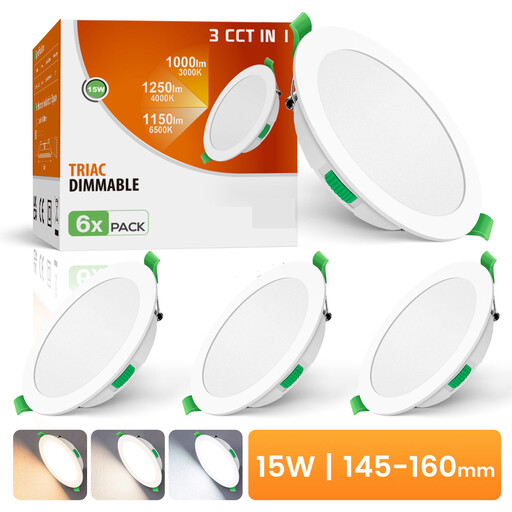
Why this product suits this profile: This set is designed for larger ceiling cut-outs of 145–160 mm and provides 1200 lm per light, with a wide 120-degree beam angle.
The exact cut-out size, 3CCT switching and dimming range from 10 to 100 per cent are stated in the product details.
230 V connection without a separate transformer, IP44 protection and three selectable colour temperatures.
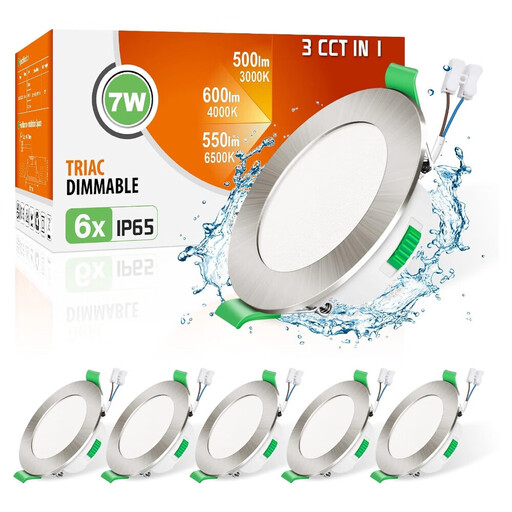
Why this product suits this profile: This model is intended for damp areas and sheltered outdoor spaces and, according to the specifications, requires a 67–75 mm cut-out.
The IP65 rating sets this model apart from IP44-only solutions; the specifications also mention a direct 230 V connection and compatible trailing-edge dimmers.
Aluminium and polycarbonate construction, 3CCT selection and dimming from 10 to 100 per cent.
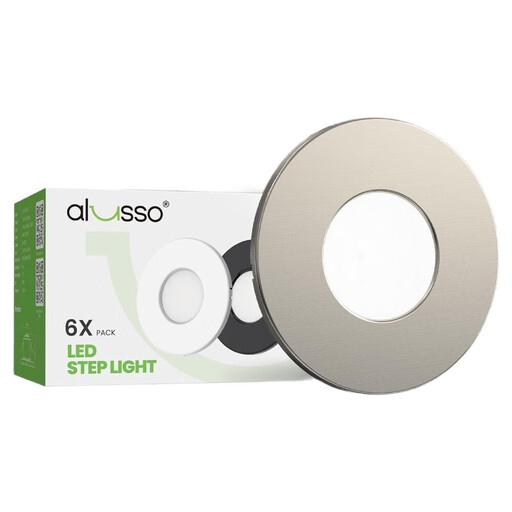
Why this product suits this profile: With a diameter of 84.5 mm and a depth of 30 mm, these round wall recessed lights are designed for stairs, hallways and orientation lighting.
The adjustable power levels of 0.5, 1.5 and 2.5 W make it easier to select the right amount of light for stairs and passageways.
3CCT, IP44, direct 230 V connection and two installation options using spring clips or screws.
We have put together a complete, regularly updated list of products that fully meet these strict selection criteria and the safety regulations applicable in the EU.
Before installation, switch off the power supply at the circuit breaker and have the absence of voltage checked. Fixed 230 V LED ceiling spotlights must be installed by a qualified electrician. Heat dissipation must also not be obstructed by insulation material or a completely enclosed installation space.
For kitchens and bathrooms, it is advisable to check the IP rating and installation position carefully. In hallways or stairwells, several lights from a 6-pack can be spaced evenly. On stair steps, the light source should be positioned so that it does not cause distracting glare.
Many models with a direct 220–240 V connection are dimmable, but only with a compatible dimmer. The specifications for the individual product are decisive, particularly those relating to trailing-edge control and the dimming range.
Depending on the model, the products mentioned are rated for an average of 25,000 to 30,000 operating hours. Actual service life depends, among other things, on operating time, ambient temperature, mains quality and adequate heat dissipation.
Consumption depends on the wattage of each individual light. A set of six 10 W spotlights theoretically uses 60 W at full power. If the lights are dimmed or operated at a lower power setting, power consumption may be correspondingly lower. Daily operating time and your electricity tariff are also important factors in the ongoing running costs.