
Lieferung heute & morgen

Qualitätsgarantie

Willkommens-Angebote freischalten: KOSTENLOSE Lieferung | Bis zu 80 % RABATT | Kostenlose 30-Tage-JoyPlus-Testphase
App herunterladen
Choosing the right lighting is a crucial step in any renovation. With LED recessed spotlights for ceilings or walls, in particular, small selection errors can lead to big problems—from safety risks in the bathroom to flickering lights in the living room. Many products on the market promise simple installation and high functionality, but pitfalls are often hidden in the technical details.
Before you make a decision, it's important to know the three most common mistakes made when purchasing LED recessed spotlights:
To avoid these mistakes, you should focus on verifiable technical features rather than marketing promises. Three core parameters are essential for a safe and functional installation.
The IP (Ingress Protection) rating indicates how well an electrical device is protected against the ingress of foreign objects and water. For rooms where water spray may occur, such as bathrooms or kitchens, an IP44 rating is a minimum standard.
Modern 230V recessed lights offer a key advantage: they can be connected directly to the standard household power grid.
The lighting mood has a major impact on well-being. Flexible lighting solutions adapt to your needs.
Based on these objective criteria, we have identified several products that provide a suitable solution for specific requirement profiles.
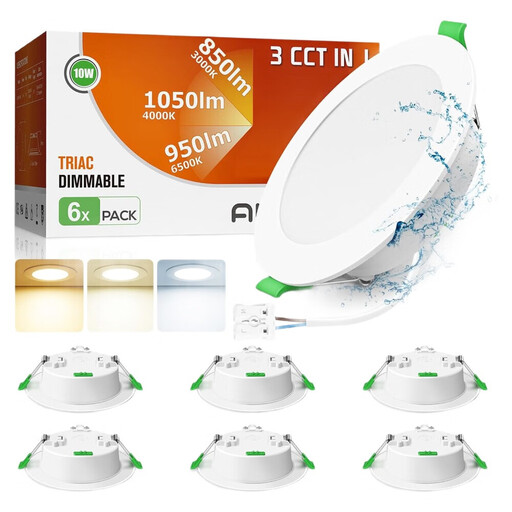
Why This Fits Their Persona: Ideal for homeowners looking for a reliable all-in-one solution to modernise a bathroom, kitchen, or living room. This set of 6 covers all essential functions and simplifies planning.
The clear IP44 certification ensures safety in damp rooms. Compatibility with trailing-edge dimmers is specified, minimising the risk of flickering. The mounting depth of 34 mm is precisely stated.
The combination of 3CCT colour change and dimmability offers maximum flexibility. With 1050 lumens per spot, it delivers high light output for bright and uniform illumination.
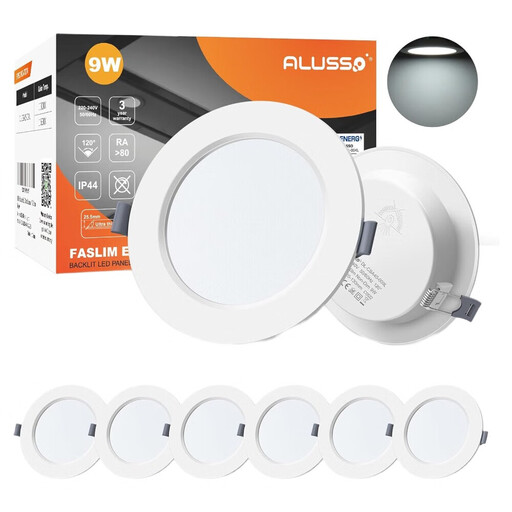
Why This Fits Their Persona: Perfect for renovators of older buildings or for suspended ceilings with extremely limited space. When every millimetre counts, this model is a practical choice.
This model directly addresses the mounting depth pitfall with an extremely slim profile of just 25.5 mm. The IP44 rating also provides the necessary safety in damp rooms.
The key advantage is the very shallow mounting depth, which allows for installation even in the most challenging conditions. The transformer-free 230V direct connection saves additional space.
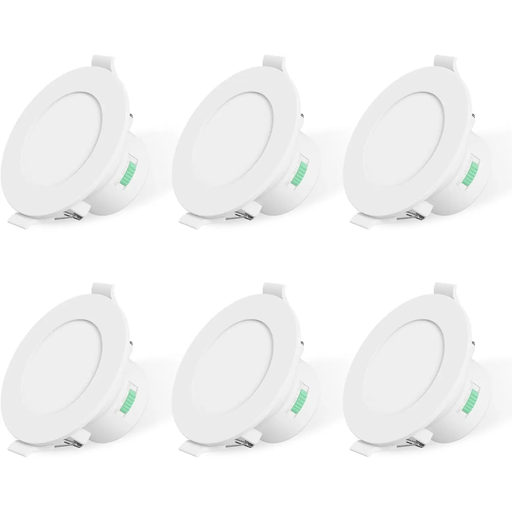
Why This Fits Their Persona: For users seeking a stylish and functional solution for LED stair lighting or as a 230V wall-recessed light. The square shape (square recessed spotlight) adds modern design accents.
With an IP44 rating, this light is also suitable for low-level installation in hallways or entrance areas. The dimmability and 3CCT colour change are clearly specified, offering full control over the lighting effect.
Unique power adjustability (0.5W / 1.5W / 2.5W) in addition to the dimming function. This allows for very fine-tuned brightness levels, ideal for orientation or accent lighting.
We have compiled a complete, real-time updated list of products that fully meet these strict selection criteria and local safety regulations.
Most modern ultra-slim LED spots are designed for trailing-edge dimmers. However, it is essential to cross-reference the product description of the light with the specifications of your dimmer. Some luminaire manufacturers provide specific recommendations for compatible dimmer models. If in doubt, the installation should be carried out by a qualified electrician to prevent flickering or damage.
3CCT stands for "3 Correlated Colour Temperatures." It means you can adjust the light colour of the luminaire. Typically, you can choose between three preset colour temperatures via a small switch on the spot's housing before installation:
A one-size-fits-all answer is difficult, as the requirement depends on the room height, the desired brightness (lumens per spot), and the use of the space. The following values can serve as a rough guide:
Calculate the total area of your room and multiply it by the desired lumen value. Divide the result by the lumen rating of a single spot to determine the required number. Plan the distribution evenly to ensure shadow-free illumination.