
Lieferung heute & morgen

Qualitätsgarantie

Willkommens-Angebote freischalten: KOSTENLOSE Lieferung | Bis zu 80 % RABATT | Kostenlose 30-Tage-JoyPlus-Testphase
App herunterladen
When upgrading ceiling lighting, slim 230V LED recessed spotlights are a popular choice. They promise a simple installation without a transformer, a modern aesthetic, and high energy efficiency. However, the market can be overwhelming, and not every product lives up to its promises. As your Joybuy Product Recommendation Officer, I'm here to help you identify the crucial features and avoid common purchasing traps.
Many buyers rely on marketing promises that lead to disappointment in practice. Pay close attention to these three points to avoid a bad investment:
To make the right choice, you should focus on objective technical data. These three criteria are essential for a solution that will satisfy you in the long run.
Space is often limited, especially in suspended ceilings or older buildings. A shallow mounting depth is not a luxury here, but a necessity.
The IP (Ingress Protection) rating indicates how well a light fixture is protected against the ingress of foreign objects and water. For damp environments, the IP44 and IP65 ratings are particularly relevant.
The lighting mood has a significant impact on well-being. Modern LED recessed spotlights offer flexible solutions in this regard.
Here are some product recommendations that represent a suitable solution for specific requirement profiles based on their technical specifications.
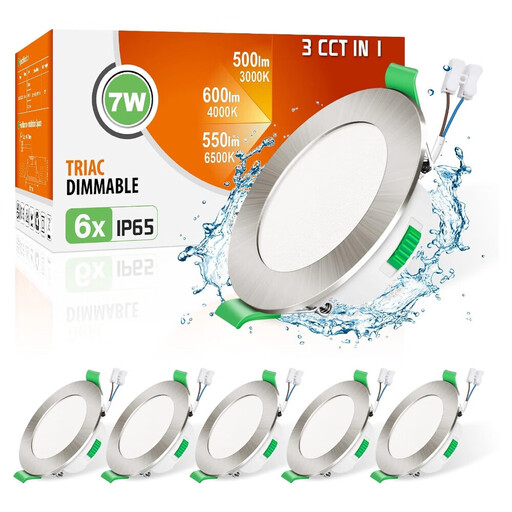
Why This Fits Their Persona: Ideal for renovators seeking a flexible and, above all, safe lighting solution for the bathroom or kitchen. The combination of dimmability, colour temperature selection, and high water protection meets demanding requirements.
With its clear IP65 rating, this spotlight is explicitly suitable for use in areas exposed to jet water (e.g., over the shower), bypassing the trap of vague "bathroom-suitable" claims.
The combination of 3CCT colour temperature switching and smooth dimming offers maximum control over the lighting atmosphere in damp rooms.

Why This Fits Their Persona: Perfect for DIY projects where ceiling space is minimal. The straightforward installation and ultra-slim design make this LED recessed light set a practical choice for renovations.
This model directly addresses the problem of limited space. With a specified mounting depth of just 25.5 mm, there are no nasty surprises during installation.
The direct connection to 230V without a transformer and the very low profile significantly simplify installation. Its IP44 rating also allows for use in kitchens and bathrooms.
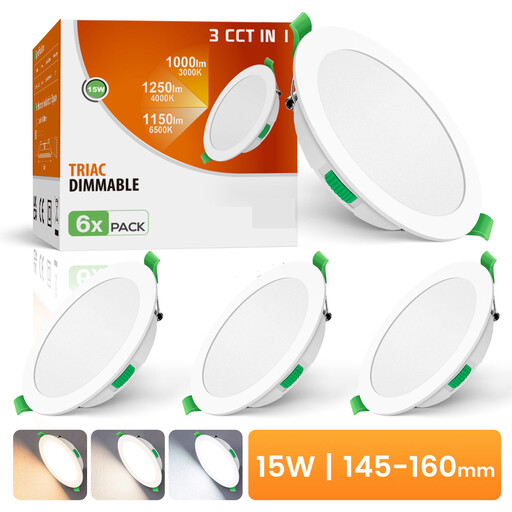
Why This Fits Their Persona: For users who refuse to compromise on brightness and flexibility. Ideal for large living spaces where lighting needs to be adapted to various situations—from bright task lighting to dimmed evening ambience.
This model bypasses the dimmer trap by being designed for trailing-edge dimmers. It is recommended to check compatibility beforehand to ensure smooth operation.
The high light output of 1200 lumens per spotlight, combined with the 3CCT function and dimmability, offers an all-in-one package for sophisticated and versatile room illumination.
We have compiled a complete, up-to-date list of products that fully meet these strict selection criteria and German safety regulations.
A general rule of thumb for ambient lighting in living spaces is one spotlight per 1.5 to 2.5 square metres. However, this heavily depends on the ceiling height, the light output (lumens) of the spotlights, and the desired brightness. For task areas like the kitchen, you should plan for a higher density or more powerful spots.
3CCT means you can set the light's colour temperature before installation, typically switching between Warm White (approx. 3000K), Neutral White (approx. 4000K), and Cool White (approx. 6500K). This gives you the flexibility to adapt the lighting mood to the specific room without having to commit to a single light colour before purchase.
Although 230V recessed spotlights do not require a separate transformer and the connection is simplified, it still involves working on the 230V mains voltage. In accordance with the regulations applicable in Germany (specifically the Low Voltage Connection Ordinance), work on the fixed electrical installation may only be carried out by a registered, qualified electrician. This is for your own safety and for insurance purposes.