
Lieferung heute & morgen

Qualitätsgarantie

Willkommens-Angebote freischalten: KOSTENLOSE Lieferung | Bis zu 80 % RABATT | Kostenlose 30-Tage-JoyPlus-Testphase
App herunterladen
LED recessed spotlights provide slimline, discreet ceiling lighting for living rooms, hallways, kitchens, offices and retail spaces. However, wattage and design are not the only factors to consider before buying. An incorrect cut-out diameter, an unsuitable IP rating or an incompatible dimmer can often lead to unnecessary costs.
This buying guide explains which technical specifications really matter and which LED recessed spotlights are suitable for different applications.
Power consumption in watts indicates how much electrical power an LED downlight requires. However, the actual brightness is determined by the luminous flux in lumens. Two 10 W lights can produce different amounts of light depending on their design, cover and luminous efficacy.
When choosing, you should therefore compare the desired luminous flux first:
The beam angle also plays a role. A 120° angle distributes light widely and is suitable for even general lighting. Other designs may be more suitable for targeted accent lighting.
An LED ceiling spotlight will not automatically fit an existing ceiling opening. The specified cut-out diameter is what matters, rather than just the outside diameter of the visible trim.
Before ordering, measure:
Slimline LED recessed lights are practical where ceiling voids are shallow. However, the light must not be covered with insulation if the manufacturer prohibits this. When connecting directly to 220–240 V or 230 V, professional electrical installation is also required.
An IP44 LED recessed spotlight is protected against solid foreign objects above a certain size and against splashing water. This may be sufficient for many bathroom areas, kitchens or covered outdoor areas, provided that local installation requirements are observed. However, IP44 does not mean that the light is suitable for direct jets of water or permanent immersion.
An IP65 LED recessed spotlight offers greater protection against dust and jets of water. For bathroom use, the installation zones, distance from water sources and the requirements specified by a qualified electrician must still be taken into account. By contrast, a light with an IP20 rating is intended exclusively for dry indoor areas.
Colour temperature is measured in Kelvin:
A 3CCT LED spotlight offers these three settings via a switch on the housing. This is practical if you want to choose the desired light colour during installation. With a smart LED recessed spotlight, the colour temperature can be changed via an app, depending on the model. Some versions also support RGBW, meaning coloured light plus white light.
“Dimmable” is not a standardised technical specification. With a dimmable LED recessed spotlight, the light and dimmer must be compatible. Check whether a leading-edge or trailing-edge dimmer is required and what dimming range is specified.
Smart models are generally controlled via Bluetooth Mesh, Wi-Fi or a separate hub. Bluetooth Mesh recessed spotlights can connect multiple lights to one another. A gateway may be required for voice control or remote access. For example, the Aigostar Smart LED recessed spotlight 18 W specifies a compatible hub for certain remote-control and voice-control functions. Depending on the model, app or local Bluetooth functions remain available without a hub.
Aluminium can support heat dissipation, while plastic housings keep weight low. More important than the material alone are the manufacturer’s specific details regarding installation depth, operating temperature, luminous flux and service life.
Many of the models listed here specify a service life of 25,000 to 30,000 hours. This is a manufacturer’s stated value and depends, among other things, on ambient temperature, switching frequency and correct installation. As a rule, the light should be cleaned with a dry, soft cloth.
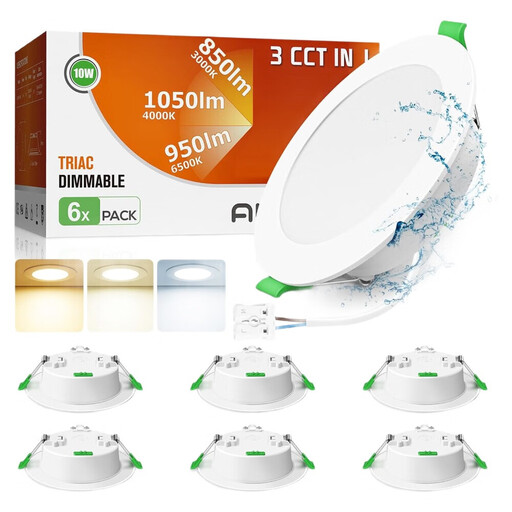
Why this product suits this profile: The set offers 10 W, 1,050 lm, 3CCT selection and a 90–100 mm cut-out for common smaller recessed openings.
The specifications for 230 V, the ceiling opening, 3CCT and dimmability are listed separately. This makes it easier to check compatibility before buying.
IP44, a 10–100% dimming range with a compatible dimmer and a specified depth of 34 mm.
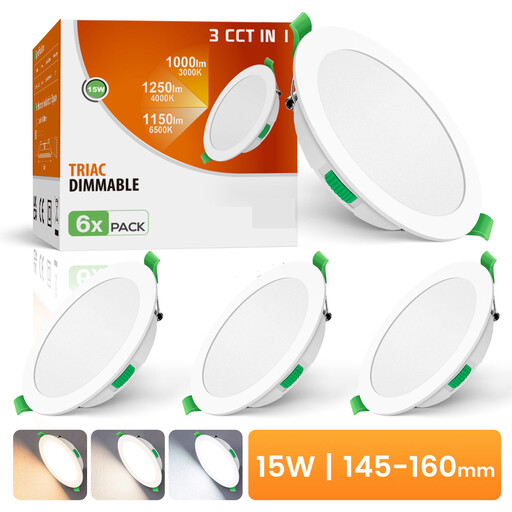
Why this product suits this profile: With 1,200 lm, a 120° beam angle and a set of six lights, this version is suitable for even room lighting.
The 145–160 mm cut-out and dimmer requirements are clearly specified. IP44 is described as protection against splashing water, not as protection against direct water jets.
3CCT switching, 10–100% dimmability and direct 230 V connection.
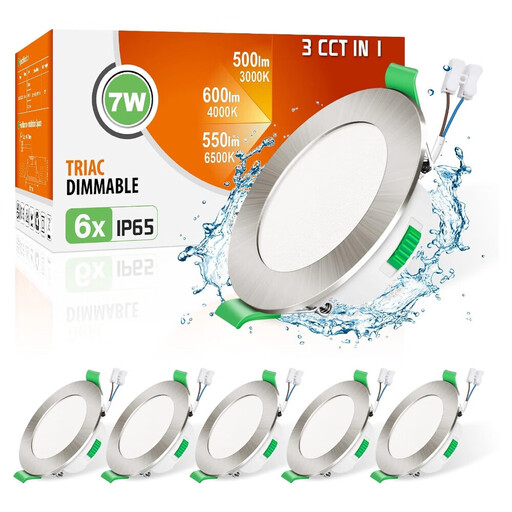
Why this product suits this profile: The specified depth of 29 mm and the 67–75 mm cut-out make planning easier where ceiling voids are tight. IP65 expands the range of possible applications in more humid areas.
The IP65 rating is clearly specified, but it does not replace checking the bathroom zone. The small installation diameter must also match the existing opening.
7 W, 500–600 lm according to the product specification, 3CCT and direct AC 230 V connection.
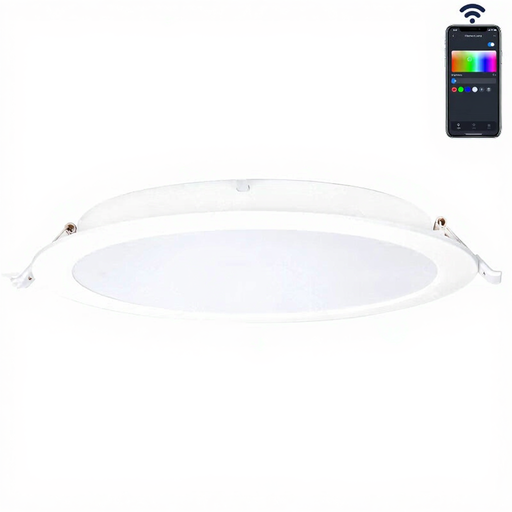
Why this product suits this profile: Bluetooth Mesh, app control, dimmability and RGB+2700–6500 K offer multiple adjustment options for living spaces or commercial areas.
The IP20 rating clearly limits use to dry indoor areas. A gateway may be required for app and voice control, depending on the function.
1,760 lm according to the product specification, 18 W, a 120° beam angle and Bluetooth Mesh networking.
We have put together a complete, regularly updated list of products that fully meet these strict selection criteria and the safety regulations applicable in the EU.
Models for 220–240 V are often connected directly to the mains. Before installation, the circuit must be switched off at the fuse box and confirmed to be de-energised. Work on fixed electrical installations in Germany should be carried out by a qualified electrician.
Depending on the model, the service life may be specified as 25,000 or 30,000 hours, for example. These are manufacturer’s stated values. Heat, frequent switching, poor ventilation and incorrect installation can affect the actual service life.
Running costs depend on the power rating, daily operating time and electricity tariff. With the same usage time, a 6 W model uses less electrical energy than an 18 W model. The calculation is: power in kilowatts × operating hours × price per kilowatt-hour. It is therefore important to compare not only the purchase price, but also the luminous flux and the number of lights required.