
Lieferung heute & morgen

Qualitätsgarantie

Willkommens-Angebote freischalten: KOSTENLOSE Lieferung | Bis zu 80 % RABATT | Kostenlose 30-Tage-JoyPlus-Testphase
App herunterladen
LED recessed spotlights provide even ceiling lighting and are suitable for living rooms, bedrooms, kitchens and bathrooms. But wattage and design aren’t the only things to consider before you buy. Cut-out diameter, fitting depth, colour temperature, dimmability and IP rating all need to suit your existing ceiling and the intended location.
Many disappointing purchases come down to three common pitfalls:
Measure the existing ceiling cut-out, not just the visible outer ring. Measurements such as 90–100 mm, 95–110 mm, 115–135 mm or 145–160 mm usually refer to the required cut-out size.
Fitting depth matters too:
There should also be enough space around the LED module for heat to dissipate. Insulation must not be placed directly on the light unless the installation instructions allow it.
Colour temperature is measured in kelvins:
A 3CCT LED spotlight with 3000, 4000 and 6500 K settings gives you a choice using a switch on the housing. You’ll usually need to select your preferred colour temperature before installation. Also check the light output in lumens and the colour rendering index (CRI or Ra). A higher lumen rating doesn’t automatically mean the light will be more comfortable or better suited to your needs.
Many 230 V LED recessed spotlights connect directly to a 220–240 V AC supply and don’t need a separate transformer. This makes planning easier, but doesn’t replace the need for a proper electrical installation. Work on a 230 V supply must be carried out by a qualified electrician.
For an IP44 recessed spotlight:
If you’re looking for dimmable recessed spotlights, check which dimming method is compatible before you buy. A non-dimmable model won’t necessarily work with an existing dimmer.
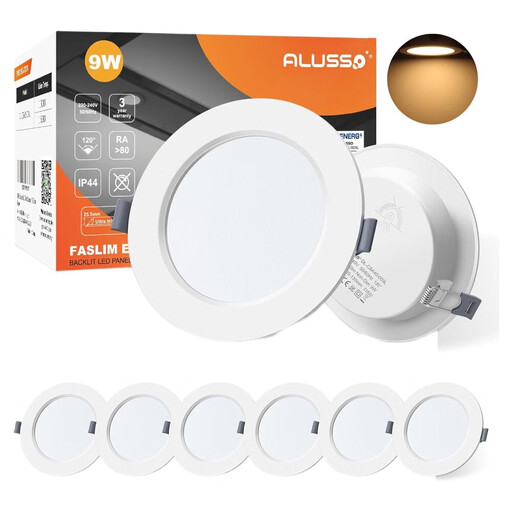
Why this product suits this profile: This six-piece set is ideal for renovations where you’re replacing several matching lights. It provides warm white light at 3000 K and, according to the product details, is designed for ceiling cut-outs measuring 115–135 mm.
The product details clearly specify the voltage, cut-out size and IP rating. They also state explicitly that this model isn’t dimmable.
230 V connection, 690 lm per light, 3000 K and IP44, according to the product description.
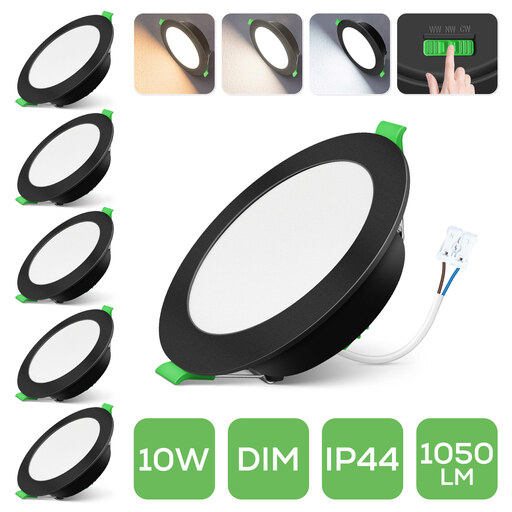
Why this product suits this profile: This model combines three selectable colour temperatures with a stated dimming range of 10–100 %. Its slim profile, with a depth of 34 mm, makes it a good option for many modern ceiling constructions.
The product details list the required ceiling cut-out, voltage and compatible dimmer separately. This makes it easier to check everything before you buy.
10 W, 1050 lm, 3000/4000/6500 K, 230 V and IP44, according to the manufacturer.
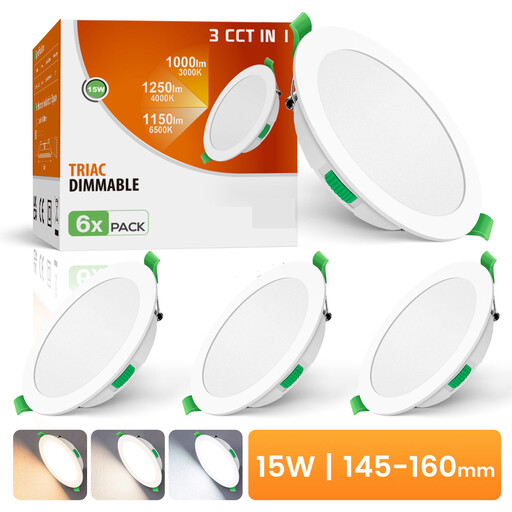
Why this product suits this profile: With 1200 lm per light, a choice of 3CCT settings and a stated cut-out diameter of 145–160 mm, this set is suitable for larger rooms or bright general lighting.
The larger cut-out range, 32 mm fitting height and IP44 rating are all clearly stated. You’ll still need to check that they suit your existing ceiling before buying.
15 W, 1200 lm, 3000/4000/6500 K, dimming from 10–100 % and a 230 V connection, according to the product details.
We’ve put together a complete, regularly updated list of products that meet these strict selection criteria and the safety regulations in force across the EU.
When installing LED ceiling lights and recessed spotlights, the circuit must be switched off and secured against being switched back on. A qualified electrician should be involved when installing 230 V models. Before buying, check:
Running costs depend on the wattage, daily usage and your electricity tariff. A 10 W light used for five hours a day consumes a calculated 0.05 kWh per day. To work out the cost, multiply this figure by the number of lights, the number of days they’re used and your price per kilowatt-hour.
IP44 recessed spotlights are suitable for many areas of a bathroom, provided they’re installed outside areas exposed to direct water and in line with the applicable installation zones. IP44 doesn’t protect against immersion or powerful water jets. A qualified electrician should carry out the installation.
The stated lifespan varies by model. The product details mentioned here, for example, give lifespans of 25,000 or 30,000 hours. These are manufacturer figures and depend on factors including heat dissipation, mains conditions and operating time. Good ventilation, in line with the installation instructions, helps the light operate as intended.
No. The dimmer must be compatible with the LED driver and the specified dimming method. Check the manufacturer’s guidance and the permitted dimming range. If you’re unsure, ask a qualified electrician to check that your existing dimmer will work with the light before installation.