
Lieferung heute & morgen

Qualitätsgarantie

Willkommens-Angebote freischalten: KOSTENLOSE Lieferung | Bis zu 80 % RABATT | Kostenlose 30-Tage-JoyPlus-Testphase
App herunterladen
LED recessed spotlights may seem straightforward at first: choose the right diameter, your preferred light colour and an attractive price, and you’re all set. In practice, however, incorrect cut-out measurements, unsuitable IP ratings or incompatible dimmers can lead to unnecessary costs.
This guide explains what homeowners, renovators and DIYers in Germany should consider before buying. We focus on installation size, electrical compatibility, brightness, colour temperature and intended use.
An LED recessed spotlight might have an external diameter of 145 mm, for example, but require a ceiling cut-out of 115 to 135 mm. It’s not just the visible front that matters: you also need to check the size of the existing opening in your ceiling.
Before you buy, check:
If you have low ceilings, ultra-slim LED ceiling lights with an installation depth of around 25.5 to 34 mm may be a suitable option.
An IP44 LED recessed spotlight is protected against solid objects larger than 1 mm and splashing water from various directions. This may be suitable for many areas of the bathroom and kitchen, but it doesn’t protect against direct jets of water or immersion.
For particularly damp areas, a model with a higher IP rating, such as IP65, may offer greater protection by design. However, its exact position in the bathroom must still comply with the applicable installation regulations. A qualified electrician should carry out any work involving the mains supply.
With dimmable LED recessed spotlights, the light and dimmer need to be technically compatible. Leading-edge or trailing-edge dimmers are commonly used, and they must be specifically suitable for LEDs. Otherwise, you may experience flickering, buzzing or a limited dimming range.
Colour temperature is also worth considering. A 3CCT LED spotlight usually lets you choose between warm white, neutral white and cool white, for example 3000 K, 4000 K and 6500 K. Depending on the model, you can switch between settings using a switch on the light fitting. Decide which setting you want before installation.
230 V LED spotlights connect directly to the German mains supply and don’t need a separate transformer. This makes planning simpler, but doesn’t replace the need for professional electrical installation.
Low-voltage models operating at 12 to 24 V, on the other hand, need a suitable transformer, which isn’t always included. A 12–24 V spotlight with a 55–58 mm cut-out, for example, may be used in furniture, shelving, kitchens, motorhomes or caravans, but must not be connected directly to 230 V.
Brightness is measured in lumens. Watts, by contrast, mainly indicate power consumption. So a 9 W spotlight with 690 or 720 lumens isn’t necessarily equivalent to every other 9 W model. Beam angle, ceiling height, wall colour and the number of lights also affect the result.
For even general lighting, several LED ceiling spotlights with a wide beam are often a better choice than a few very bright points of light. So it’s worth considering the lumen and beam-angle specifications together.
A smart GU10 LED spotlight or an integrated RGB+CCT system can be controlled via an app, Bluetooth Mesh or a voice assistant. These features require a compatible app and sometimes a gateway. Smart models with an IP20 rating are designed for dry indoor spaces only.
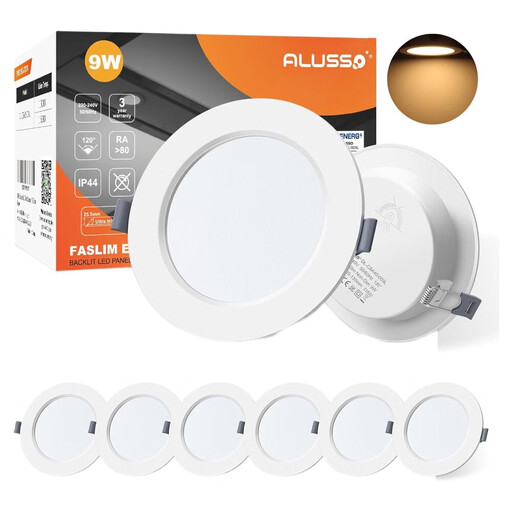
Why this product suits this type of buyer: This set of six lights is designed to provide consistent general lighting in a bathroom, kitchen, hallway or utility room. It runs directly on 220–240 V and doesn’t need a transformer.
The specified ceiling cut-out is 115–135 mm. It’s also clearly stated that the lights aren’t dimmable.
6 W, 690 lm, 3000 K, IP44, 25.5 mm installation depth and direct 230 V connection.
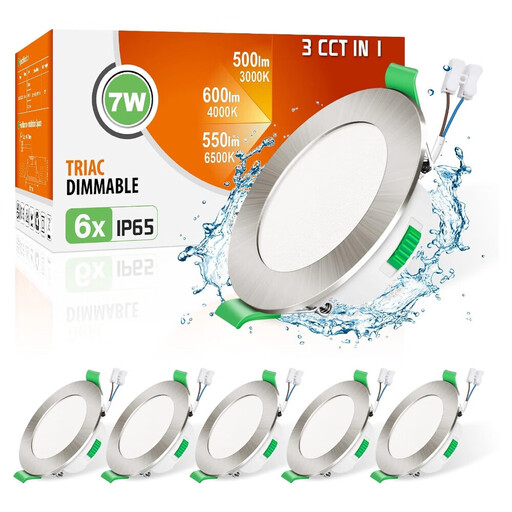
Why this product suits this type of buyer: The combination of 3CCT settings, dimmability and IP65 is ideal for buyers who want to compare specifications carefully for different rooms.
The IP65 rating and required installation opening of 67–75 mm are clearly specified. Dimming requires a compatible trailing-edge dimmer.
7 W, up to 600 lm, 3000/4000/6500 K, dimmable from 10–100% and 29 mm installation depth.
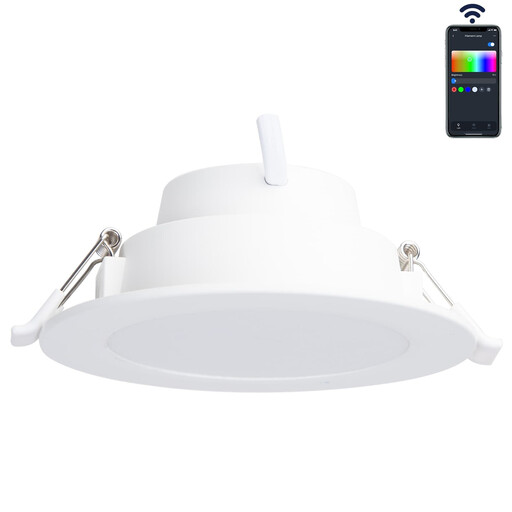
Why this product suits this type of buyer: This model is suited to indoor spaces where app and voice control, along with adjustable light colours, matter more than conventional wall dimming.
The technical limitations are clear: IP20, a 120–130 mm cut-out and no use with an external wall dimmer.
780 lm, 9 W, RGB+CCT from 2700–6500 K, Bluetooth Mesh and app control.
For façades, garages or driveways, you’ll need LED outdoor floodlights with a suitable IP rating and mains voltage. A product rated at 120 V, as some international outdoor lights are, isn’t automatically suitable for German 230 V installations.
H7 LED car bulbs aren’t ceiling spotlights either. Before buying a model such as the OSRAM NIGHT BREAKER LED SPEED H7, check the vehicle type, lighting function and applicable approval against the compatibility list.
We’ve put together a complete, regularly updated list of products that meet these strict selection criteria and fully comply with the safety regulations in force in the EU.
Many people choose neutral white light at around 4000 K for bathrooms, as it gives a crisp, balanced appearance. Warm white at 3000 K can create a cosier atmosphere. The right choice ultimately depends on your bathroom’s design and your personal needs.
Product specifications often quote a lifespan of 25,000 to 30,000 hours. This figure depends on factors including operating temperature, ventilation, mains quality and daily usage. Good heat dissipation through aluminium or suitable housing materials can also be important.
LED lights often use less power than older halogen models for a comparable amount of light. However, your actual running costs depend on the wattage, daily usage, number of spotlights and current electricity tariff. So treat ‘halogen equivalent’ as a rough guide only.