
Lieferung heute & morgen

Qualitätsgarantie

Willkommens-Angebote freischalten: KOSTENLOSE Lieferung | Bis zu 80 % RABATT | Kostenlose 30-Tage-JoyPlus-Testphase
App herunterladen
LED recessed spotlights are suitable for many rooms: as even ambient lighting in the living room, as a functional LED ceiling spotlight in the kitchen or as a recessed spotlight in the bathroom. However, it is worth taking a close look at the technical specifications before buying. A low wattage alone says little about the actual brightness, and the description ‘waterproof’ is no substitute for checking the IP rating.
‘Ultra-flat’ does not automatically mean that a light will fit into every ceiling. The decisive factors are external diameter, required ceiling cut-out and installation depth. A model with an installation depth of 25.5 mm may be suitable for a low suspended ceiling, but could require a larger cut-out than a traditional spotlight.
Existing openings should be measured precisely before ordering. This is particularly important when replacing old halogen lights, as the existing cut-out is not always compatible with new LED recessed spotlights.
An IP44 LED recessed spotlight is protected against solid foreign objects measuring 1 mm or more, as well as splashing water from various directions. This makes it suitable for many bathroom areas and kitchens, provided that the specific installation zone and local requirements are taken into account. Direct jets of water and immersion are not covered.
For areas exposed to more moisture or particularly demanding conditions, an IP65 LED recessed spotlight may be more suitable. IP65 means complete protection against dust and protection against water jets. The light must still be approved for the intended installation location. A smart spotlight with IP20, on the other hand, is intended exclusively for dry indoor areas.
With dimmable LED recessed spotlights, the light and dimmer must be compatible. The product information should clearly state which type of dimmer is required, such as a compatible phase-cut or trailing-edge dimmer. An unsuitable dimmer can cause flickering, buzzing or a limited brightness range.
Wattage describes power consumption, not brightness directly. For comparison purposes, luminous flux in lumens is more meaningful. According to the product specifications, a 10 W model with 1,050 lm produces significantly more light than a 6 W model with 430 lm. The number of lights required also depends on the room size, ceiling height, beam angle and desired illuminance.
For even room lighting, several LED recessed spotlight sets of 6 are often more practical than a single bright spotlight. For kitchen worktops, the position of the lights should be planned so that your own body creates as little shadow as possible.
Colour temperature is measured in kelvin:
An LED 3CCT ceiling spotlight lets you choose between several light colours, usually warm white, neutral white and cool white. With the products mentioned, the setting is changed using a switch on the light housing. Important: the desired colour temperature should be selected before installation if the switch will be difficult to reach afterwards.
230 V LED recessed spotlights are connected directly to the 220–240 V mains and do not require a separate transformer. Mains connection work in Germany must be carried out in accordance with the applicable electrical regulations; if you are unsure, you should consult a qualified electrician.
12–24 V lights are a different product group. They require a suitable transformer, which is often not included in the delivery. They may therefore be suitable for furniture, cupboards, shelves, kitchen cabinets or vehicles. A 12–24 V spotlight must never be connected directly to 230 V.
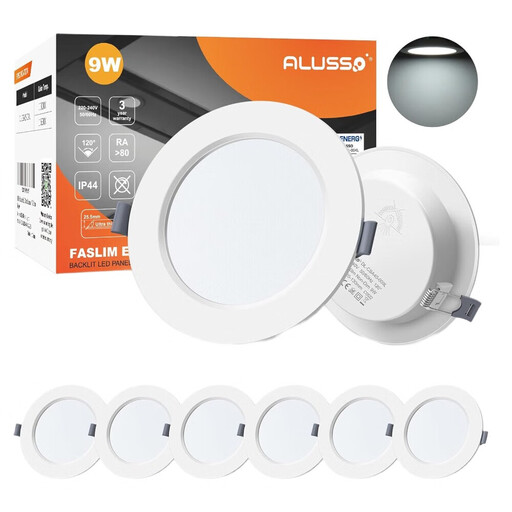
Why this product suits this profile: This set is ideal for buyers who need several lights for the bathroom, kitchen or living area and prefer a slim design.
The specifications state a ceiling cut-out of 115–135 mm, an installation depth of 25.5 mm and a direct 230 V connection. This makes it easier to check suitability before buying.
9 W, 720 lm per light, IP44 and 6 lights per set. The colour temperature is fixed at 6,500 K; dimming is not supported.
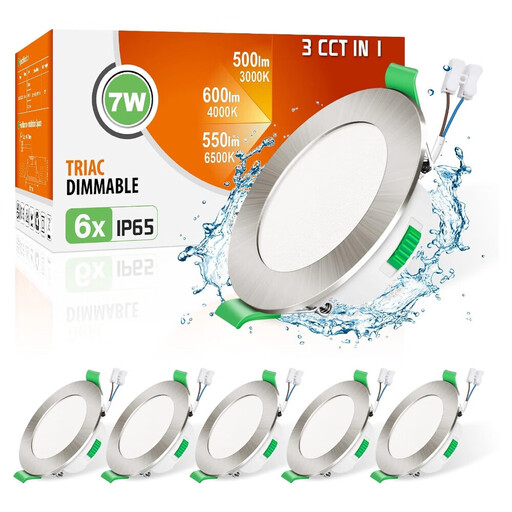
Why this product suits this profile: The combination of IP65 protection, 3CCT selection and dimming is aimed at buyers with specific requirements for damp areas and lighting control.
The IP65 rating is clearly stated rather than being described merely as general suitability for damp areas. A compatible trailing-edge dimmer is required for dimming.
7 W, 500–600 lm according to the product specifications, 3CCT, dimming range of 10–100%, 29 mm installation depth and direct 230 V connection.
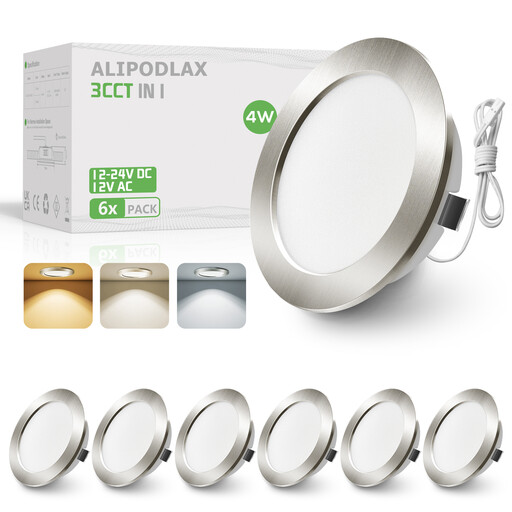
Why this product suits this profile: With a compact design and a 55–58 mm cut-out, this light is suitable for furniture, shelving, kitchen cabinets, caravans and low-voltage installations.
The required voltage of 12–24 V and the separately required transformer are clearly stated. Direct connection to 230 V is not permitted.
14.5 mm overall height, 270 lm, 3CCT selection, IP44 and a 55–58 mm ceiling cut-out. The transformer is not included.
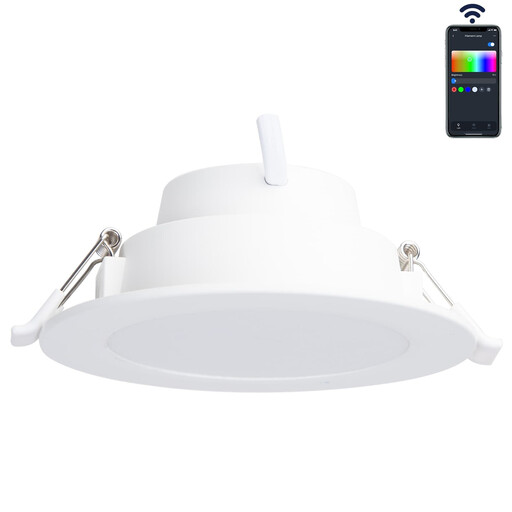
Why this product suits this profile: This light is designed for users who want to adjust colour temperature, RGB colours and brightness via an app and, optionally, voice control.
The IP20 rating is clearly stated. This means the light can be planned for dry rooms from the outset, but not for bathrooms or other damp areas.
780 lm, 2,700–6,500 K, RGB+CCT, Bluetooth Mesh, app-controlled dimming and a ceiling cut-out of 120–130 mm. According to the product specifications, an external wall dimmer is not supported.
We have put together a complete, regularly updated list of products that fully meet these strict selection criteria and the safety regulations applicable in the EU.
Before installation, check the circuit, ceiling cut-out and connection type. With 230 V lights, the power supply must be switched off at the circuit breaker. Electrical work on a fixed mains connection should be carried out by a qualified professional.
For a long service life, adequate heat dissipation and correct installation are essential. Insulation material must not cover the light if the manufacturer prohibits this. The light should generally be cleaned with a soft, dry cloth. Direct jets of water and harsh cleaning products should be avoided.
This depends on the room size, luminous flux per light, ceiling height and intended use. For even illumination, several spotlights should be spaced out appropriately. In a kitchen or home office, additional targeted lighting for the work surface may be needed.
Depending on the version, the product specifications for the models featured state an average lifespan of approximately 25,000 to 30,000 operating hours. The actual service life is influenced by factors including heat generation, switching frequency, mains quality and correct installation.
LED lights generally require less electrical power than older halogen models for a comparable luminous flux. For a realistic assessment, wattage, lumens and daily operating time should be considered together. The energy efficiency class of the specific product, such as D, E or F, should also be taken into account when making your choice.