
Lieferung heute & morgen

Qualitätsgarantie

Willkommens-Angebote freischalten: KOSTENLOSE Lieferung | Bis zu 80 % RABATT | Kostenlose 30-Tage-JoyPlus-Testphase
App herunterladen
LED recessed spotlights provide discreet, low-profile lighting for living rooms, kitchens, hallways and bathrooms. However, when buying, wattage and a low price are not the only deciding factors. The key considerations are cut-out diameter, voltage, light colour, IP rating and dimmability.
If these specifications are not checked against the existing ceiling cut-outs, you risk additional work, incompatible connections or unsuitable lighting. The following advice helps private customers, renovators, interior designers and electricians compare LED recessed spotlights objectively.
An LED recessed spotlight usually has two different measurements:
For example, a spotlight with an outer diameter of 145 mm may require a ceiling cut-out of 115–135 mm or 145–160 mm. These measurements are not interchangeable. Before ordering, check the existing opening with a tape measure or vernier callipers.
The IP rating is shown by the abbreviation IP followed by two digits. An IP44 LED recessed spotlight is protected against solid foreign objects measuring 1 mm or more, as well as splashing water. An IP65 LED recessed spotlight also offers protection against dust and can withstand water jets. Neither rating automatically permits use in every area of a bathroom or outdoors.
Depending on the installation location, IP44 may be suitable for areas exposed to occasional splashes. IP65 may be the better choice for zones with higher moisture levels. The specific electrical installation requirements and the classification of bathroom protection zones must be taken into account.
A 3CCT LED recessed spotlight lets you choose between several colour temperatures, such as:
However, this does not indicate whether the spotlight is dimmable. With dimmable LED recessed spotlights, the phase-angle or trailing-edge dimmer being used must also be compatible. Otherwise, flickering, humming or a limited dimming range may occur.
Flat LED recessed spotlights are particularly useful for low ceilings or restricted cavities. Models with an installation depth of around 25–34 mm require less space than deeper lights. Even so, sufficient room must be left behind the light for cables, connection terminals and heat dissipation. Thermal insulation must not be placed directly on the light without first checking that this is permitted.
A 230 V recessed spotlight is connected directly to the mains and does not require a separate transformer. Installation at mains voltage must be carried out by a qualified electrician.
By contrast, 12–24-volt models are intended for motorhomes, boats, furniture or special low-voltage applications. A suitable transformer may be required for use in a household. A low-voltage spotlight must never be connected directly to 230 V.
Wattage describes power consumption, not brightness alone. For comparison purposes, luminous flux in lumens is more meaningful. For example, a 10 W model producing 1050 lm provides different lighting performance from a 6 W spotlight producing 430 lm.
Warm white light is often chosen for living rooms and bedrooms. Neutral white can be a practical choice for kitchens, hallways or work areas. Cool white at 6500 K appears noticeably whiter and should suit both the room design and its intended use. The beam angle also affects the result: 120° spreads the light widely and is suitable for even general lighting.
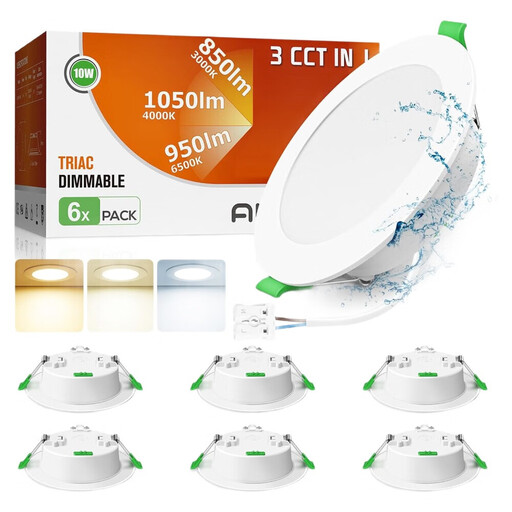
Why this product suits this profile: These six LED ceiling spotlights connect directly to 230 V, offer three selectable colour temperatures and are designed for cut-outs measuring 90–100 mm.
The cut-out size, voltage and IP rating are clearly listed separately. IP44 is not presented as protection against direct water jets.
1050 lm per light, 3000/4000/6500 K, dimmable from 10–100% with a compatible dimmer.
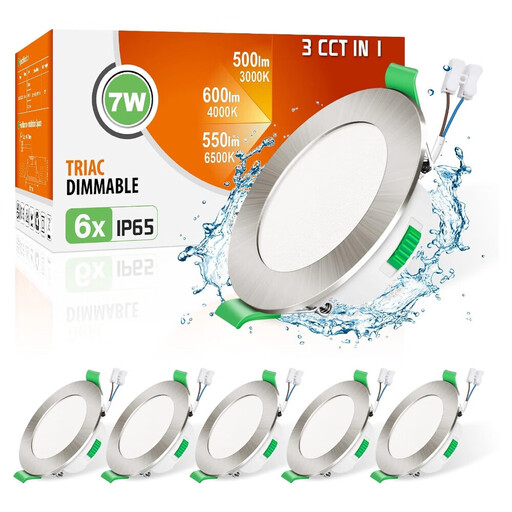
Why this product suits this profile: This model combines a 29 mm installation height with IP65 protection, three colour temperatures and a direct 230 V connection.
The IP65 rating is clearly specified. The required cut-out of 67–75 mm prevents confusion with the visible diameter of the light.
Dimmable from 10–100% with a compatible dimmer, 500/550/600 lm depending on colour temperature, 3-year warranty according to the product information.

Why this product suits this profile: This low-voltage version is designed for camper vans, motorhomes, boats and compact furniture installations.
The required voltage of 12–24 V DC is clearly stated. A separate transformer is required for 12 V AC.
400 lm, 3CCT selection, 55–68 mm cut-out and a 29 mm profile for restricted installation spaces.
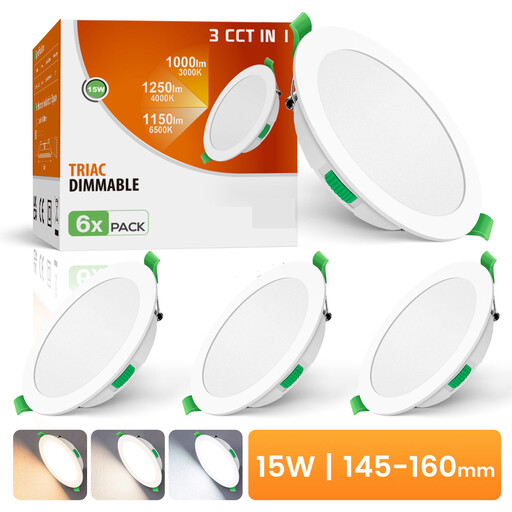
Why this product suits this profile: The combination of a 145–160 mm cut-out and 1200 lm per light is suitable for larger existing openings and widely distributed room lighting.
The adjustable colour temperature means you do not have to commit to an unsuitable light colour before installation. IP44 remains limited to protection against splashing water.
120° beam angle, 3000/4000/6500 K and dimmability from 10–100% with a compatible phase-control dimmer.
We have put together a complete, regularly updated list of products that fully meet these strict selection criteria and the safety regulations applicable in the EU.
For all 230 V LED recessed spotlights, the circuit must be switched off at the circuit breaker before installation and secured against being switched on again. The connection should be carried out by a qualified electrician in accordance with the applicable electrical regulations.
Check the following points before fitting:
An LED recessed spotlight with a stated service life of 25,000 or 30,000 hours achieves this figure under specified operating conditions. High ambient temperatures, frequent switching, poor ventilation or unsuitable dimmers can affect the actual service life. The lights should be cleaned with a dry, soft cloth.
This depends on the IP rating and the position within the room. IP44 LED recessed spotlights are protected against splashing water, while IP65 provides a higher level of protection against dust and water jets. The light must still be approved for the intended protection zone and installed correctly.
There is no one-size-fits-all number. Room size, luminous flux per spotlight, beam angle, ceiling height and intended use are all important factors. For even lighting, the spotlights should be planned with sufficient spacing from the walls and from one another. A closer arrangement may be useful above work surfaces.
Running costs depend on the power rating, daily operating time and electricity tariff. The simple calculation is: power in kilowatts × operating hours × electricity price. For example, a 6 W spotlight uses 0.06 kWh when operated for ten hours. With several lights and daily use, consumption increases accordingly.