
Lieferung heute & morgen

Qualitätsgarantie

Willkommens-Angebote freischalten: KOSTENLOSE Lieferung | Bis zu 80 % RABATT | Kostenlose 30-Tage-JoyPlus-Testphase
App herunterladen
LED recessed spotlights provide flush, space-saving lighting for hallways, kitchens, living rooms, bedrooms and bathrooms. But there’s more to consider before buying than just wattage and design. The wrong cut-out size, an unsuitable IP rating or an incompatible dimmer can make installation more difficult and lead to extra costs.
This buying guide helps homeowners, tenants, renovators and electricians assess technical specifications and choose suitable models for different rooms.
A slim LED recessed spotlight can be useful where ceiling voids are shallow. What matters, though, is the actual installation depth, including the space needed for connections. Measurements such as 25.5 mm or 32 mm don’t always cover the full space required above the ceiling. You’ll also need to allow for cables, connectors and, where necessary, a driver.
An IP44 LED recessed spotlight is protected against solid objects and splashing water from different directions. That doesn’t mean it’s suitable for direct water jets, immersion or every installation zone in a bathroom. You’ll also need to follow the applicable bathroom installation zones and clearance requirements. Electrical work should be carried out by a suitably qualified person.
A model described as “dimmable” will often need a compatible leading-edge or trailing-edge dimmer. Smart LED recessed spotlights, on the other hand, may only be dimmable via an app or gateway. An external wall dimmer may be specifically unsuitable for these products. Before buying, check that the light, dimmer, app and any hub you need will work together.
The cut-out size is the diameter of the hole in the ceiling, not the visible outside diameter of the light. Depending on the model, you may see sizes such as:
Measure existing openings accurately. Retaining springs can’t reliably compensate for a hole that’s too large. If the opening is too small, the recessed spotlight won’t sit flush.
An 230 V LED recessed light connects directly to the mains and normally doesn’t need a separate transformer. This can simplify planning, but it still requires a professionally installed mains connection.
12–24-volt models are suitable for uses such as furniture, shelving, kitchen cabinets, motorhomes or low-voltage installations. They need a suitable transformer. According to the product specifications, one isn’t included with the 4-watt model with 3CCT function. This model must not be connected directly to 230 V.
The lumen figure describes the light output and is a more useful guide to brightness than wattage. Depending on the model, a 9-watt spotlight might produce 720 or 780 lumens, for example. For effective lighting design, consider the room size, beam angle, ceiling height and number of lights together.
Colour temperatures typically fall into these ranges:
A 3CCT LED spotlight lets you choose between warm white, neutral white and cool white. Some smart models can be adjusted between 2700 K and 6500 K. Also check whether the lights are controlled by a switch, app, Bluetooth Mesh or an additional hub.
The models below differ in their IP rating, voltage, cut-out size, lighting controls and colour temperature. The details are based on the respective product specifications.
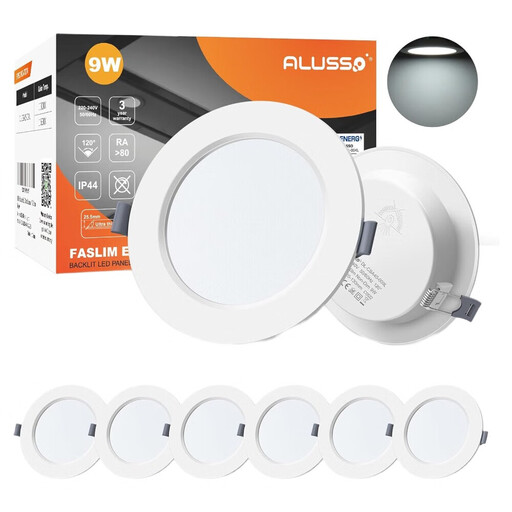
Why this product suits this profile: This set includes six lights that connect directly to 220–240 V, with a 9 W output, 720 lumens and an installation depth of 25.5 mm. That makes it a practical option for standard renovation projects with limited ceiling space.
The specified cut-out size of 115–135 mm and installation depth of 25.5 mm make it easier to check measurements before fitting. However, the light isn’t dimmable.
Direct 230-volt connection, set of 6, IP44 rating and a stated lifespan of over 30,000 hours.
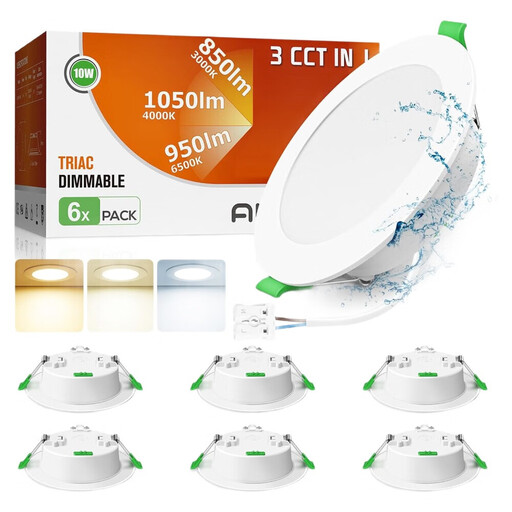
Why this product suits this profile: This spotlight combines 1050 lumens with three selectable colour temperatures and a stated dimming range of 10 to 100 per cent. You can tailor the lighting to different rooms and times of day.
The required cut-out size of 90–100 mm is clearly stated. You’ll still need a compatible trailing-edge dimmer to use the dimming function.
Aluminium and polycarbonate construction, 230-volt connection, 3CCT and IP44 rating.
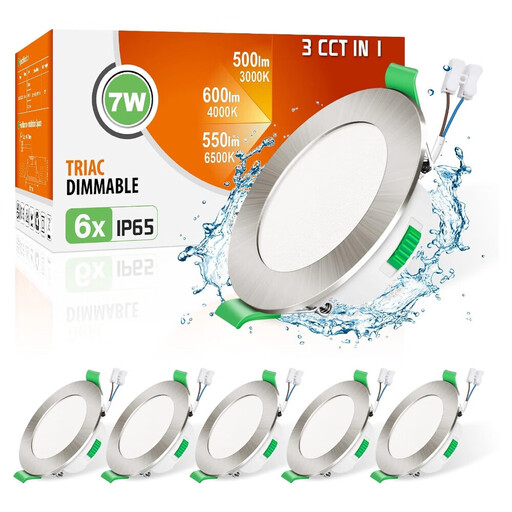
Why this product suits this profile: With its stated IP65 rating, three colour temperatures and dimming range of 10 to 100 per cent, this model is worth considering where splash and dust protection and flexible lighting controls are important.
The product specifications give a cut-out size of 67–75 mm and an installation depth of 29 mm, making it easier to plan the fitting accurately in advance.
IP65, 3CCT, 230-volt connection and an aluminium housing with a polycarbonate cover.
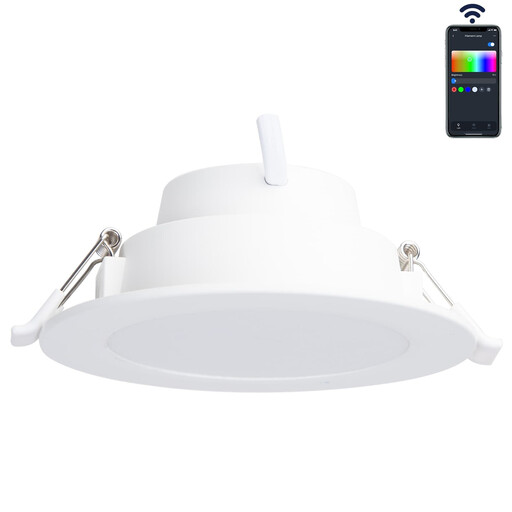
Why this product suits this profile: This model uses Bluetooth Mesh, offers RGB and 2700–6500 K, and can be controlled via a compatible app, a gateway and, in some cases, voice control.
With an IP20 rating, this light is intended for dry indoor spaces only and isn’t suitable for bathrooms. Dimming is controlled via the app, not an external wall dimmer.
RGB+CCT control, Bluetooth Mesh, 780 lumens and a cut-out size of 120–130 mm.
We’ve put together a complete, regularly updated list of products that meet these strict selection criteria and fully comply with the safety regulations in force in the EU.
Before fitting, switch off the circuit at the circuit breaker and check that the power is off. 230-volt lights must be installed professionally in accordance with the applicable German regulations. Also make sure you check:
These lights can usually be cleaned with a soft, dry cloth. Avoid water jets, harsh cleaning products and opening the LED module yourself.
That depends on the room size, ceiling height, beam angle and number of lights. For a reliable lighting plan, you need to consider the total light output of all the recessed spotlights. A single lumen figure isn’t a substitute for planning the lighting for the room.
IP44 may be suitable for certain dry areas or areas exposed to only light splashing. However, the IP rating alone doesn’t determine where a light can be installed. You’ll need to take installation zones, clearances and the manufacturer’s instructions into account.
Running costs depend on the wattage, daily usage and electricity tariff. The simple calculation is: wattage ÷ 1000 × operating hours × electricity price. For example, a 9-watt spotlight used for ten hours consumes 0.09 kWh. For sets, add together the wattage of each individual light.