
Lieferung heute & morgen

Qualitätsgarantie

Willkommens-Angebote freischalten: KOSTENLOSE Lieferung | Bis zu 80 % RABATT | Kostenlose 30-Tage-JoyPlus-Testphase
App herunterladen
LED recessed spotlights provide even ceiling lighting, take up little space and work well in a wide range of homes. But there’s more to choosing the right ones than wattage and design. Incorrect measurements, an unsuitable IP rating or an incompatible dimmer can lead to unnecessary returns and extra installation work.
This buying guide explains which technical details matter when choosing LED ceiling spotlights, LED recessed spotlights and slim LED downlights.
An LED recessed spotlight might have an external diameter of 145 mm, for example, but need a ceiling cut-out of just 115 to 135 mm. If you’re replacing existing lights, the key measurement is the recessed fitting size or cut-out diameter – not just the visible diameter.
Before ordering, measure:
IP44 LED spotlights are protected against solid objects above a certain size and splashes of water from different directions. This makes them suitable for many areas of bathrooms, kitchens and utility rooms, but not necessarily for direct jets of water or installation inside a shower.
For damper environments, a model with IP65 may be more suitable. The specific installation zone, manufacturer’s instructions and applicable installation regulations must still be taken into account.
With dimmable LED recessed spotlights, the dimmer must be compatible with the light. For example, a product may offer dimming from 10 to 100 per cent when used with a compatible trailing-edge dimmer. Smart lights, on the other hand, are often controlled exclusively via an app, Bluetooth Mesh or Wi-Fi, and aren’t designed for a conventional wall dimmer.
Slim LED recessed spotlights are suitable for low ceilings or renovations where ceiling void space is limited. Models with a recess depth of 25.5 to 34 mm may work well in these situations. The cut-out size still needs to be an exact match. A model requiring an opening of 120–130 mm won’t fit a 90–100 mm cut-out.
Many 230 V LED recessed spotlights connect directly to a 220–240 V AC mains supply and don’t need a separate transformer. Mains-voltage lights should be installed by a qualified electrician in accordance with the applicable regulations.
Smaller recessed lights for furniture, shelving or under kitchen cabinets sometimes operate at 12–24 V. These need a suitable transformer, which may have to be bought separately, depending on the product. A low-voltage model must not be connected directly to 230 V.
Light output is measured in lumens and tells you how much light a fitting produces. Wattage, by contrast, mainly indicates energy consumption. For a meaningful comparison, consider lumens, beam angle and the number of spotlights together.
Colour temperature is measured in kelvin:
A 3CCT LED spotlight lets you switch between several colour temperatures using a switch on the light fitting. This is useful if the way you use a room changes over time.
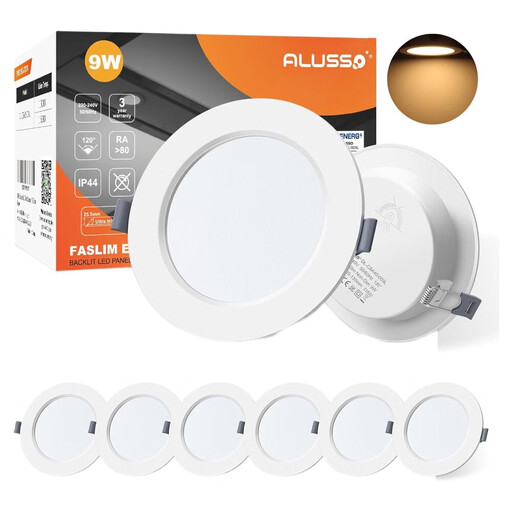
Why this product suits this profile: The pack of 6 offers a consistent lighting solution for several rooms or one continuous ceiling area. The lights operate at 220–240 V and, according to the product details, provide 690 lumens at 3000 K.
The stated cut-out size of 115–135 mm helps reduce the risk of ordering the wrong product, provided you check the ceiling opening first. The product description also makes clear that this model isn’t dimmable.
6 lights, 25.5 mm recess depth, direct 230 V connection and IP44 protection for suitable indoor areas.
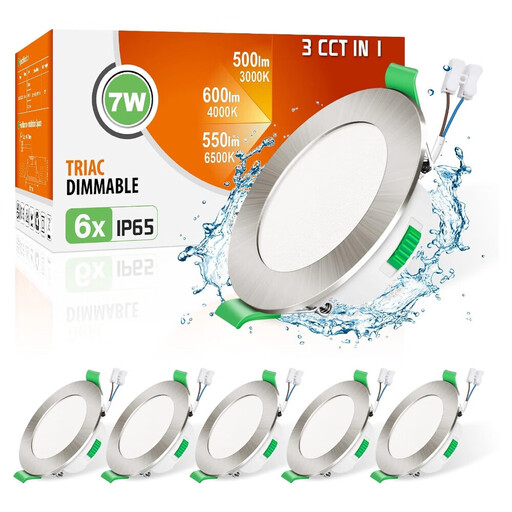
Why this product suits this profile: This model combines a shallow recess depth of 29 mm with three selectable colour temperatures and an IP65-rated housing. It’s a good choice if you like to check the technical details carefully before buying.
The specifications clearly state the cut-out size of 67–75 mm, the recess depth and the need for compatibility with trailing-edge dimmers. This lets you check the measurements and controls in advance.
IP65, 3CCT with 3000/4000/6500 K, dimmable from 10 to 100 per cent and direct 230 V connection.
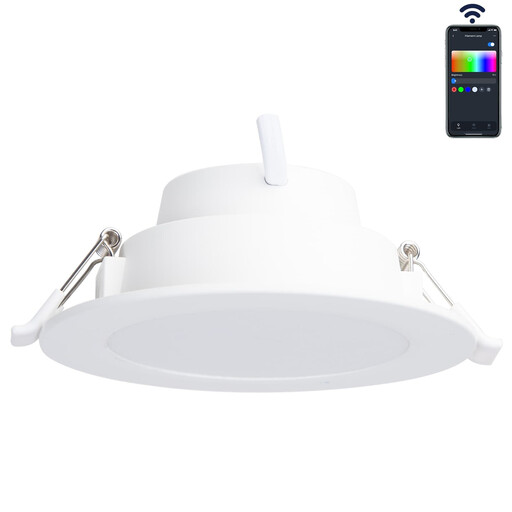
Why this product suits this profile: This smart LED recessed spotlight is designed for indoor spaces where you want app control, RGB colours and adjustable colour temperatures. According to the product details, it provides 780 lumens and requires a cut-out of 120–130 mm.
The IP20 rating makes clear that this model isn’t intended for damp rooms. It’s also dimmed via the app, not an external wall dimmer.
Bluetooth Mesh, RGB+CCT, 2700–6500 K, app control and compatibility with selected voice assistants.
We’ve put together a complete, regularly updated list of products that meet these strict selection criteria and fully comply with the safety regulations in force in the EU.
Before installing any LED recessed spotlights, switch off the power supply. 230 V lights must be installed by a qualified electrician. You should also make sure there is:
If you’re replacing an existing ceiling light, check that the new cut-out will cover the old opening. With GU10 systems, it’s important to distinguish between a recessed fitting and a GU10 LED spotlight: the spotlight may be replaceable, while the fitting is installed separately.
It depends on the size of the room, ceiling height, beam angle and the lighting effect you want. For a reliable plan, consider the light output of each fitting alongside the number of spotlights and the room’s purpose. Manufacturer specifications such as 430, 690 or 1050 lumens per light make it easier to compare models.
Models with IP44 can be used in suitable areas exposed to splashes. Higher levels of protection are required where lights may be exposed to direct water. The key factors are the bathroom’s protection zones, the specific IP rating and local installation regulations. IP20 models shouldn’t be used in damp areas.
Running costs depend on the light’s power, how many hours it’s used each day and your electricity tariff. A 9 W spotlight uses 0.09 kWh when operated for ten hours. To calculate the actual cost, multiply this figure by the number of lights, the number of days they’re used and your rate per kilowatt-hour.