
Lieferung heute & morgen

Qualitätsgarantie

Willkommens-Angebote freischalten: KOSTENLOSE Lieferung | Bis zu 80 % RABATT | Kostenlose 30-Tage-JoyPlus-Testphase
App herunterladen
LED recessed spotlights are suitable for bathrooms, kitchens, hallways, bedrooms and living areas. They require very little installation depth, can often be connected directly to 230 V, and offer warm white, neutral white or cool white light, depending on the model.
However, it is worth taking a close look at the technical specifications before buying. An appealing product description alone does not tell you whether an LED ceiling spotlight will fit into your existing ceiling or work with your current dimmer.
For slim LED recessed lights, at least three measurements are relevant:
A spotlight with a diameter of 145 mm will not automatically fit into an existing 120 mm cut-out. Measure the ceiling cut-out before ordering. When renovating, you should also check whether there is enough space above the ceiling for the connection cable and light fitting.
Dimmable LED recessed spotlights require a suitable dimmer. According to the product information, the 10 W model described requires a compatible trailing-edge dimmer. Minimum load, dimming method and flicker behaviour can also be relevant for other dimmable lights.
A dimmer previously used for halogen lamps is therefore not necessarily suitable. If you are planning continuous brightness adjustment, compare the manufacturer’s specifications with those of the dimmer.
An IP44 LED recessed spotlight is protected against solid foreign objects above a certain size and against splashing water. This makes it suitable for many areas of the bathroom or for use in the kitchen. However, IP44 does not mean that the light is suitable for direct jets of water, the inside of a shower or immersion.
In rooms exposed to moisture, you must also observe the installation zones and electrical installation requirements. In the UK, electrical connections should be carried out by a suitably qualified professional.
230 V recessed spotlights are connected directly to the mains and, according to the product information, do not require a separate transformer. This can simplify planning, but does not replace professional installation. Before working on the ceiling, switch off the circuit at the consumer unit and check that it is not live.
The wattage describes power consumption, not brightness alone. The value in lumens is what determines light output. According to the product data, a 10 W spotlight with 1,050 lumens produces a different amount of light from a 6 W model with 430 lumens.
Even, sufficiently bright illumination is important in kitchens and work areas. In the living room or bedroom, a lower light output with a warm white colour temperature may feel more comfortable. The number of spotlights required depends on factors including room size, ceiling height, beam angle and the desired level of illumination.
Many 3CCT LED spotlights offer three selectable colour temperatures:
With the 3CCT models described, the selection is made using a switch on the light fitting. The colour temperature should therefore usually be selected before final installation. A selectable colour temperature is not the same as stepless colour control via remote control.
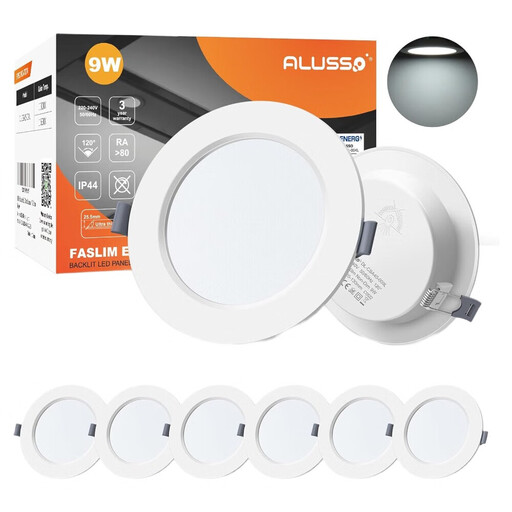
Why this product suits this profile: The set of six lights is ideal for shoppers who want to fit out several rooms or a continuous ceiling area. The stated installation depth is 25.5 mm.
The required ceiling cut-out of 115–135 mm and direct connection to 220–240 V are clearly specified. According to the product data, the light is not dimmable, helping to avoid planning errors involving a dimmer.
9 W, 720 lumens, 6500 K and IP44. Suitable for indoor areas such as bathrooms, kitchens, living rooms and bedrooms, according to the product description.
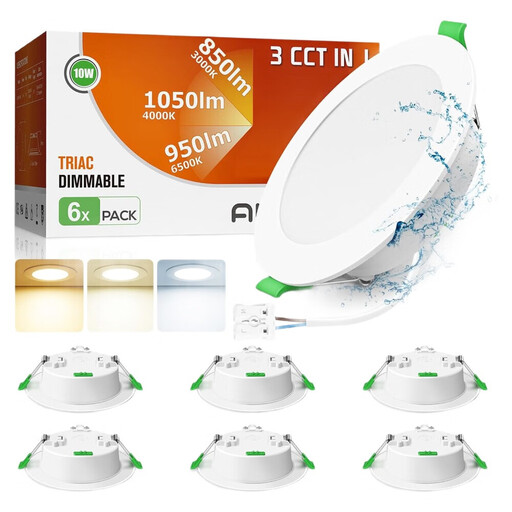
Why this product suits this profile: The combination of selectable colour temperature and dimmable brightness offers greater flexibility for kitchens, bathrooms and living areas.
The specifications state the 90–100 mm ceiling cut-out, the 34 mm depth and the required compatibility with a trailing-edge dimmer. This allows installation and dimming requirements to be checked in advance.
Selectable 3000, 4000 and 6500 K; according to the product data, dimmable from 10–100%, with 1050 lumens per spotlight and IP44.
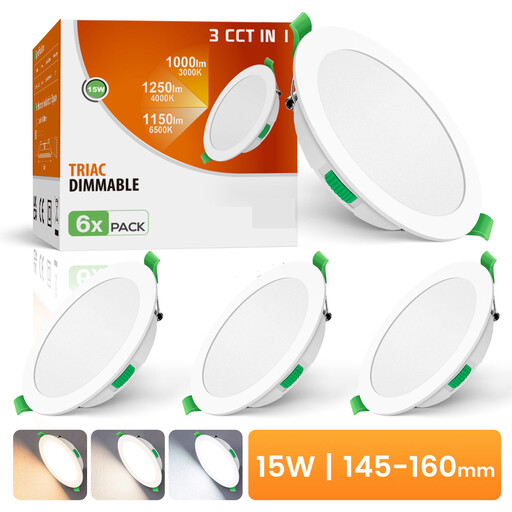
Why this product suits this profile: The larger design with a 145–160 mm cut-out is suitable for renovations where larger openings already exist or a higher light output is required.
The product specifications explicitly state the cut-out, the 32 mm housing height and the limitations of IP44: protection against splashing water, but not direct jets of water or immersion.
Selectable between 3000, 4000 and 6500 K; according to the description, dimmable from 10–100%, with 1200 lumens and a 120° beam angle.

Why this product suits this profile: The installation depth of 25.5 mm and the specified cut-out of 95–110 mm are useful for low ceilings or limited ceiling cavities.
The light is explicitly described as non-dimmable. If you do not need a dimming function, this helps you avoid buying an unsuitable model for a dimmer that has already been planned.
6 W, 430 lumens, 6500 K, 25.5 mm installation depth and IP44 according to the product information.
We have put together a complete, regularly updated list of products that fully meet these strict selection criteria and the safety regulations applicable in the EU.
For LED spotlights for kitchens and living rooms, positioning is crucial. Above work surfaces, the lights should be arranged so that your body casts as little shadow as possible over the surface. In the living room, combining general lighting with separately switchable areas can be a practical solution.
In the bathroom, you should consider the precise installation location as well as the IP44 rating. An LED ceiling spotlight for bathrooms must not be installed in every area solely because of its protection rating. In rooms with low ceilings, slim models with an installation depth of 25.5 to 34 mm are particularly useful.
If you do not want to create ceiling cut-outs, you can choose a slim surface-mounted ceiling light instead. Models with 3000 K, integrated LED technology and a multi-stage dimmer may be suitable for living rooms or hallways, for example. However, they are not the same as an LED recessed spotlight and often have a different protection rating.
According to the product information, the products listed have an average lifespan of 25,000 to 30,000 hours. This is a manufacturer’s specification and depends on factors including operating time, ambient temperature, ventilation and professional installation. Good heat dissipation remains important, even with slim lights.
Consumption depends on the wattage and daily operating time. A 10 W spotlight uses 0.1 kWh after ten hours of operation. A set of six lights would use 0.6 kWh under the same conditions. Running costs therefore depend on both the wattage and the number of spotlights switched on at the same time.
A direct connection to 220–240 V presents a risk of electric shock. Installation should therefore be carried out by a qualified electrician in accordance with the applicable technical regulations. DIY enthusiasts can check the measurements, colour temperature, switching groups and dimmer compatibility in advance, but should not connect the mains supply without the appropriate qualifications.