
Lieferung heute & morgen

Qualitätsgarantie

Willkommens-Angebote freischalten: KOSTENLOSE Lieferung | Bis zu 80 % RABATT | Kostenlose 30-Tage-JoyPlus-Testphase
App herunterladen
LED recessed spotlights save space and blend discreetly into ceilings. However, not every model is right for every room. A cut-out that doesn’t fit, excessive installation depth or an unsuitable IP rating can all mean extra work during installation. And the label ‘230 V’ alone tells you nothing about the colour of the light, whether it can be dimmed or how much electricity it actually uses.
This buying guide explains which technical details matter when choosing LED recessed spotlights, LED ceiling spots or low-profile LED downlights.
When it comes to installation, the spotlight’s external diameter isn’t the only measurement that matters. The key measurement is the cut-out size: the diameter of the hole in the ceiling. For example, a fitting with an external diameter of 145 mm might require a cut-out of 115 to 135 mm. Other LED recessed spotlights need a cut-out of just 95 to 110 mm.
If you’re replacing existing fittings, measure the openings in several places before ordering. If a hole is too large, the spotlight may not be secure. If it’s too small, you’ll need to enlarge it.
Installation depth is an important consideration for low ceilings and suspended ceilings. Some models need just 25.5 mm of depth, while other low-profile LED downlights are around 32 mm high. You’ll also need to leave enough room behind the fitting for cables, connectors and heat dissipation.
A shallow fitting can make planning easier, but you’ll still need to check the space available for installation.
An IP44-rated recessed spotlight is protected against solid objects above a certain size and water splashes from various directions. However, this doesn’t mean it’s suitable for direct water jets, constant exposure to moisture or immersion.
When choosing a bathroom recessed spotlight, consider the installation zone, its distance from water sources and the specific IP rating. Electrical installation must comply with the relevant regulations. If the fitting connects directly to the mains, installation should be carried out by a qualified electrician.
230 V LED recessed spotlights can be connected directly to a 220–240 V AC supply, provided they’re designed for this. No separate transformer is needed, which can simplify planning, but the mains connection must be installed correctly.
Models rated at 12–24 V, on the other hand, need a suitable power supply or transformer. This isn’t included with every set. Before you buy, check:
Never connect a 12–24 V spotlight directly to the mains.
Light colour is measured in Kelvin:
3CCT LED downlights offer several of these light colours in one fitting. Depending on the model, you can choose the setting using a switch on the back or the housing. This is useful if you’d rather decide on the room’s lighting effect after installation.
Brightness is measured in lumens, not just watts. Watts indicate the amount of electrical power used. For example, a 9 W spotlight may produce 720 lumens, according to the manufacturer. ‘Replaces 72 W halogen’ is a comparison figure and doesn’t mean the light distribution will be identical.
With dimmable LED recessed spotlights, the dimmer must be compatible with the fitting. A leading-edge or trailing-edge dimmer is often required. Non-dimmable models must not be connected to a dimmer.
Lifespan figures are also provided by the manufacturer. The models featured here, for example, are rated for 25,000 or more than 30,000 hours. Actual lifespan depends on factors including ambient temperature, installation, ventilation and switching frequency.
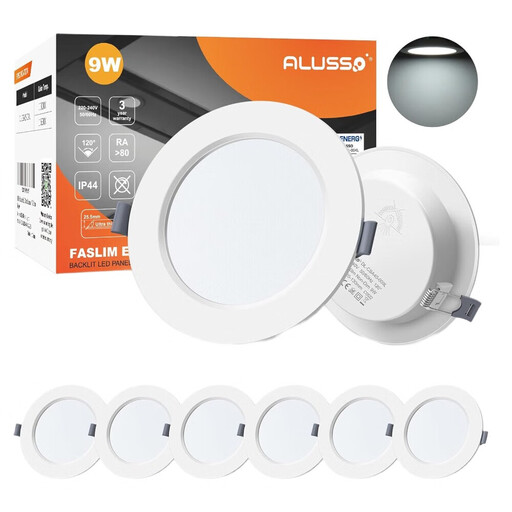
Why it’s a good fit: This set of six is ideal for rooms that need several matching LED ceiling spots. It connects directly to a 220–240 V supply, so there’s no need for a separate transformer.
The stated installation depth of 25.5 mm and cut-out size of 115–135 mm make it easier to plan. According to the product details, the fitting isn’t dimmable.
9 W, 720 lumens, 6,500 K, IP44 and a stated lifespan of more than 30,000 hours.
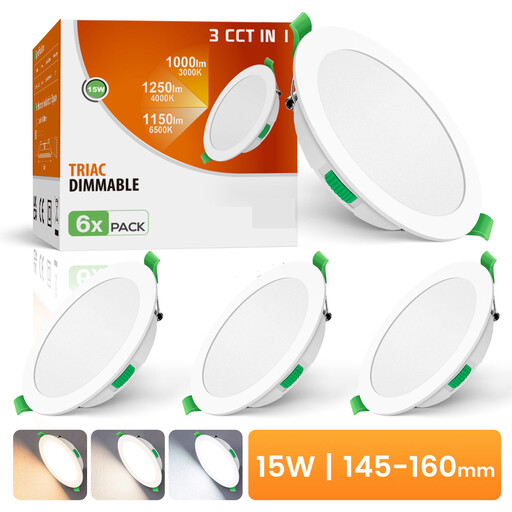
Why it’s a good fit: This model is for buyers who want to adjust the light colour and brightness to suit their living room, bedroom, kitchen or bathroom.
The 3CCT settings mean you don’t have to settle on a light colour before installation. The cut-out size is 145–160 mm.
1,200 lumens, 3,000/4,000/6,500 K, IP44 and dimming from 10–100 per cent, according to the product details.
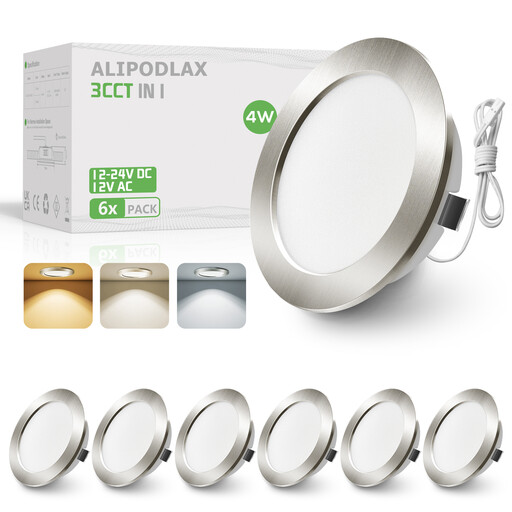
Why it’s a good fit: This compact model is suitable for furniture, shelving, kitchen areas, caravans or rooms with very little installation space.
The required 12–24 V supply is clearly specified. You’ll need a suitable transformer, so remember to plan for it separately.
14.5 mm installation height, 55–58 mm cut-out, 270 lumens, 3CCT and IP44, according to the product description.
We’ve put together a complete, regularly updated range of products that meet these strict selection criteria and the safety regulations in force across the EU.
Before ordering and installing, make sure you’ve checked the following:
Energy use depends on the wattage and how many hours the spotlight is on each day. A 9 W spotlight uses 0.09 kWh when switched on for ten hours. If you have several fittings, add their wattages together. For energy-efficient LED ceiling lighting, both wattage and the brightness you need are important.
Depending on the installation zone, models with IP44 may be suitable for areas exposed to water splashes. However, IP44 doesn’t protect against direct water jets or immersion. You’ll need to take the exact installation position and the bathroom’s electrical zones into account.
Depending on the model, manufacturers often quote a lifespan of 25,000 to more than 30,000 operating hours. These figures are based on specific test conditions. Heat, poor ventilation, frequent switching and incorrect installation can all affect the actual lifespan.