
Lieferung heute & morgen

Qualitätsgarantie

Willkommens-Angebote freischalten: KOSTENLOSE Lieferung | Bis zu 80 % RABATT | Kostenlose 30-Tage-JoyPlus-Testphase
App herunterladen
LED recessed spotlights can provide targeted lighting for ceilings, kitchen worktops, bathrooms and covered outdoor areas. Choosing the right ones may seem straightforward, but technical details determine whether a light will actually fit your existing ceiling and work reliably day to day.
Three common pitfalls can lead to the wrong purchase:
Before you buy, measure the existing ceiling cut-out accurately. The key measurements are:
Slim LED recessed spotlights with an installation depth of around 25,5 to 34 millimetres are suitable for ceilings with limited cavity space. Even so, there must be enough room behind the light for the electrical connection. An oversized cut-out cannot always be covered neatly.
Light output is measured in lumens (lm). It describes how much light a product emits and is a more useful guide to brightness than wattage alone. For example, a 10 W model with 1.050 lumens will give a different level of brightness from a 6 W model with 430 lumens.
Colour temperature is measured in kelvin (K):
A 3CCT recessed spotlight lets you select from several colour temperatures using a switch on the product. Set it before installation if the switch won’t be accessible afterwards.
A 230 V LED spotlight runs directly from the mains and generally doesn’t need a separate transformer. Fixed lights connected to a 220–240 V supply should be installed by a suitably qualified electrician. Always switch off the power at the consumer unit before installation or maintenance.
For dimmable recessed spotlights, the light and dimmer must be technically compatible. Check the stated dimmability, dimming range and type of compatible dimmer.
The IP rating matters when choosing LED recessed spotlights for a bathroom or kitchen. IP44 protects against solid objects above a certain size and splashing water. This makes these lights suitable for damp indoor spaces or sheltered areas, but not for direct water jets. For outdoor areas exposed to harsher weather, a higher rating such as IP65 may be a better choice.
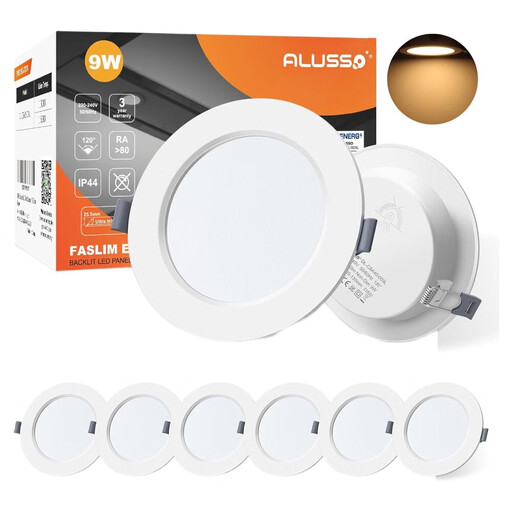
Why it suits this profile: This set is a good choice for renovations where you need to replace several ceiling lights with 230 V, warm-white lighting.
The specified cut-out is 115–135 mm, and the installation depth is 25,5 mm. The product is also clearly marked as non-dimmable.
Six lights, 9 W per spotlight, 690 lm per spotlight, 3000 K and direct connection to 220–240 V; IP44 rating.
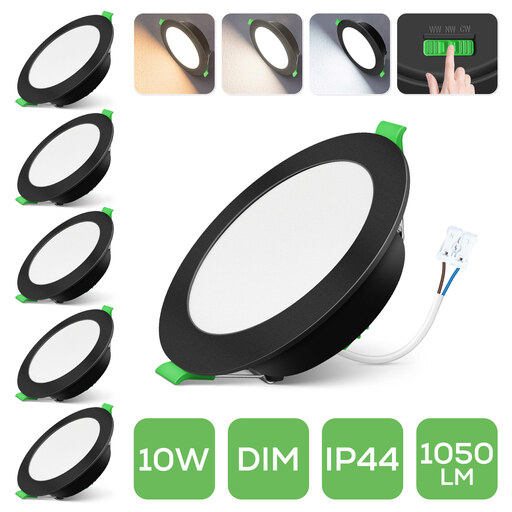
Why it suits this profile: This model combines a slim design with adjustable colour temperature and dimmability, making it suitable for living rooms, kitchens and bathrooms.
The specifications state that it needs a 90–100 mm ceiling cut-out, has an installation depth of 34 mm and must be used with a compatible dimmer.
10 W, 1050 lm, three colour temperatures from 3000 to 6500 K, a dimming range of 10–100 % and IP44.
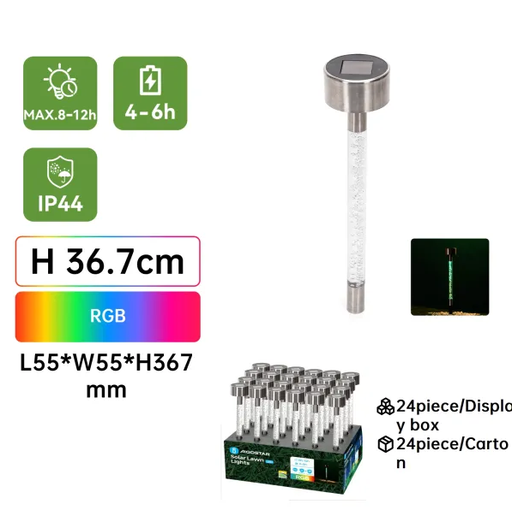
Why it suits this profile: Solar ground lights and decorative RGB garden lighting offer a flexible way to illuminate paths, flower beds and patios without a mains connection.
The specifications state a charging time of 4–6 hours, a lighting time of 8–12 hours and an IP44 rating. This helps you plan realistically for the effects of shade and weather.
RGB lighting, built-in Ni-MH battery, automatic switch-on at dusk and a height of 36,7 cm for ground installation.
For garages, sheds, driveways or exterior walls, LED floodlights are another option alongside recessed spotlights. A model with several adjustable heads can direct light onto a path or entrance. When choosing products for connection to the German mains, pay particular attention to the stated voltage. An outdoor floodlight rated for AC 120 V is not automatically suitable for a German 230 V supply.
Solar garden lights need a spot that gets as little shade as possible. Trees, walls and short winter days can affect charging performance. If you’re using IP44-rated solar ground lights, choose a location where water won’t collect around the light.
It depends on the size of the room, ceiling height and the lighting effect you want. For general lighting, several spotlights are usually spaced evenly around the room. Compare the stated light output in lumens rather than looking at wattage alone.
Models with an IP44 rating may be suitable for areas exposed to splashes and moisture, provided you take the specific installation location and applicable installation zones into account. IP44 is not designed for direct water jets or immersion. A qualified professional should check the electrical connection.
The cost depends on the wattage, how many hours you use the light each day and your electricity tariff. To work it out, divide the wattage by 1000, then multiply by the operating hours and the price per kilowatt-hour. For example, a 10 W spotlight uses 0,1 kWh when left on for ten hours.