
Lieferung heute & morgen

Qualitätsgarantie

Willkommens-Angebote freischalten: KOSTENLOSE Lieferung | Bis zu 80 % RABATT | Kostenlose 30-Tage-JoyPlus-Testphase
App herunterladen
LED recessed spotlights provide clear, space-saving lighting for bathrooms, kitchens, hallways, living rooms and bedrooms. There are also suitable LED solutions for furniture and wall cabinets. However, low prices and attention-grabbing advertising claims do not automatically guarantee a suitable installation. The key factors are the installation depth, ceiling cut-out, IP rating and electrical compatibility.
A recessed spotlight must fit the existing opening exactly. Descriptions such as “flat” or “universally compatible” do not replace checking the dimensions. Depending on the model, cut-outs of 90–100 mm, 95–110 mm, 120–130 mm or 145–160 mm may be required, for example. The external diameter and installation depth must also be suitable for the ceiling.
For low suspended ceilings, flat LED recessed spotlights with an installation depth of around 25.5 to 34 mm are practical. Before buying, measure the available height between the ceiling covering and the structural ceiling.
An IP44 LED recessed spotlight is protected against splashing water from various directions. This may be suitable for many areas in the bathroom or kitchen, but it does not mean that the spotlight can be exposed to a direct jet of water or consistently high humidity.
An IP65 LED recessed spotlight offers greater protection against dust and water jets. Even so, the installation location, bathroom installation zone and manufacturer’s instructions must be taken into account. For dry living areas, a model with IP20 may be sufficient. Smart spotlights with IP20 must not be used in damp or wet areas.
“Dimmable” does not mean that every existing wall dimmer will work. Many dimmable LED recessed spotlights require a compatible phase-cut or trailing-edge dimmer. An unsuitable combination can cause flickering, buzzing or a restricted dimming range.
A 3CCT function allows you to choose between several colour temperatures, such as 3000 K warm white, 4000 K neutral white and 6500 K cool white. On many models, the setting is changed using a switch on the light fitting. It is not automatically controlled via an app and generally does not alter the brightness.
A 230 V LED recessed spotlight is connected directly to the 220–240 V AC mains supply. These models do not require a separate transformer. However, existing cables, terminals and the installation conditions must be compatible with the light fitting.
12 to 24-volt spotlights, on the other hand, require a suitable power supply or transformer. This is not included with every set. A 12–24 V model must not be connected directly to the mains voltage.
Work on mains voltage should be carried out by a qualified electrician in Germany. Before installation and maintenance, switch off the power supply at the circuit breaker and secure it against being switched on again.
Wattage describes power consumption, not brightness directly. The amount of light is determined by the value in lumens. Depending on the room size, ceiling height, beam angle and number of spotlights, a 720-lumen spotlight may appear different from a 1,050-lumen model.
For LED spotlights for bathrooms and kitchens, a suitable IP rating, sufficient brightness and an easy-to-clean surface are also important.
Aluminium can help dissipate heat, while polycarbonate or PBT may be used for the cover or housing. However, the material specification alone is not a substitute for a complete installation check. The spotlight must not be covered with insulation material if the manufacturer prohibits this.
Sets containing six lights are suitable for continuous ceiling illumination. For individual areas, furniture or later additions, single lights or packs of two may be more practical.
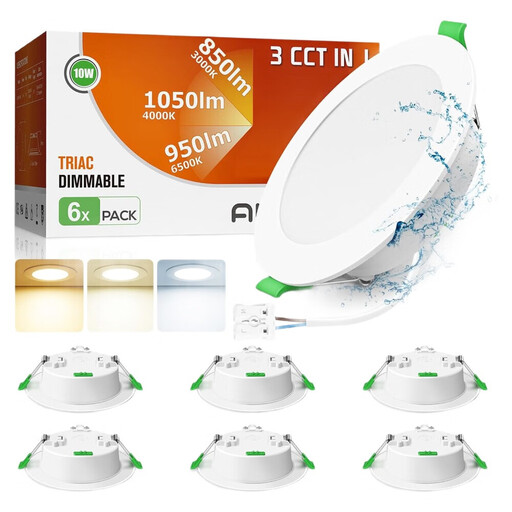
Why this product suits this profile: The six-piece set is suitable for renovations where several ceiling points need to be fitted with a consistent light colour. It offers a direct 230 V connection, three colour temperatures and a stated dimming range of 10 to 100 per cent with a compatible dimmer.
The required ceiling cut-out of 90–100 mm and installation depth of 34 mm are clearly specified. IP44 is correctly described as splash protection, not as approval for direct water jets.
1,050 lm per light, 3000/4000/6500 K, 10 W and six lights per set.
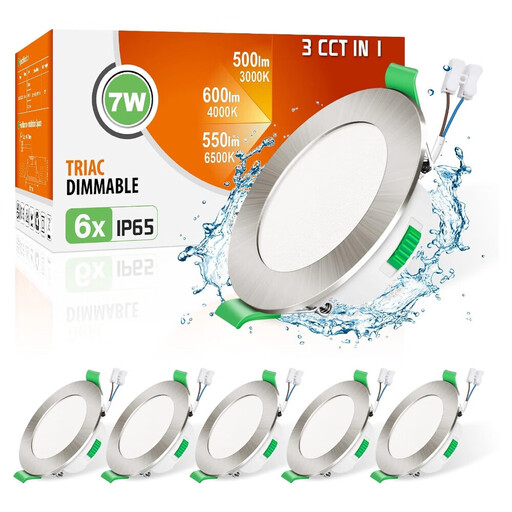
Why this product suits this profile: This set combines a stated IP65 rating with 3CCT selection and a dimming function. The ceiling cut-out is 67–75 mm and the installation height is 29 mm. This makes it suitable for compatible installations in damp areas where space is limited.
The IP rating, cut-out size and direct 230 V connection are clearly specified. The dimming function requires a compatible trailing-edge dimmer.
IP65, 500–600 lm depending on the setting, 3000/4000/6500 K and a six-piece set.

Why this product suits this profile: As an under-cabinet LED light with a motion sensor, this set is suitable for kitchen cabinets, wardrobes, shelving and hallways. The battery is charged via USB, so no permanent wiring is required.
The dimensions of 400 × 38 × 10 mm and adhesive-strip installation are clearly specified. The battery and USB connection prevent you from buying an unsuitable power supply.
61 LEDs per light, PIR detection range of 3–5 m, 1100 mAh battery and three colour temperatures.
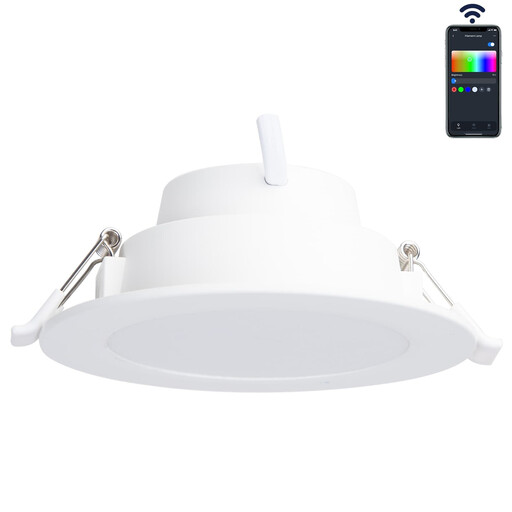
Why this product suits this profile: The spotlight uses Bluetooth Mesh and can be controlled via a compatible app and gateway. Colour temperatures from 2700 to 6500 K, RGB colours and app-based dimming are ideal for users who want to configure their lighting centrally.
The light is controlled via the app and Bluetooth Mesh, not an external wall dimmer. With IP20, the spotlight is intended exclusively for dry indoor areas.
780 lm, RGB+CCT, 120° beam angle and Bluetooth Mesh connectivity.
Before placing your order, make a note of the following:
For dedicated furniture or worktop lighting, a USB LED cabinet light with a motion sensor may be more suitable than a permanently installed ceiling spotlight.
We have put together a complete, regularly updated list of products that fully meet these strict selection criteria and the safety regulations applicable in the EU.
This depends on the room size, desired brightness, lumen output, beam angle and intended use. For even illumination, the spotlights should be positioned with sufficient spacing rather than directly above the walls alone. Careful planning is particularly useful for kitchen worktops and bathrooms.
Depending on the model, the product specifications in this selection state a lifespan of around 25,000 to 30,000 operating hours. The actual service life can be affected by heat, switching frequency, mains quality and installation conditions. Adequate heat dissipation and compliance with the installation instructions therefore remain important.
LED lights often require less electrical power than older halogen solutions for a comparable light output. However, running costs depend on the actual operating time, electricity tariff, number of lights and wattage consumption. The energy efficiency class and lumen output should be considered together.