
Lieferung heute & morgen

Qualitätsgarantie

Willkommens-Angebote freischalten: KOSTENLOSE Lieferung | Bis zu 80 % RABATT | Kostenlose 30-Tage-JoyPlus-Testphase
App herunterladen
LED recessed spotlights provide even, unobtrusive ceiling lighting and suit a wide range of homes, from bathrooms and kitchens to bedrooms. But choosing the right one involves more than checking the wattage or opting for a modern-looking fitting. The wrong cut-out size, a misunderstood IP rating or an incompatible dimmer can mean the light won’t fit or won’t work as expected in everyday use.
This buying guide explains which details to check before buying 230 V LED recessed spotlights and which models may suit different needs.
Slim recessed LED lights need little clearance above the ceiling, but the existing ceiling cut-out still needs to match the product. Depending on the model, the required cut-out size might be 90–100 mm, 95–110 mm, 115–135 mm or 145–160 mm.
Many recessed spotlights cannot safely cover a cut-out that is too large. Before ordering, compare these three measurements:
IP44 indicates protection against solid objects above a certain size and splashing water from different directions. It does not make a recessed LED spotlight suitable for direct jets of water, shower enclosures or immersion.
When choosing a recessed spotlight for a bathroom, you also need to consider the installation location, distance from water sources and applicable electrical regulations. In rooms with high moisture levels, installation should be carried out by a qualified electrician.
For dimmable recessed spotlights, the existing dimmer must be compatible with the LED electronics. A specification such as “10–100% dimmable” describes the product’s intended dimming range, but does not replace a compatibility check. An unsuitable dimmer can cause flickering, buzzing or a limited dimming range.
230 V LED recessed spotlights and models operating at 220–240 V AC are suitable for direct connection to the UK mains supply. These products generally don’t need a separate power supply or transformer.
12–24 V models are useful for furniture, display cabinets, under-cabinet kitchen lighting, motorhomes or specialist installations. However, they require a suitable transformer, which may not be included. A 12–24 V spotlight must not be connected directly to 230 V.
Wattage describes electricity consumption, not brightness. For comparison, luminous flux in lumens is a more useful measure. A 9 W model producing 690 lm gives a different amount of light from a 10 W spotlight producing 1050 lm.
Colour temperature is measured in kelvins:
A 3CCT recessed spotlight lets you choose between several colour temperatures. The models listed here offer 3000 K, 4000 K and 6500 K, selected using a switch on the light’s housing. You’ll usually need to choose your preferred colour temperature before fitting the light.
Aluminium housings can help dissipate heat. With plastic models, pay particular attention to the material, temperature resistance and required installation clearance. Also, don’t cover the light with insulation unless the manufacturer explicitly says this is permitted.
For energy-efficient LED ceiling lighting, consider the actual brightness, expected lifespan and energy efficiency class, as well as power consumption. Check the relevant product data sheet for these details.
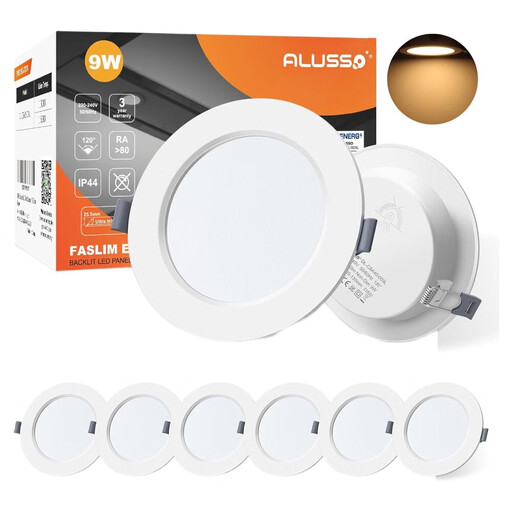
Why this product suits this user type: This six-piece set is ideal if you want matching recessed lights in several locations, such as the bathroom, kitchen or hallway. Each light is rated at 690 lm and 9 W.
The specified cut-out size of 115–135 mm and installation depth of 25.5 mm make it easier to check whether the lights will fit your existing ceiling. They’re not dimmable, so dimmer compatibility won’t be an issue.
Six lights, 230 V connection, warm white at 3000 K and IP44 rating. The manufacturer quotes an average lifespan of 30,000 hours.
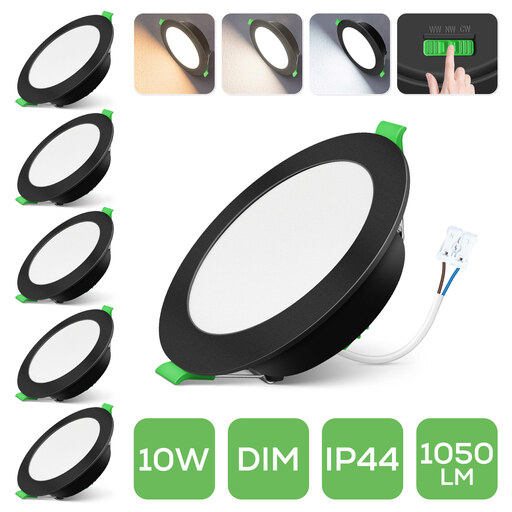
Why this product suits this user type: This six-piece set combines an aluminium and polycarbonate housing with adjustable colour temperature and dimming. It’s a good choice for rooms where the way you use the space or the lighting mood may change.
The specifications give a required cut-out size of 90–100 mm and an installation depth of 34 mm, so you can check compatibility before buying. Dimming requires a compatible dimmer.
1050 lm per light, 3000/4000/6500 K, a dimming range of 10–100% and direct connection to 220–240 V AC.
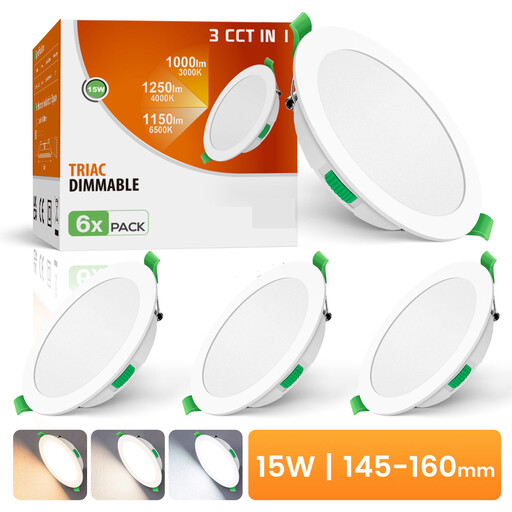
Why this product suits this user type: This model is aimed at renovators and frequent users with larger ceiling cut-outs of 145–160 mm who want to choose between three colour temperatures.
The larger cut-out size is clearly stated, so check it against your existing ceiling. The IP44 rating indicates protection against splashing water; the lights aren’t designed for direct jets of water or immersion.
1200 lm per light, 32 mm height, 3000/4000/6500 K and dimming from 10–100% when used with a compatible trailing-edge dimmer.
We’ve put together a complete, regularly updated list of products that meet these strict selection criteria and the safety regulations in force across the EU.
Before installation, switch off the circuit at the fuse box and make sure it cannot be switched back on accidentally. For a direct 230 V connection, follow the applicable installation regulations. Work on fixed electrical wiring must be carried out by a qualified electrician.
You should also check:
The stated lifespan varies by model. The product specifications for the lights mentioned here quote, for example, 25,000 or 30,000 hours. These figures are supplied by the manufacturer and depend on factors such as heat dissipation, operating time and the surrounding conditions.
No. Only models specified as dimmable should be used with a suitable LED dimmer. Before installation, check the manufacturer’s guidance on dimmer type, minimum load and connection method.
No. IP44 indicates protection against splashing water, not direct jets of water or persistently high humidity. The installation position, distance from water sources and electrical protection measures all need to be considered together.