
Lieferung heute & morgen

Qualitätsgarantie

Willkommens-Angebote freischalten: KOSTENLOSE Lieferung | Bis zu 80 % RABATT | Kostenlose 30-Tage-JoyPlus-Testphase
App herunterladen
LED recessed spotlights provide even, space-saving lighting in living rooms, kitchens, hallways, bathrooms and offices. However, when buying, it is not just the wattage and design that matter. A ceiling cut-out that is too large, an unsuitable IP rating or incompatible dimmer technology can make installation considerably more difficult and lead to additional costs.
The most common purchasing problems arise from three typical pitfalls:
Slim LED recessed lights are practical for low ceilings, suspended structures or furniture. Check the following before buying:
A model with a depth of 34 mm may be suitable for many shallow ceilings. Particularly compact 12–24-volt lights sometimes require only around 14.5 mm of installation height, but they do need a suitable transformer. Connecting such lights directly to 230 volts would not be permitted.
Colour temperature is measured in Kelvin:
3CCT LED recessed spotlights allow you to select several colour temperatures using a switch on the light housing. This is particularly useful if the function of a room may change later. Luminous flux, measured in lumens, describes the amount of light emitted. When planning your lighting, you should also consider the beam angle, number of lights and room size.
The IP rating consists of two digits. The first describes protection against solid foreign objects, while the second indicates protection against water. IP44 LED spotlights are protected against solid foreign objects measuring 1 mm or more, as well as splashing water from various directions. IP65 offers a higher level of protection against dust and water jets.
However, the IP rating alone is no substitute for professional bathroom lighting planning. The installation zone, distance from water sources, mounting height and local installation regulations must all be taken into account. When connecting directly to 220–240 volts, installation should be carried out by a qualified electrician or an appropriately qualified person.
The following LED ceiling spotlights differ in terms of installation diameter, colour temperature, dimmability, IP rating and control options. This makes it easier to choose the right product for your intended use.
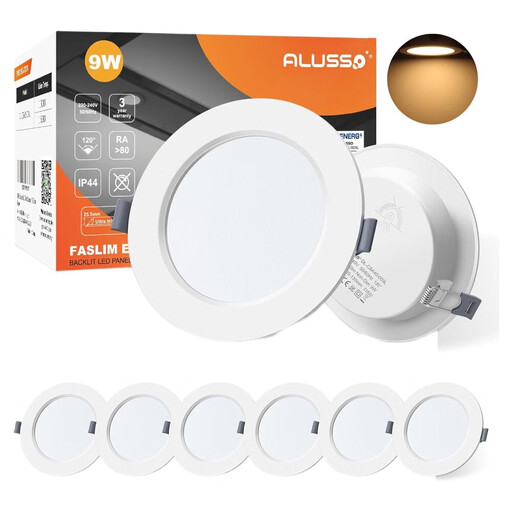
Why this product suits this profile: This six-piece set is designed to provide consistent general lighting in hallways, kitchens or smaller living areas. The warm-white colour temperature is 3000 K.
The required ceiling cut-out of 115–135 mm and installation depth of 25.5 mm are clearly specified. However, this model is not dimmable.
6 lights per set, 9 W per light, 690 lm per light and IP44 for humid indoor areas.
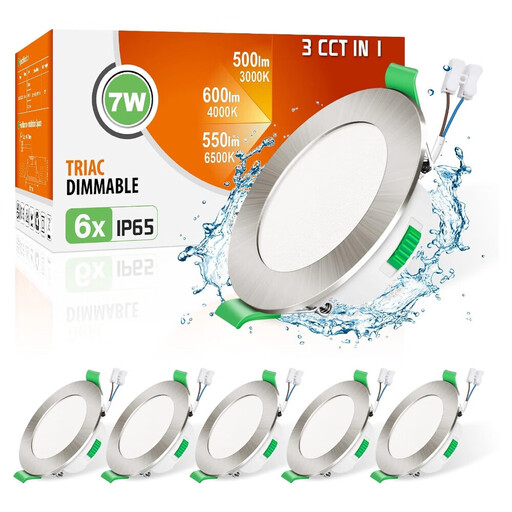
Why this product suits this profile: The combination of 3CCT selection, dimmability and IP65 is ideal for users who want to adapt their lighting flexibly to the room and how it is used.
Dimmability depends on compatible trailing-edge dimmers. Check your existing dimmer technology before installation.
7 W, 500–600 lm, 3000/4000/6500 K, installation diameter of 67–75 mm and IP65.
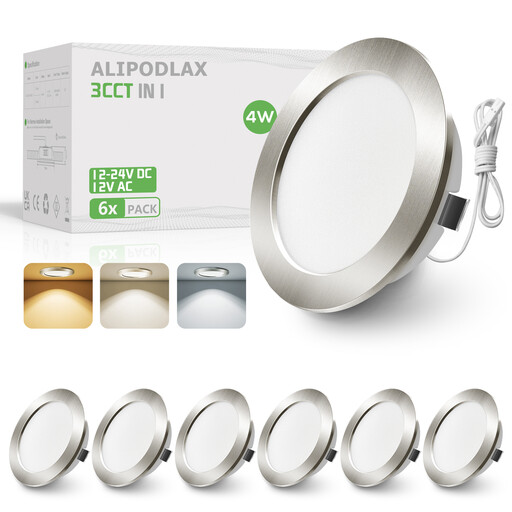
Why this product suits this profile: This compact light is designed for furniture, cupboards, under-cabinet areas, caravans and installations with limited installation height.
The light must not be connected directly to the mains. A suitable 12–24-V transformer is required and is not included.
14.5 mm installation height, 55–58 mm cut-out, 270 lm, 3CCT and IP44.
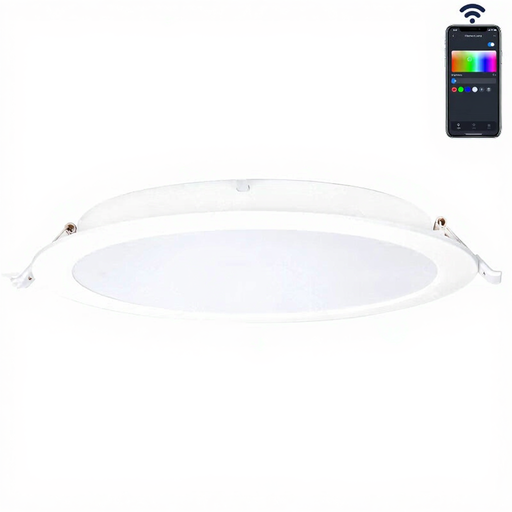
Why this product suits this profile: For connected indoor spaces, this spotlight offers Bluetooth Mesh, app and voice control, plus adjustable colours and colour temperatures.
With IP20, this model is suitable exclusively for dry indoor spaces. Dimming is controlled via an app or smart home system, not an external wall dimmer.
18 W, up to 1760 lm, RGB+CCT from 2700–6500 K, Bluetooth Mesh and a 200–220 mm cut-out.
We have put together a complete, regularly updated list of products that fully meet these strict selection criteria and the safety regulations applicable in the EU.
Before ordering LED recessed spotlights, check the following:
That depends on the IP rating and the specific installation zone. Models with IP44 may be suitable for certain humid indoor areas, while IP65 offers a higher level of protection. IP20 lights are intended for dry rooms. Bathroom electrical installations should be planned and carried out in accordance with the applicable regulations.
The product specifications for the models listed often state an average service life of around 30,000 hours. This is a manufacturer’s parameter and depends, among other things, on operating temperature, ventilation, switching frequency and professional installation.
LED lights often require less electrical power than halogen models for a comparable luminous flux. The key comparison is lumens per watt, not just the wattage. Running costs also depend on daily usage time, the number of lights and your individual electricity tariff.