
Lieferung heute & morgen

Qualitätsgarantie

Willkommens-Angebote freischalten: KOSTENLOSE Lieferung | Bis zu 80 % RABATT | Kostenlose 30-Tage-JoyPlus-Testphase
App herunterladen
An LED recessed spotlight can illuminate rooms evenly while blending discreetly into the ceiling. However, when buying one, it is not just the wattage or the term “ultra-flat” that matters. The key factors include the ceiling cut-out, installation depth, IP rating and type of control.
As Joybuy Product Recommendation Officer, I filter the most important product details and show you which version is suitable for different usage scenarios.
A flat LED recessed spotlight can be suitable for suspended ceilings where space is limited. Even so, the outer diameter, cut-out diameter and installation depth must all match. A model with a diameter of 145 mm will not fit an existing cut-out of 90 to 100 mm. Before ordering, measure the existing ceiling cut-out to the nearest millimetre.
An IP44 LED recessed spotlight is protected against splashing water from different directions. This may be sufficient for certain areas in the bathroom or kitchen. However, IP44 does not mean that the light is suitable for a direct jet of water or permanently damp outdoor areas. For zones subject to greater exposure, an IP65 LED spotlight may be the better choice. The specific installation must comply with the applicable electrical regulations and the protection zones in the bathroom.
A dimmable LED recessed spotlight is not automatically compatible with every wall dimmer. Some models require a trailing-edge dimmer, while others are controlled exclusively via an app. Smart lights with Bluetooth Mesh may also require a gateway. Before buying, you should therefore decide whether you want to operate the light using a wall switch, smartphone, voice assistant or a combination of these.
First, check these three measurements:
For a new installation, take the position of ceiling joists, cables and insulation materials into account. Lights must not be covered with thermal insulation materials unless the manufacturer expressly permits this.
The lumen rating describes the luminous flux. A 6-W model with 430 to 600 lm is more suitable for smaller areas or lighting with multiple spotlights. Models with 1,050 lm or more can illuminate larger zones more powerfully. The actual requirement depends on the room size, ceiling height, wall colour and desired light distribution.
A 3CCT LED recessed spotlight usually offers three selectable colour temperatures:
Some smart models cover a range from 2,700 or 3,000 up to 6,500 K. RGB+CCT recessed spotlights add coloured light, while the colour rendering index for some of the models listed is specified as Ra ≥ 80.
An LED recessed spotlight 230 V connects directly to 220–240 V AC and does not require a separate transformer for the products mentioned. By contrast, low-voltage models with 12–24 V may only be operated with a suitable transformer.
The smart models in this selection are designed for dry indoor rooms and have an IP20 rating. An LED recessed spotlight for the bathroom, on the other hand, should have at least the IP rating required for its intended location. IP44 protects against splashing water, while IP65 also provides greater protection against dust and jets of water. The IP rating does not replace professional electrical installation.
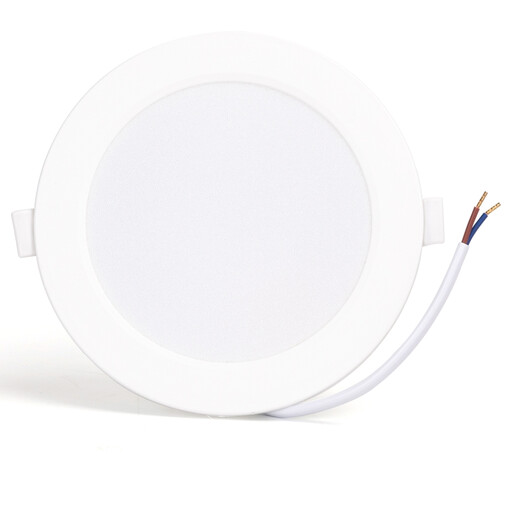
Why this product suits the profile: This model is suitable for dry indoor rooms if you are looking for a compact smart home light with adjustable colour temperature and Bluetooth Mesh.
The specifications clearly state 600 lm, 6 W, 2700–6500 K, a 100–110-mm cut-out and IP20. This makes it easy to assess whether the light is suitable before buying.
CCT adjustment from 2700–6500 K, a 120° beam angle and Bluetooth Mesh connectivity; dimming is controlled via the app.
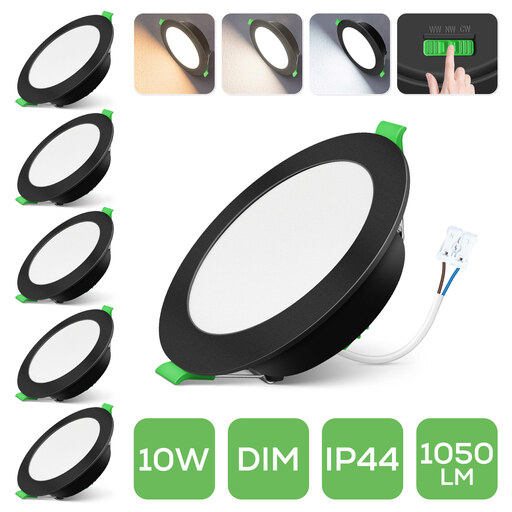
Why this product suits the profile: Aluminium and polycarbonate, three colour temperatures and a specified dimming range of 10–100% combine practical flexibility with a direct 230-V connection.
The required ceiling cut-out of 90–100 mm and installation depth of 34 mm are clearly specified. Nevertheless, IP44 protection and the necessary dimmer compatibility should be checked for the installation location.
1,050 lm per light, a 3CCT selection of 3000/4000/6500 K and direct connection to 220–240 V.
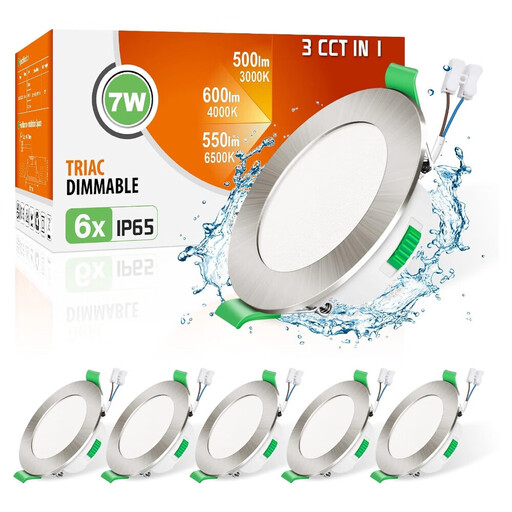
Why this product suits the profile: A 6-pack with IP65 protection is suitable for buyers planning several lights in areas exposed to higher levels of moisture and requiring a shallow installation depth.
The IP65 rating is clearly stated. The product also specifies a 29-mm installation depth, a 67–75-mm cut-out and suitability for 230 V; direct exposure to water should still be avoided.
3CCT with 3000/4000/6500 K, dimmable with a compatible trailing-edge dimmer and six lights per pack.
We have put together a complete, regularly updated list of products that fully meet these strict selection criteria and the safety regulations applicable in the EU.
With an LED recessed spotlight set, check whether all the lights require the same cut-out and whether drivers, connection cables or terminals are included. The power supply must be switched off at the circuit breaker before installation. Work on 230-V systems must be carried out by a qualified electrician.
Power consumption is the key factor when it comes to running costs. Six lights rated at 9 W each require a total of 54 W when operated at the same time. However, a lower wattage does not automatically mean that fewer lights will be needed if the desired brightness cannot be achieved. Standby consumption, usage time and the number of switching cycles may also be relevant for smart models.
Warm white light of around 3,000 K is often chosen for living rooms and bedrooms. Neutral white light of around 4,000 K is often a good fit for kitchens, hallways and work areas. A 3CCT or smart LED recessed spotlight allows you to choose the colour temperature after installation.
No. The product specifications must state that dimming is supported. The light and dimmer must also be technically compatible. With Bluetooth Mesh lights, brightness is sometimes adjusted via an app or gateway rather than an external wall dimmer.
Depending on the version, the models mentioned have a declared service life of approximately 25,000 to 30,000 operating hours. This is a manufacturer’s specification and depends, among other things, on the ambient temperature, ventilation, switching frequency and professional installation.