
Lieferung heute & morgen

Qualitätsgarantie

Willkommens-Angebote freischalten: KOSTENLOSE Lieferung | Bis zu 80 % RABATT | Kostenlose 30-Tage-JoyPlus-Testphase
App herunterladen
An LED recessed spotlight can illuminate rooms evenly while integrating neatly and space-savingly into ceilings or walls. However, not every model is suitable for every renovation project. Unnecessary costs often arise because buyers focus only on wattage, appearance or an attractive set price before purchasing. The key specifications are usually the cut-out size, installation depth, IP rating and dimmer compatibility.
This Joybuy Product Recommendation Officer selection guide explains which technical specifications matter for bathrooms, kitchens, hallways, living rooms and covered outdoor areas.
A slim LED recessed spotlight is not automatically suitable for every existing opening. Models can vary considerably:
You should therefore measure the existing ceiling cut-out at several points before ordering. If the opening is a different size, adjustment work or a different light fitting frame may be required.
A dimmable LED recessed spotlight requires a compatible dimmer. Depending on the product, suitable options may include trailing-edge dimmers or specific trailing-phase dimmers. An existing dimmer from a halogen installation is therefore not automatically suitable. Possible consequences of an incompatible combination include flickering, a limited dimming range or delayed switching on.
With smart models, brightness may be controlled exclusively via an app. An external wall dimmer may not be supported with these versions.
An IP44 LED recessed spotlight is protected against solid foreign objects and splashing water from various directions. However, this does not mean it is suitable for direct jets of water, permanently wet areas or immersion. In a bathroom, the installation position must also comply with the relevant bathroom zone planning requirements. Installation should be carried out by a qualified electrician in accordance with the applicable regulations.
A 230 V LED recessed spotlight is connected directly to an alternating-current supply of approximately 220–240 V and, with suitable models, does not require a separate transformer. This simplifies planning, but makes professional electrical installation especially important.
Low-voltage lights with 12–24 V are more suitable for furniture, motorhomes, caravans or special installations. They require a suitable transformer, which is not always included in the package. A low-voltage model must not be connected directly to a 230-volt mains supply.
The following guide values generally apply to light colour:
A 3CCT LED spotlight with a selector switch can change between warm white, neutral white and cool white. With many recessed lights, the selection is made before installation using a switch on the housing. This is useful if you want to decide on the final lighting atmosphere after installation.
Wattage describes electricity consumption, not brightness directly. The amount of light is indicated by the value in lumens. For example, a 10 W model from the selection produces 1050 lm, while a 6 W model reaches 430 lm. Whether this amount of light is sufficient depends on the room size, ceiling height, number of lights and desired level of illumination.
A wide beam angle of around 120° distributes light over a larger area. For even general lighting, several lights positioned at suitable intervals are often more effective than a small number of particularly bright spotlights.
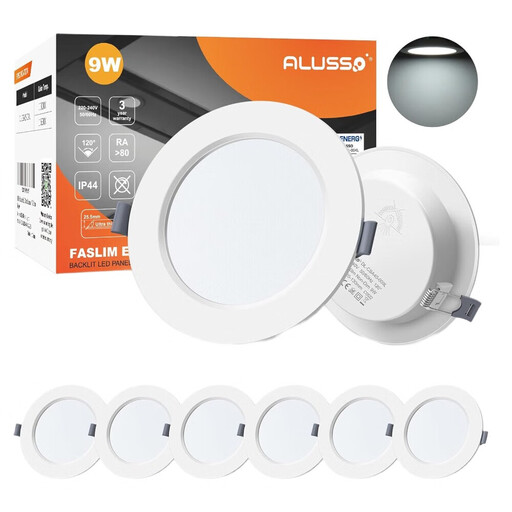
Why this product suits this profile: This set is aimed at renovators who want to fit out several ceiling openings consistently and need a particularly shallow installation depth.
The specified installation depth is 25.5 mm. The required ceiling cut-out is 115–135 mm. The model is also explicitly non-dimmable.
Direct connection to 220–240 V, IP44 classification and six lights per set. Each light is specified as producing 720 lm, with an average lifespan of 30,000 hours.
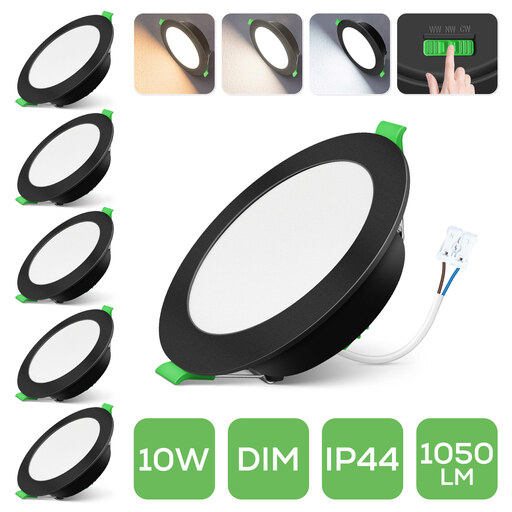
Why this product suits this profile: Suitable for users who want to adjust the light colour and brightness to suit the room and time of day.
The three colour temperatures, 3000 K, 4000 K and 6500 K, can be selected using an integrated switch. A compatible dimmer is required for dimming.
10 W power consumption, 1050 lm luminous flux, 34 mm depth and a suitable ceiling cut-out of 90–100 mm. The IP44 rating is intended for indoor areas exposed to splashing water.
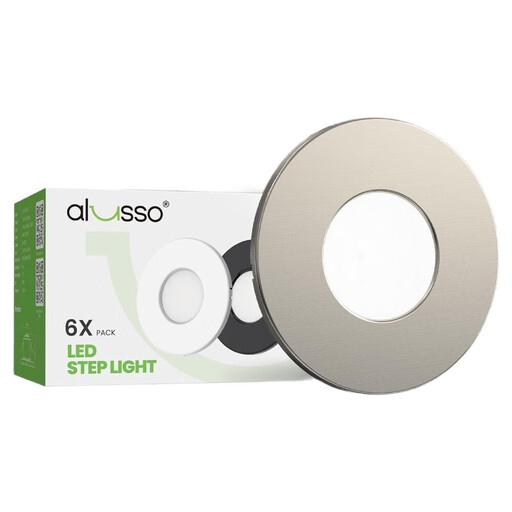
Why this product suits this profile: The compact design is suitable for stairs, hallways and wall areas where low power consumption and targeted guidance lighting are required.
The power levels 0.5 W, 1.5 W and 2.5 W can be selected. The light is designed for trailing-phase dimmers and, with IP44, is not intended for direct jets of water.
84.5 mm diameter, approximately 30 mm depth, 220 lm luminous flux and three colour temperatures from 3000 K to 6500 K. According to the product information, installation is possible using a spring clip or screw.
We have put together a complete, regularly updated list of products that fully meet these strict selection criteria and the safety regulations applicable in the EU.
Models with IP44 may be suitable for certain indoor areas with increased humidity. However, IP44 only protects against splashing water, not direct jets of water or immersion. The specific installation position must comply with the applicable installation regulations.
Depending on the model, the product specifications in this selection state an average lifespan of 25,000 to 30,000 hours. This is a manufacturer’s figure and depends, among other things, on operating time, ambient temperature, ventilation and correct installation.
Running costs depend on power consumption, daily operating time and the electricity price. The simple calculation is: wattage ÷ 1000 × operating hours × electricity price. For example, a 10 W spotlight uses 0.1 kWh when operated for ten hours. With several lights in a set, add together the power consumption of each individual light.