
Lieferung heute & morgen

Qualitätsgarantie

Willkommens-Angebote freischalten: KOSTENLOSE Lieferung | Bis zu 80 % RABATT | Kostenlose 30-Tage-JoyPlus-Testphase
App herunterladen
Switching to LED lighting is a crucial step towards a modern and energy-efficient home. Dimmable 230V LED recessed spotlights, in particular, offer flexible and atmospheric lighting design. However, the market can be overwhelming, and the wide selection can quickly lead to costly mistakes. This guide will help you understand the key features and avoid common pitfalls, ensuring you find the perfect solution for your project.
Before making a decision, you should be aware of the most common issues that can arise when selecting ceiling spots. Knowing these will save you not only money but also installation frustration.
To avoid the mistakes mentioned above, focus on the following technical features. These define the quality and functionality of your new lighting.
The "dimmable" label alone is not enough. For flicker-free brightness control of modern LED lamps, a trailing-edge dimmer (identifiable by the "RC" or "trailing edge" marking) is typically required. Older leading-edge dimmers ("RL" or "leading edge"), designed for halogen lamps, often cause the problems described. Therefore, always check the compatibility between the spotlight and your existing or newly purchased dimmer. A dimmable downlight kit from a single manufacturer often ensures that the components are perfectly matched.
Color temperature is measured in Kelvin (K) and determines whether the light appears warm, neutral, or cool.
A solution to this dilemma is offered by recessed spotlights with selectable color temperature, also known as 3CCT recessed spots. With these models, the color temperature can be set directly on the spotlight's housing via a small switch, allowing for maximum flexibility in any room.
For use in damp areas like the bathroom or kitchen, the IP protection rating is crucial. LED spots for the bathroom should have at least an IP44 rating. This indicates that the spotlight is protected against splashing water from all directions.
At the same time, a shallow installation depth is an important criterion for straightforward installation. A slim, low-profile recessed spotlight with a depth of under 40 mm can be integrated into almost any ceiling structure. Models designed as transformerless recessed downlights connect directly to the 230V mains supply, further simplifying installation.
Instead of making a one-size-fits-all recommendation, we have identified products tailored to specific user profiles and their requirements.
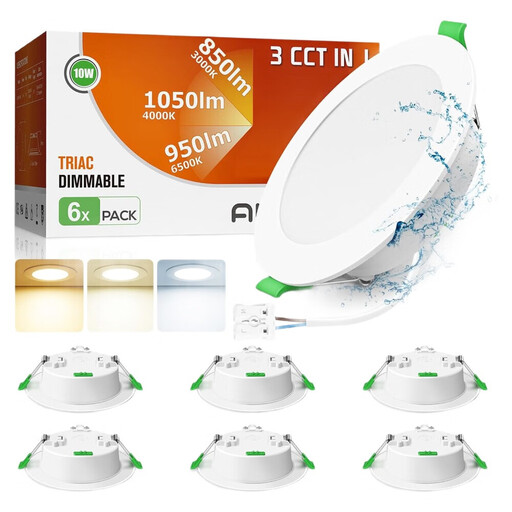
Why This Fits Their Persona: Ideal for users who want full control over the lighting mood in various rooms like the kitchen, living room, or bathroom and don't want to commit to a single light color beforehand.
The 3CCT function solves the problem of choosing the wrong color temperature by allowing a selection between 3000K, 4000K, and 6500K directly on the spotlight. Its dimming feature is designed for trailing-edge dimmers.
Combines dimmability, selectable color temperature (3CCT), and a slim profile (34 mm). The IP44 certification also makes it suitable for damp areas.
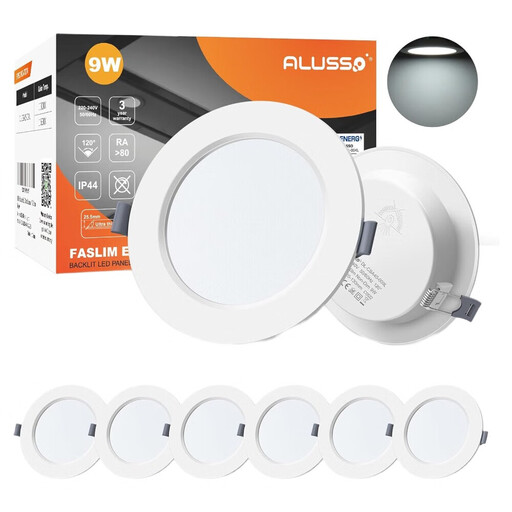
Why This Fits Their Persona: Perfect for projects where an extremely shallow installation depth is crucial and no dimming function is needed, e.g., in hallways, storage rooms, or as general lighting in a bathroom.
With an installation depth of just 25.5 mm, this model directly solves the pitfall of insufficient ceiling space. As a non-dimmable 230V spot, it also avoids any compatibility issues with dimmers.
Extremely slim profile (25.5 mm) for ceilings with very limited cavity space. The IP44 rating allows for safe use in damp areas.
We've compiled a complete, up-to-date list of products that fully meet these strict selection criteria and safety regulations.
No, 230V models are designed for direct connection to the standard 230-volt household mains. This makes a separate transformer (or driver) unnecessary and significantly simplifies installation, which is why they are also known as transformerless recessed downlights.
3CCT stands for "Correlated Color Temperature" and means you can choose between three preset color temperatures on these spotlights. Typically, these are Warm White (approx. 3000K), Neutral White (approx. 4000K), and Cool White (approx. 6500K). The selection is usually made via a small switch on the spot's housing before installation.
For most modern, dimmable LED recessed spotlights, a trailing-edge dimmer (often marked as "trailing-edge" or with the symbol "C") is recommended. These are specifically designed for the capacitive load of LEDs and ensure stable, flicker-free dimming. Using an unsuitable dimmer, such as an old leading-edge dimmer, is the most common cause of problems. Always check the manufacturer's specifications for both the spotlight and the dimmer.