
Lieferung heute & morgen

Qualitätsgarantie

Willkommens-Angebote freischalten: KOSTENLOSE Lieferung | Bis zu 80 % RABATT | Kostenlose 30-Tage-JoyPlus-Testphase
App herunterladen
LED recessed spotlights create clear, space-saving lighting for hallways, kitchens, living rooms, offices or bathrooms. However, before you buy, it’s not just about wattage and looks. What really matters are recessed diameter, recessed depth, voltage, luminous flux, dimming function and IP rating. Overlook these details and you could end up with lights that don’t fit your ceiling cut-out or can’t be connected as you’d hoped.
The visible width of the light is not the same as the ceiling cut-out required. A model with a 145 mm diameter, for example, may need an opening of 115 to 135 mm. Other LED ceiling spots only require 67 to 75 mm.
Recessed depth also matters. Slim LED recessed lights around 25 to 29 mm deep are ideal for ceilings with limited space. Even so, you need enough room for cables, connectors and, if applicable, a driver. Before ordering, measure your existing cut-out and the available cavity.
IP44 protects against solid objects larger than 1 mm and against splashing water. IP65 means dust-tight protection and protection against water jets. Neither rating replaces a proper assessment of the installation zone in a bathroom.
For recessed spotlights in the bathroom, you must also consider the relevant electrical regulations, the mounting position and the distance from water sources. If connecting directly to the mains, installation should be carried out by a qualified electrician.
Dimmable LED recessed spotlights need a compatible dimmer. For the 230 V model described, for example, a compatible trailing-edge dimmer is specified. Smart lights, on the other hand, can only be dimmed via an app and are not necessarily compatible with an external wall dimmer.
LED recessed spots 230 V connect directly to the mains and usually don’t need a separate transformer. This simplifies planning but increases the requirements for proper electrical installation.
12–24 V lights require a suitable transformer. For the 12–24 V model in our selection, this is not included. So before buying, you need to check the output voltage, total wattage and connection type of the transformer. Depending on the system, several lights can be powered together.
Brightness is given in lumens (lm), not just by wattage. A 6 W model with 430 lm will light differently to a 10 W model with 1,050 lm. For even room lighting, the beam angle also matters.
For colour temperature, here are some general guidelines:
LED recessed spotlights 3CCT are practical if the use of a room might change later. Selection is usually made via a switch on the light housing or through a control system.
With a 6-pack of LED recessed spots, check that six lights are actually included and that the luminous flux and colour temperature apply to all units. A set can simplify installing several matching spots, but it only makes sense if the cut-out, connection and spacing are consistent.

Why this product fits the profile: The 6-pack is suitable for rooms where you need several slim lights with a consistent colour temperature. It connects directly to 220–240 V without a separate transformer.
The specifications state a cut-out of 95–110 mm, a recessed depth of 25.5 mm and an IP44 rating. This lets you check the key installation details in advance.
Six lights, 430 lm per spot, 230 V connection and a slim design. This model is not dimmable and gives 6,500 K light.
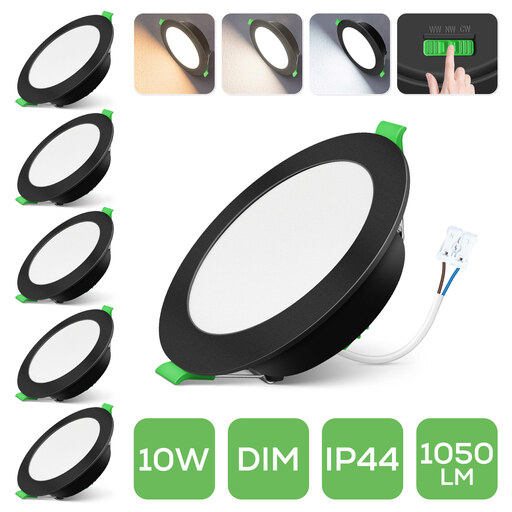
Why this product fits the profile: This model combines a direct mains connection with three selectable colour temperatures and stated dimming from 10 to 100 per cent with a compatible installation.
The product data specifies a ceiling cut-out of 90–100 mm and a recessed depth of 34 mm. It also clearly states that a compatible dimmer is required.
1,050 lm, aluminium and polycarbonate housing, 3CCT with 3,000/4,000/6,500 K and IP44.
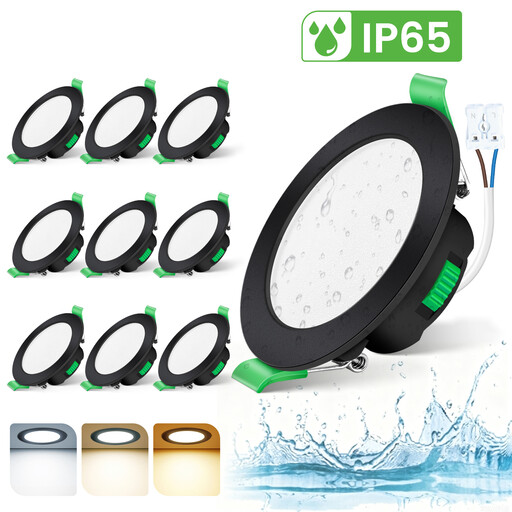
Why this product fits the profile: This model is ideal for buyers who want variable colour temperatures and a higher level of protection against dust and water jets. It is designed for direct connection to 230 V.
The specifications include recessed depth, outer diameter and a cut-out of 67–75 mm. The dimmer type, IP65 rating and three colour temperatures are also clearly stated.
7 W, up to 600 lm according to the product data, 3,000/4,000/6,500 K, dimmable and IP65. The set contains six lights.
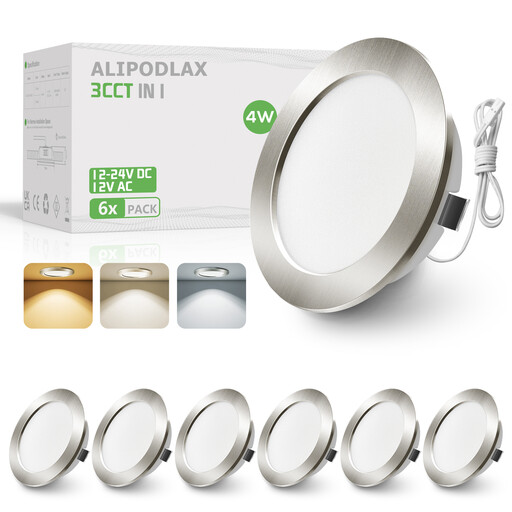
Why this product fits the profile: The 14.5 mm mounting height is designed for furniture, shelving, kitchen areas or other installation situations with very limited space.
This light must not be connected directly to 230 V. The product description clearly states that a separate 12–24 V transformer is required.
55–58 mm cut-out, 270 lm, 3CCT with 3,000/4,000/6,000 K, 4 W and IP44 for suitable indoor areas.
We’ve put together a full, regularly updated list of products that fully meet these strict selection criteria and the safety regulations in force in the EU.
Before ordering and installing, check the following points:
That depends on the IP rating, the installation position and the applicable installation regulations. LED recessed spotlights IP44 are intended for suitable damp indoor areas. LED recessed spotlights IP65 offer a higher level of protection against dust and water jets. A qualified electrician should assess the specific installation in the bathroom.
For several of the models listed, an average lifespan of 30,000 hours is stated. This figure is a manufacturer’s specification and depends on factors such as operating time, heat dissipation, mains quality and ambient temperature. Adequate ventilation must not be blocked by insulation material or covers.
For a comparable use, LED lights often require less electrical power. However, for a realistic assessment, you should compare the actual consumption in watts, the daily operating time and your electricity tariff. What matters isn’t just the advertised halogen equivalent, but the stated luminous flux in lumens.