
Lieferung heute & morgen

Qualitätsgarantie

Willkommens-Angebote freischalten: KOSTENLOSE Lieferung | Bis zu 80 % RABATT | Kostenlose 30-Tage-JoyPlus-Testphase
App herunterladen
LED recessed spotlights provide even ceiling lighting, take up very little space and suit a wide range of interior styles. But when choosing them, it’s not just the wattage or the depth of the fitting that matters. You’ll also need to check the ceiling cut-out, installation depth, protection against moisture and whether the light can be connected directly to 230 V.
Renovations often come with extra costs because measurements haven’t been checked or technical specifications have been misread. The points below will help you choose the right LED ceiling spotlights for your bathroom, kitchen, living room, bedroom, hallway or office.
A low-profile design doesn’t automatically mean that a light will fit an existing opening. As well as the installation depth, you’ll need to check the exact ceiling cut-out. For example, a spotlight with an installation depth of 25.5 millimetres may require a cut-out of 115 to 135 millimetres. Another model of a similar depth might instead be designed for a 95 to 110-millimetre opening.
Before you buy, make a note of the following measurements:
A bathroom recessed spotlight with IP44 protection is safeguarded against solid objects and water splashes from different directions. However, IP44 doesn’t mean the light is suitable for direct water jets, prolonged exposure to high levels of moisture or immersion. In a bathroom, you’ll also need to take the relevant installation zones and distances from water sources into account.
A qualified electrician should carry out any work on the mains supply. Switch off the power at the fuse box before installation or maintenance.
At 6500 kelvin, the light is noticeably cool and similar to daylight. This can work well in a utility room or office, but it gives a very different feel in a bedroom or living room from 3000 kelvin warm white. If you’d like more flexibility, you can choose 3CCT LED ceiling spotlights with switchable colour temperatures.
“Dimmable” isn’t a standard feature of all LED lights, either. A dimmable model requires a compatible leading-edge or trailing-edge dimmer. Non-dimmable LED recessed lights must not be connected to a dimmer.
For recessed lights for low ceilings, look for low-profile models with a clearly stated installation height. Some particularly compact options are available with a mounting height of around 14.5 millimetres or less. The mains voltage is also important when choosing a light:
A set containing several lights can make planning easier. Even so, check that the set size, light output and cut-out are suitable for each room.
Wattage describes how much electricity a light uses, not how bright it is. Light output is measured in lumens. A 9-watt model producing 720 lumens will therefore give you a different amount of light from a 6-watt model producing 430 lumens.
For a rough estimate of running costs, use this calculation:
Wattage × hours of use ÷ 1,000 = kilowatt hours
If you’re using several spotlights at the same time, add together the wattage of all the lights. You should also take the energy efficiency class shown on the energy label, such as E or F, into account when comparing models. Figures such as an estimated halogen equivalent are intended as a guide and don’t replace a direct comparison of lumen output and energy consumption.
3000 kelvin usually means warm white, 4000 kelvin neutral white and 6000 to 6500 kelvin cool white. A CRI or Ra value of 80 indicates basic colour rendering, although colours may still look different depending on the room and how the light is used.
A wide beam angle spreads light over a larger area. For focused task lighting, such as above a kitchen worktop, a different arrangement may work better than for even ambient lighting in a hallway.
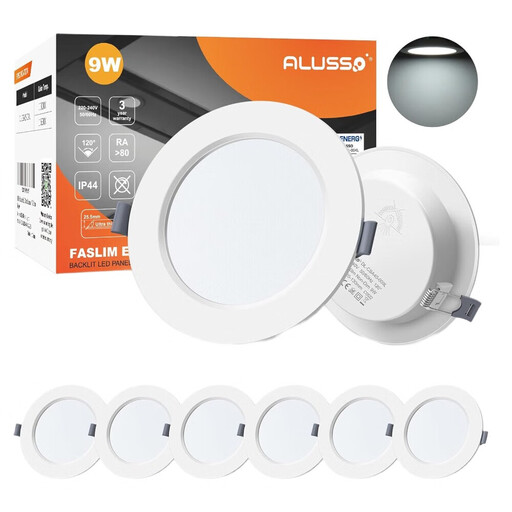
Why it suits this profile: This set of six is designed to provide even ambient lighting and, according to the product specifications, connects directly to AC 220–240 V.
The specifications state both the 25.5 mm installation depth and the 115–135 mm ceiling cut-out. This model is explicitly non-dimmable.
9 W, 720 lm, 6500 K, IP44 and a 230 V connection. The set includes six lights.
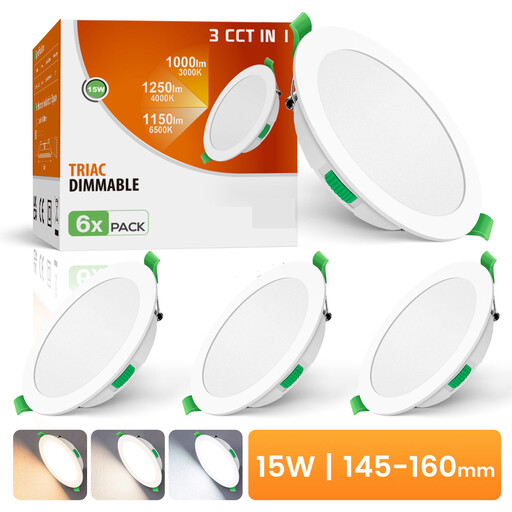
Why it suits this profile: Switchable colour temperatures and dimming let you tailor the lighting to different living spaces.
The product details list 3000, 4000 and 6500 K, as well as a dimming range of 10–100%. Check the 145–160 mm ceiling cut-out before installation.
1200 lm, 15 W, a 120° beam angle, IP44 and direct connection to 230 V, according to the product specifications.
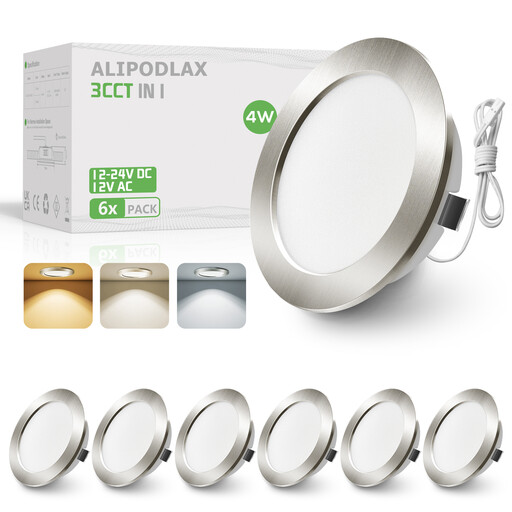
Why it suits this profile: According to the product details, this compact light is suitable for furniture, cupboards, kitchens, selected damp areas and vehicles.
According to the product specifications, this light must not be connected directly to the mains. A separate 12–24 V transformer is required.
14.5 mm mounting height, 55–58 mm cut-out, 270 lm, 4 W and three selectable colour temperatures.
We’ve put together a complete, regularly updated list of products that meet these strict selection criteria and the safety regulations in force across the EU.
It depends on the size of the room, ceiling height, wall colour and the lighting effect you want. When planning your lighting, consider the total light output of all the fittings. A single spotlight producing 430 lumens will give you a different level of ambient light from a model producing 720 or 1200 lumens. Several lights can often be spaced more evenly than a single central fitting.
A 230 V model with IP44 protection may, according to the product specifications, be intended for certain indoor areas and damp rooms. However, IP44 only protects against water splashes and doesn’t replace proper planning of bathroom zones. A qualified electrician should check the exact installation position and electrical connection.
Manufacturers often give the lifespan in operating hours. For the products mentioned, for example, the stated lifespan ranges from 25,000 to over 30,000 hours. These are product specifications, and the actual lifespan can be affected by heat build-up, frequent switching, mains conditions and the installation environment. That’s why it’s important to allow enough ventilation behind the light.