
Lieferung heute & morgen

Qualitätsgarantie

Willkommens-Angebote freischalten: KOSTENLOSE Lieferung | Bis zu 80 % RABATT | Kostenlose 30-Tage-JoyPlus-Testphase
App herunterladen
By: Joybuy Product Recommendation Officer
LED recessed spotlights work well in many areas of the home: from hallways to kitchens and bathrooms. However, wattage alone doesn't determine whether a light will perform well in everyday use. Ceiling cut-out, installation depth, colour temperature, dimmability and ingress protection rating all need to match your existing setup and the room where the light will be installed.
If you buy purely on low price or a high lumen figure, you may run into problems later: the light might not fit your ceiling, the light could feel too cold, or a supposedly suitable LED recessed spotlight with IP44 might be incorrectly used in a wet area.
An LED recessed spotlight with an outer diameter of 145 mm doesn't automatically need a 145 mm opening. Depending on the model, the required cut-out could be, for example, 90–100 mm, 115–135 mm, 120–130 mm or 145–160 mm.
Before buying, you should therefore measure:
Installation depth is especially important with suspended ceilings. Ultra-flat LED recessed lights around 25.5 to 34 mm deep can be more suitable here than deeper housings.
The IP44 rating protects against solid objects above a certain size and against splashing water from any direction. That makes it relevant for many areas in bathrooms or kitchens. However, IP44 does not mean the light can be submerged in water or exposed to a direct water jet.
An LED recessed spotlight for the bathroom should also be chosen according to the installation zone. Additional requirements apply in areas close to a shower or bath. When in doubt, have the electrical installation checked by a qualified electrician. Models with IP20, such as certain smart ceiling spots, are intended only for dry indoor areas.
Brightness is given in lumens, while power consumption in watts describes electricity usage. Two lights with a similar wattage can still appear differently bright. Also relevant are:
For work surfaces in the kitchen, neutral white light around 4000 K can be practical. Warm white light around 2700–3000 K is often used in living rooms or bedrooms. A 3CCT LED spotlight lets you choose between warm white, neutral white and cool white.
With an LED recessed spotlight 230 V, the light is designed for direct connection to the standard household AC mains. Some models don't need a separate transformer. Even so, the connection, circuit protection and cable routing must comply with current regulations.
Installation should only be carried out with the power supply switched off. If you're unsure, a qualified electrician is the right person to consult.
"Dimmable" doesn't mean it will work with every wall dimmer. Pay attention to the specified dimmer technology, such as leading edge or trailing edge. With some smart spots, brightness control is done exclusively via an app, not through an external wall dimmer.
Non-dimmable models aren't automatically unsuitable. They can make sense if you want a fixed brightness level. If you want to cover different usage scenarios, you can choose dimmable LED recessed spotlights or 3CCT models.
RGB+CCT smart spots and Bluetooth mesh ceiling lights offer additional control options. Before buying, check:
A smart spot with RGB and 2700–6500 K can produce coloured light as well as different white tones. That's practical for living rooms, gaming areas or rooms where you want to change the lighting mood. For the bathroom, however, the ingress protection rating is what matters, not the number of app features.
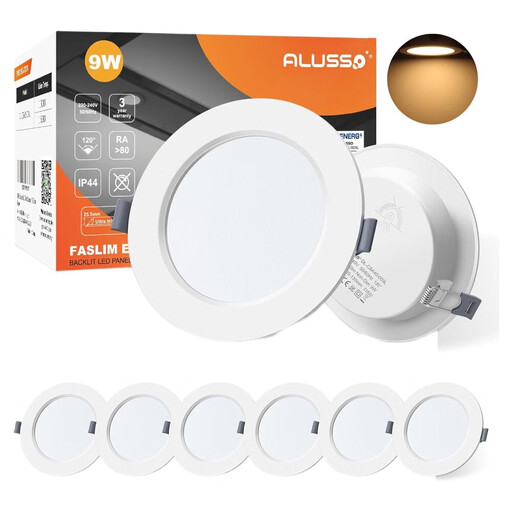
Why this product fits the profile: The 6-pack is designed for even general lighting in bathrooms, kitchens or hallways, and provides warm white light at 3000 K.
The specifications state a required cut-out of 115–135 mm and IP44. This lets you check compatibility before installation.
6 lights, 9 W per spot, 690 lm per spot and 25.5 mm installation depth; according to product information, not dimmable.
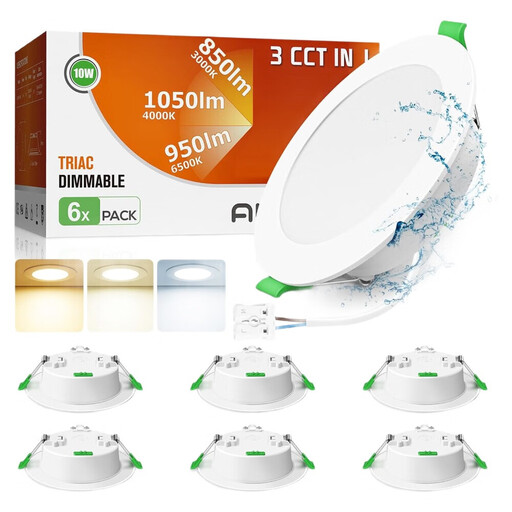
Why this product fits the profile: This model combines 3CCT selection, dimmability and an aluminium construction for flexible room lighting planning.
Colour selection is made via a switch on the light body; dimmability requires a compatible dimmer.
10 W, 1050 lm, 3000/4000/6500 K, IP44 and 90–100 mm required ceiling cut-out.
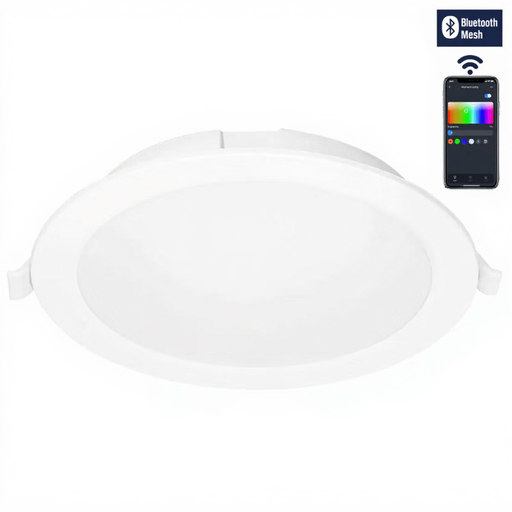
Why this product fits the profile: For smart home enthusiasts, this Bluetooth mesh ceiling light offers RGB as well as white light from 2700 to 6500 K.
The product data explicitly states IP20 and use in dry indoor areas. A different protection concept is therefore needed for bathroom areas.
15 W, 1430 lm, 120° beam angle, Bluetooth Mesh and cut-out of 150–160 mm.
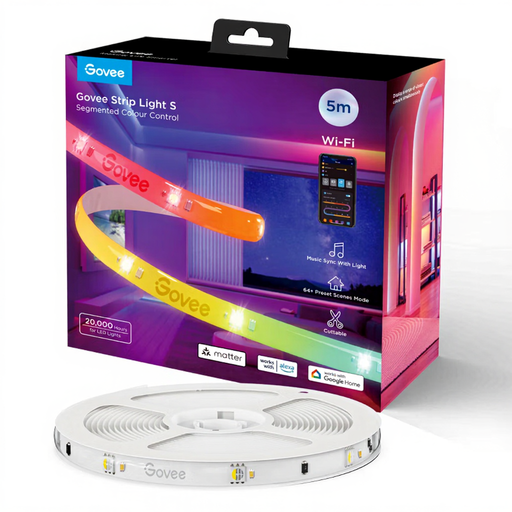
Why this product fits the profile: The 5 m LED strip complements recessed spotlights as indirect lighting behind furniture, at desks or in a home cinema.
The product information marks the strip for indoor use and warns against moisture as well as prolonged operation while coiled.
5 m length, RGBIC segment control, Wi-Fi, Bluetooth and Matter support; 24 W at 24 V DC.
We've put together a full, regularly updated list of products that fully meet these strict selection criteria and the safety regulations in force in the EU.
With LED recessed spotlights, you should switch off the power supply at the consumer unit before installation. The cut-out must be clean and within the specified range. Springs or retaining clips must not be twisted under tension.
Also make sure there is adequate heat dissipation. Insulation material or covers must not sit directly on the light housing contrary to the manufacturer's instructions. With multiple spotlights, the positioning should suit the room size and the desired beam angle.
There is no one-size-fits-all number. What matters are room size, lumens per light, ceiling height, beam angle and the purpose of the lighting. For even illumination, several LED ceiling spotlights are usually arranged at regular intervals. Work surfaces often need more targeted lighting planning than a hallway.
No. IP44 offers protection against splashing water, not against continuous water or submersion. Check the installation position, the specific model's ingress protection rating and local installation regulations. Models with IP20 are not intended for damp or wet areas.
The cost depends on power, daily operating hours and your electricity tariff. The simple calculation is: wattage ÷ 1000 × hours of use × electricity price. With a 10 W model and three hours of use per day, that works out at 0.03 kWh daily. With multiple lights, you should add up the power consumption of all spotlights.