
Lieferung heute & morgen

Qualitätsgarantie

Willkommens-Angebote freischalten: KOSTENLOSE Lieferung | Bis zu 80 % RABATT | Kostenlose 30-Tage-JoyPlus-Testphase
App herunterladen
LED recessed spotlights are suitable for ceilings, furniture, kitchens, bathrooms and vehicles. On product pages, many models look similar, but they differ significantly in cut-out size, installation depth, voltage, IP rating and control method. If you only focus on wattage or a low price, you may end up buying a light that doesn't fit your existing ceiling or isn't suitable for the intended location.
Slim LED recessed lights require little space behind the ceiling, but the installation dimensions are still crucial. A model with a 25.5 mm installation depth may be suitable for a low ceiling lining, but it still needs the correct diameter for the ceiling cut-out. Sizes such as 55–58 mm, 90–100 mm or 145–160 mm are not interchangeable.
Before buying, you should therefore measure the existing cut-out. For a new installation, you also need to consider the installation dimensions, the space for cables and, if necessary, a driver or transformer.
IP44 describes protection against solid objects of a certain size and against splashing water from various directions. This does not mean that a light is suitable for direct water jets, persistently high humidity or immersion. For a bathroom, you must also consider the installation zone, the distance from water sources and the applicable installation regulations.
Models with IP20 are intended exclusively for dry indoor areas. A smart LED recessed spotlight with IP20 therefore does not belong in a shower, bath or damp outdoor areas.
Dimmable LED recessed spotlights require a compatible dimmer. With smart models, brightness control is carried out via app, Bluetooth Mesh, gateway or voice assistant, depending on the version. An external wall dimmer is not automatically compatible. A 3CCT function also usually means that the light colour is selected via a switch on the housing before installation – not necessarily by remote control.
230 V LED recessed spotlights are connected directly to the mains supply. A separate transformer is not required for the corresponding models. Connection to the mains voltage should be carried out by a qualified electrician or an appropriately authorised person.
12–24 V LED recessed spotlights require a suitable DC or AC power supply. For the 12–24 V model with 4 W, a separate transformer is required according to the product information, which is not included in the scope of delivery. For a motorhome, caravan, campervan or boat, a 12 V or 24 V system may be suitable. Check the existing on-board voltage and the polarity or connection type beforehand.
Light colour is given in Kelvin:
A 3CCT LED recessed spotlight allows you to select several colour temperatures. The luminous flux in lumens describes the amount of light emitted. Wattage alone tells you little about brightness. Therefore, compare lumens, beam angle and the number of lights.
Measure the diameter of the ceiling cut-out with a suitable measuring tool. When replacing, the new recessed spotlight should either fit exactly or cover the existing cut-out. A 6-pack LED ceiling spot can be useful for several rooms or for uniform ceiling lighting. However, pay attention to whether the stated luminous flux applies per light or to the entire set.
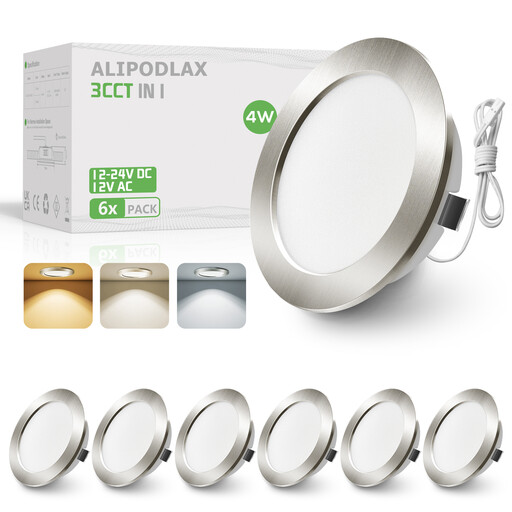
Why this product fits the profile: This compact light is designed for 12–24 V and offers three selectable colour temperatures. With a 55–58 mm cut-out and 14.5 mm installation height, it is suitable for furniture, kitchen areas or compatible on-board electrical systems.
The product details explicitly state the voltage, transformer requirement, cut-out and installation depth. This allows you to check compatibility before installation.
4 W, 270 lm, 3CCT with 3,000/4,000/6,000 K, IP44 and 12–24 V operation. The transformer must be purchased separately.
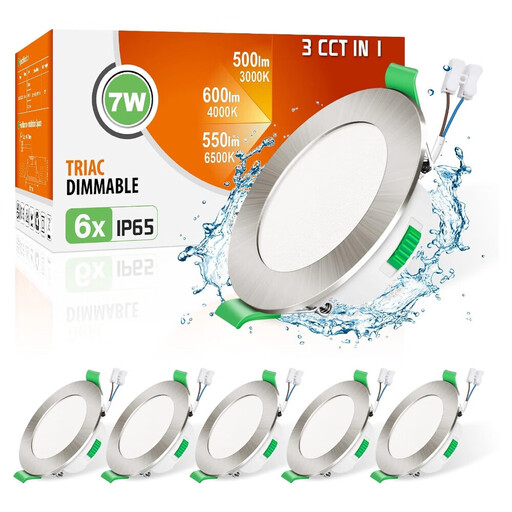
Why this product fits the profile: This model combines 230 V connection, 3CCT selection, dimmability and IP65. It is aimed at buyers who need to check several technical requirements for a bathroom or kitchen before installation.
The IP rating, the 67–75 mm cut-out and the direct 230 V connection are all clearly stated. For dimming, a compatible leading-edge or trailing-edge dimmer is required.
IP65, 500–600 lm according to product information, 3,000/4,000/6,500 K, 10–100 % dimmable and six lights per pack.

Why this product fits the profile: This light is designed for 12–24 V DC systems and therefore for typical applications in campervans, motorhomes, caravans or boats. Its compact design requires a 55–68 mm cut-out.
The stated voltage prevents a direct connection to 230 V. For 12 V AC in a household, a separate transformer is required according to the product description.
4 W, 400 lm, 3CCT with 3,000/4,000/6,500 K, IP44 and aluminium-ABS housing with 29 mm profile height.
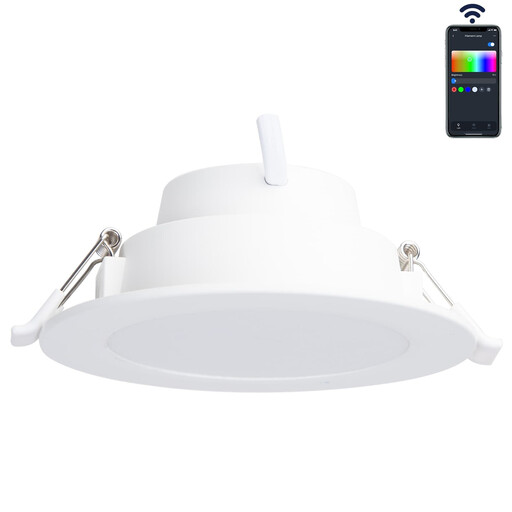
Why this product fits the profile: This model operates on 220–240 V and Bluetooth Mesh. Using a compatible gateway, you can control the colour temperature and other settings via an app.
The product data states IP20 and use exclusively indoors. This makes it clear that the light is not intended for bathrooms or other damp areas.
9 W, 780 lm, 2,700–6,500 K, Bluetooth Mesh, 120° beam angle and a required cut-out of 120–130 mm.
We have put together a complete, regularly updated list of products that fully meet these strict selection criteria and the safety regulations in force in the EU.
First, switch off the power supply at the circuit breaker. Then check the cut-out size, installation depth and connection type. 230 V lights are connected directly according to the manufacturer's instructions; 12–24 V models require the appropriate power supply or a transformer. Work on the mains voltage should be carried out by a qualified electrician.
The stated lifespan varies depending on the model. Several of the products mentioned have a lifespan of 25,000 or 30,000 operating hours. This value is a manufacturer's specification and depends, among other things, on the ambient temperature, ventilation, switching frequency and correct installation. Adequate heat dissipation must not be hindered by insulation material or covers.
The costs depend on the wattage, daily operating time and electricity tariff. The simple calculation is: Wattage ÷ 1,000 × operating hours × electricity price. For several LED ceiling spots, the wattage of all lights operating simultaneously is added together. Also check the declared energy efficiency class of the specific model and compare the luminous flux in lumens with your lighting needs.