
Lieferung heute & morgen

Qualitätsgarantie

Willkommens-Angebote freischalten: KOSTENLOSE Lieferung | Bis zu 80 % RABATT | Kostenlose 30-Tage-JoyPlus-Testphase
App herunterladen
LED recessed spotlights provide space-saving ceiling lighting for bathrooms, kitchens, hallways and living rooms. But before you buy, there’s more to consider than just wattage and design. The wrong cut-out size, an incorrectly assessed IP rating or an incompatible dimmer can make installation more difficult and add to the cost.
This buying guide from Joybuy’s Product Recommendation Officer explains which technical details matter when choosing LED recessed spotlights, and which models suit different homes and uses.
“Flat” doesn’t automatically mean that a light requires little installation depth. What matters is how much space there is behind the ceiling for the light, connection cable and, where applicable, driver. The ceiling cut-out is just as important. A model requiring a 90–100 mm cut-out won’t necessarily fit an existing 120–130 mm opening.
Before ordering, measure:
An IP44 LED recessed spotlight is protected against solid foreign objects and splashing water from different directions. However, this rating doesn’t mean the light is suitable for a direct jet of water, prolonged high condensation or immersion.
The intended installation zone also matters in a bathroom. You must follow the manufacturer’s guidance and the applicable installation regulations. IP20 models are intended for dry indoor areas only and must not be installed in a shower, near a bath or in other damp areas.
These terms describe different functions:
So even if a smart model can be dimmed using an app, it may not work with an external leading-edge or trailing-edge dimmer. Check the product description carefully before buying.
Depending on the design, 230 V LED recessed spotlights can be connected directly to a 220–240 V AC supply. Models operating at 12–24 V, on the other hand, need a suitable transformer, which often has to be bought separately. A 12–24 V spotlight must not be connected directly to the mains.
In Germany, electrical connections should be made by a suitably qualified person. Before installation, switch off the power at the consumer unit and check that the circuit is not live.
Brightness is measured in lumens, not just watts. A 9 W model producing 720 lumens may be enough for a particular area, while an 18 W downlight producing up to 1760 lumens can light a larger space. The number you need depends on the room size, ceiling height, wall colour and how you want the light to be distributed.
Colour temperature affects the feel of the light:
With 3CCT LED spotlights, you can select the colour temperature on the light fitting. This is useful if the way you use the room changes later on.
A wide beam angle, such as 120°, spreads light over a broad area. Even so, plan the spacing between spotlights to avoid noticeable dark patches.
For low ceilings, flat LED recessed spotlights with an installation depth of around 25.5 to 34 mm are worth considering. Make sure the available depth is sufficient, including space for the connection. Heat dissipation must not be obstructed by insulation or an overly tight installation space.
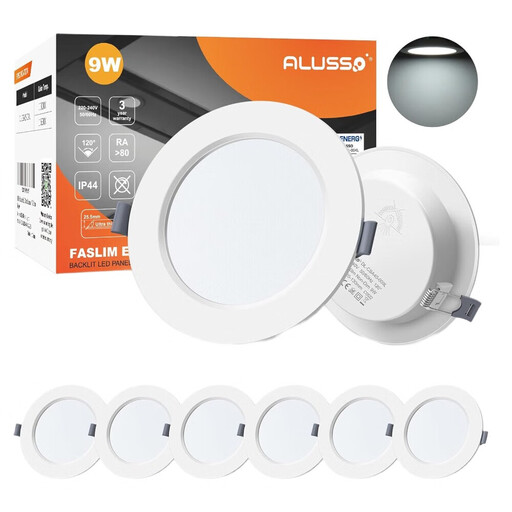
Why this product suits this profile: The six-pack uses 9 W per light, delivers 720 lumens according to the product details and connects directly to a 220–240 V supply. Installation depth is 25.5 mm.
The stated cut-out size of 115–135 mm and shallow installation depth make it easier to plan for low ceilings. According to the product details, the light is not dimmable.
Direct 230 V connection, 25.5 mm installation depth and IP44 protection for suitable indoor areas.
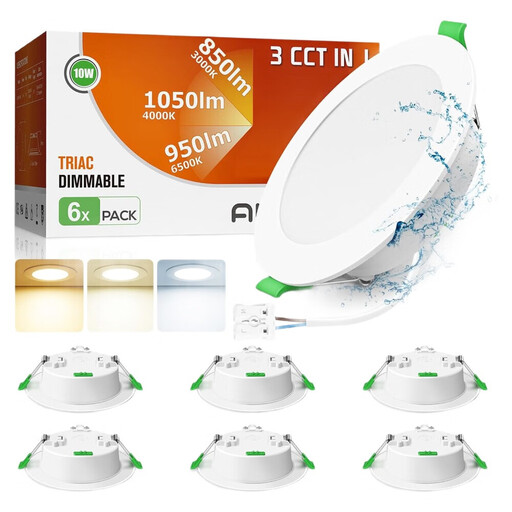
Why this product suits this profile: The six-pack delivers 1050 lumens per light, offers three colour temperatures and can be dimmed from 10 to 100 per cent with a compatible trailing-edge dimmer.
The colour temperature options and dimmer compatibility are clearly specified. The cut-out size is 90–100 mm, so you can check whether it matches your existing ceiling opening.
Aluminium and polycarbonate construction, 3CCT selection, IP44 protection and dimmable light output.
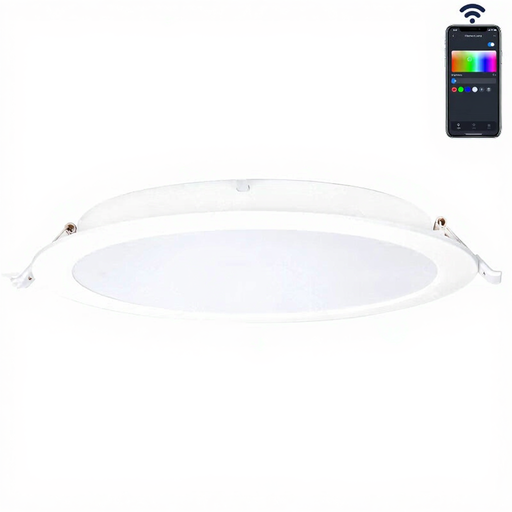
Why this product suits this profile: Bluetooth Mesh, app and voice control, plus a colour temperature range of 2700 to 6500 K, offer flexible settings for hallways, rooms and larger indoor spaces.
The product details clearly state IP20 and specify use in dry indoor areas. This helps prevent it being used incorrectly in a bathroom.
1760 lumens according to the product details, 18 W power consumption, RGB+CCT control and Bluetooth Mesh.
We’ve put together a complete, regularly updated list of products that meet these strict selection criteria and fully comply with the safety regulations in force in the EU.
Before installation, check the fitting instructions against the cut-out size and connection type. A 230 V light must be installed correctly by a qualified person. You should also avoid covering recessed spotlights with insulation if the manufacturer advises against it.
Power consumption determines running costs. A 10 W spotlight uses less energy than a 20 W spotlight operated for the same length of time each day. For a realistic estimate, multiply the wattage by the hours of use and your current electricity rate. The energy efficiency class is another useful point of comparison, but it doesn’t replace looking at lumens and how long the light will be used.
That depends on the IP rating and where the light will be installed. An IP44 LED recessed spotlight is designed for suitable areas where it may be exposed to splashing water. IP20 models are for dry indoor areas only. You must follow local installation requirements and the manufacturer’s instructions.
Many of the models mentioned here have a stated average lifespan of 25,000 to 30,000 hours. This figure comes from the respective product details and depends on operating conditions, heat dissipation and power supply. It shouldn’t be taken as a guarantee of a specific service life.
No. Only models explicitly labelled as dimmable should be used with a compatible dimmer. Smart LED recessed spotlights are often adjusted via an app, Bluetooth Mesh or a gateway. Before buying, check both the type of dimmer and the control method.