
Lieferung heute & morgen

Qualitätsgarantie

Willkommens-Angebote freischalten: KOSTENLOSE Lieferung | Bis zu 80 % RABATT | Kostenlose 30-Tage-JoyPlus-Testphase
App herunterladen
LED recessed spotlights provide a space-saving ceiling lighting solution for hallways, kitchens, bathrooms, bedrooms or offices. However, important technical details are often overlooked before purchase. Choosing the right model isn't just about wattage, design or a long lifespan claim.
A LED ceiling spotlight requires a precisely matching cut-out. The available models vary significantly: some variants require a diameter of 67–75 mm, others 90–100 mm, 115–135 mm or 145–160 mm. If the opening is too large, the spring clips may not hold securely. If the cut-out is too small, the light fitting cannot be installed flush.
Existing holes should therefore be measured before ordering. The installation depth and space for connection cables or drivers are also important.
An IP44 LED recessed spotlight is protected against solid foreign objects and splashing water from various directions. This is suitable for many bathroom areas, kitchens and covered balconies, but does not offer protection against direct water jets or continuous immersion.
For more humid environments, an IP65 LED recessed spotlight may be more appropriate. Even then, the installation zone, electrical installation and regulations for wet areas must be observed. A model with IP20, such as several smart indoor lights, should not be used in bathrooms or areas with water vapour.
A dimmable LED recessed spotlight requires a compatible dimmer. You should check the product specifications to see whether a leading-edge, trailing-edge or another type of dimmer is intended. Otherwise, flickering, humming or a limited adjustment range may occur.
Smart lights often take a different approach: brightness is controlled via an app rather than an external wall dimmer. According to the product description, the Aigostar model with Bluetooth Mesh is not designed to be compatible with an external wall dimmer.
Before buying a LED recessed light, these specifications need to match:
Work on mains voltage must only be carried out with the power supply switched off and in accordance with applicable electrical regulations. Connection should be left to a qualified electrician.
Brightness is given in lumens, not just in watts. A 10 W model with 1,050 lm delivers a different amount of light than a 6 W model with 430 lm. For even room lighting, the number and spacing of the spots are also relevant.
A beam angle of 120° distributes the light widely. This suits hallways or general ceiling lighting. A narrower angle can be useful if you want to highlight specific areas or pieces of furniture.
For colour temperature, the following guidelines are helpful:
A 3CCT LED recessed spotlight offers warm white, neutral white and cool white in one fitting. On many models, selection is made via a switch on the housing and must be done before installation or final connection.
Aluminium can help with heat dissipation, while polycarbonate, PBT or other plastics are used for the cover and housing depending on the design. The manufacturer's specific information on heat development, installation and cleaning remains crucial.
The energy efficiency classes of the products mentioned here range, for example, from D to F. For running costs, the actual power consumption, daily operating time and electricity tariff are what matter. A 10 W light used for four hours a day theoretically consumes 0.04 kWh per day.
RGB+CCT models additionally offer coloured light. An RGB LED recessed spotlight or a smart LED recessed light with Bluetooth Mesh can network several lights and control them via an app. A gateway may be required for this. Range, app compatibility and voice control should be checked before purchase.

Why this product fits the profile: This set is aimed at buyers who need several simple spots for indoor spaces and prefer a shallow installation depth. It specifies 25.5 mm installation depth, 430 lm and a cut-out of 95–110 mm.
The specific cut-out measurement and the note "not dimmable" reduce the risk of misplanning due to unclear specifications.
230 V direct connection, slim design and IP44 for suitable indoor areas.
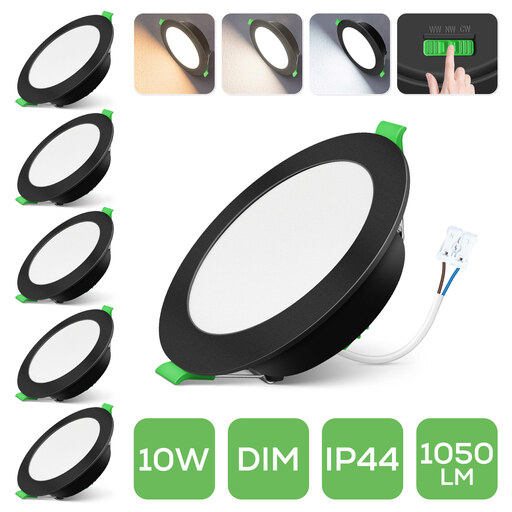
Why this product fits the profile: The combination of aluminium, polycarbonate, 1,050 lm, three colour temperatures and a stated dimming range of 10–100 % suits renovations with changing lighting requirements.
The required compatibility with a suitable dimmer is explicitly stated; the cut-out of 90–100 mm is also specified.
3CCT switch, dimming function and slim 34 mm design with direct 220–240 V connection.
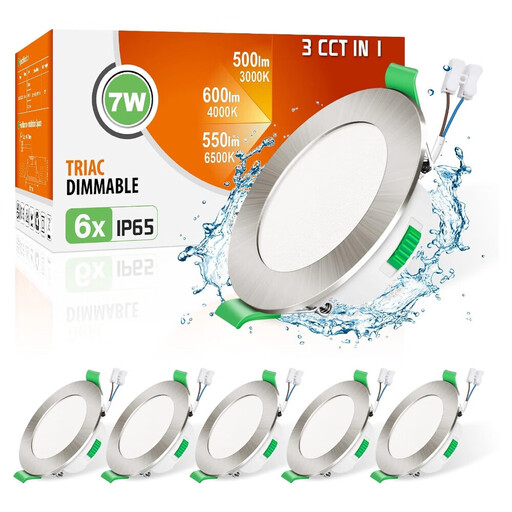
Why this product fits the profile: For bathrooms, kitchens, covered outdoor areas or other damp zones, the stated IP65 protection rating is a relevant selection criterion. The cut-out is 67–75 mm.
IP65 is clearly distinguished from pure indoor lights with IP20. Nevertheless, the installation location and direct water exposure must be checked separately.
IP65, 3CCT selection, 10–100 % dimming with a suitable dimmer and 29 mm installation depth.
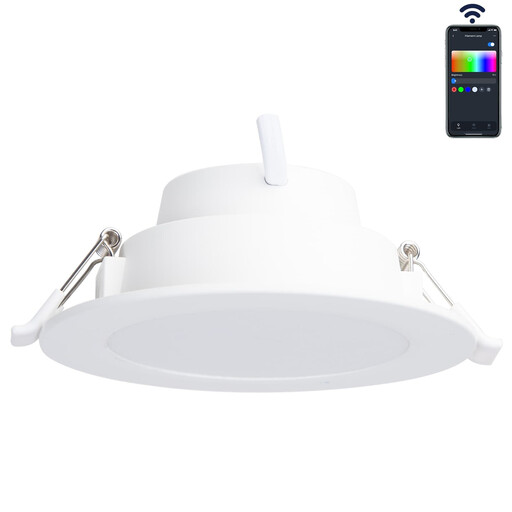
Why this product fits the profile: This light is aimed at users who want app, voice and scene control for indoor spaces. It specifies 780 lm, 2,700–6,500 K and RGB colours.
The product data indicates IP20 and indoor use only. This means the light is not intended for damp areas.
Bluetooth Mesh networking, RGB+CCT, app dimming and optionally stated voice control.
We've put together a complete, regularly updated list of products that fully meet these strict selection criteria and the safety regulations in force in the EU.
That depends on the room size, ceiling height, beam angle and number of lights. For general lighting, several wide-beam spots are usually more even than a single very bright light. The lumen rating per spot should therefore always be considered together with the planned spacing of the lights.
Only models with an expressly stated 220–240 V or 230 V connection are designed for this. A 12–24 V spot must not be connected directly to the mains supply and requires a suitable transformer. Electrical connection should be left to a qualified professional.
In the product data, several of the models mentioned are rated at approximately 25,000 to 30,000 operating hours. This figure is a guideline under certain operating conditions. Heat, frequent switching, moisture, the quality of the power supply and unsuitable installation can affect the actual service life.