
Lieferung heute & morgen

Qualitätsgarantie

Willkommens-Angebote freischalten: KOSTENLOSE Lieferung | Bis zu 80 % RABATT | Kostenlose 30-Tage-JoyPlus-Testphase
App herunterladen
LED recessed spotlights create even ceiling lighting, take up little space and suit a wide range of living areas. However, when buying, it's not just about wattage and design. Choosing the wrong cut-out diameter, an unsuitable IP rating or an incompatible dimmer can make installation difficult and lead to extra costs.
This buying guide from the Joybuy Product Recommendation Officer helps homeowners, renovators, DIY enthusiasts, interior designers and qualified electricians to objectively compare the relevant specifications of LED recessed spots, LED ceiling spots and suitable ceiling recessed lights.
The most important measurement isn't just the visible diameter. What matters is the ceiling cut-out – in other words, the size of the existing hole. A spot with a 145 mm outer diameter, for example, may require a cut-out of 115 to 135 mm. Other models need 90 to 100 mm or 67 to 75 mm.
Before buying, you should therefore check:
An IP44 LED spot is protected against solid objects and splashing water from various directions. However, this does not mean it is suitable for water jets, continuous moisture or immersion. For many bathroom areas and kitchens, IP44 can be appropriate, provided the light is used in accordance with the installation zone.
An IP65 LED recessed spotlight offers higher protection against dust and water jets. Nevertheless, the installation location, electrical circuit and applicable installation regulations must still be considered. For damp rooms, the choice should always be checked against local requirements.
Wattage describes energy consumption, not directly the amount of light. For comparison, the luminous flux in lumens is much more meaningful. A 7 W model with 600 lm does not automatically shine as brightly as a 9 W model with 690 lm or a 10 W model with 1,050 lm.
The beam angle, the number of lights and the room size also affect the result. With a set of 6 LED recessed spots, you should consider the total luminous flux, not just the output of a single spot.
230 V recessed spotlights are connected directly to the mains supply and, for the models mentioned, do not require a separate transformer. This can simplify planning. However, work on 230 V circuits in Germany may only be carried out by a suitably qualified electrician.
12–24 V lights, on the other hand, require a suitable transformer. This is not always included with every product. A 12–24 V model with a 55–58 mm cut-out can therefore be interesting for furniture, wall-hung cabinets, shelves or under-kitchen-cabinet use, but cannot be connected directly to the household mains without additional components.
Colour temperature is given in Kelvin:
A 3CCT LED recessed spotlight allows you to select between several colour temperatures, usually via a switch on the light housing. This is practical if the use of the room is not yet finalised. The setting should be made before installation, especially if the switch will be difficult to reach afterwards.
'Dimmable' does not mean that every wall dimmer will work. Many dimmable LED recessed spotlights require a suitable trailing-edge dimmer or a dimmer type specified by the manufacturer. Using an external dimmer with non-dimmable models can cause flickering or malfunction.
Also pay attention to:
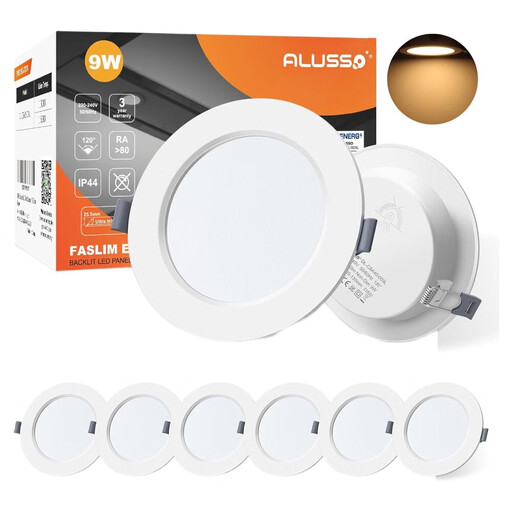
Why this product suits the profile: The set offers six directly connectable lights with a warm white colour temperature, ideal for creating uniform basic lighting in bathrooms, kitchens, hallways or living areas.
The specifications clearly state the cut-out of 115–135 mm, the installation depth of 25.5 mm and the direct connection to 220–240 V. This allows you to check the key installation points in advance.
690 lm per spot, 3000 K, IP44 and six lights per pack; not dimmable.
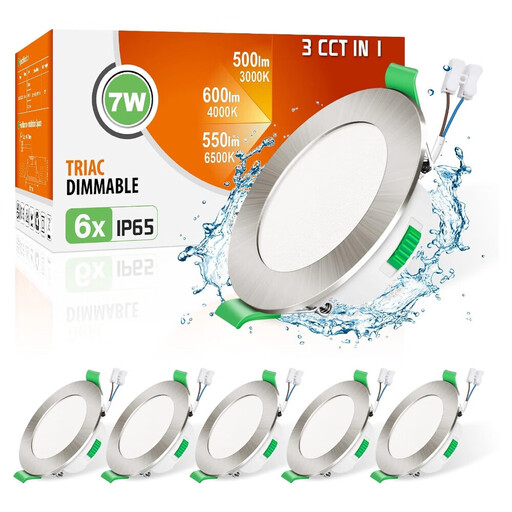
Why this product suits the profile: This model combines aluminium, polycarbonate, 230 V connection, three colour temperatures and a stated IP65 rating for selected damp indoor or sheltered outdoor areas.
The protection rating, the cut-out of 67–75 mm and the installation depth of 29 mm are all clearly stated. However, IP65 does not replace checking the installation zone and does not protect against every application scenario.
3CCT with 3000, 4000 and 6500 K; dimmable from 10–100 per cent with a compatible trailing-edge dimmer; 600 lm per spot.

Why this product suits the profile: The shallow installation depth of 25.5 mm makes it suitable for low ceilings. With a ceiling cut-out of 95–110 mm, this model can offer a suitable form factor for certain renovation projects.
The fixed light colour of 6500 K and the lack of dimming are clearly stated. This avoids the risk of accidentally expecting a variable or dimmable lighting concept.
430 lm per spot, direct connection to 220–240 V, a stated average lifespan of 30,000 hours and a compact design.
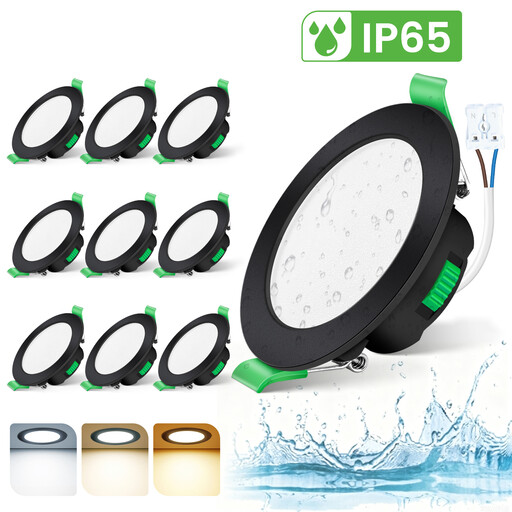
Why this product suits the profile: This 6-pack is aimed at buyers who want to combine a dark recessed look, variable light colour and dimming capability for multiple rooms or a larger ceiling area.
The three colour temperatures, the dimming range and the required cut-out of 67–75 mm are all specified. Before buying, you only need to check that your existing ceiling cut-out matches.
3CCT, 10–100 per cent dimming with a suitable dimmer, 600 lm per spot and IP65 according to the product specification.
We have compiled a complete, regularly updated list of products that fully meet these strict selection criteria and the safety regulations in force in the EU.
Before installation, the electrical circuit and connection must be isolated from the power supply. For 230 V lights, installation by a qualified electrician is required. Additionally, the installation depth must be compatible with the ceiling construction. Insulation material must not impede the light's heat dissipation, unless the product specifications indicate suitability for such use.
Running costs depend on the power rating, usage time and electricity tariff. A simple calculation is:
Power in kW × operating hours × electricity price = electricity costs
A 9 W spot, for example, uses 0.09 kWh over ten hours of operation. With multiple lights, the consumption adds up accordingly. The energy efficiency class should also be checked on the product label.
This depends on the IP rating, the specific installation location and the applicable installation regulations. IP44 can be suitable for areas exposed to splashing water, while IP65 offers higher protection. However, the light cannot automatically be used in every zone and should not be placed under a direct water jet.
The product specifications for many models state average lifespans of between 25,000 and 30,000 hours. This is a manufacturer's value and depends on factors such as heat dissipation, operating conditions and the quality of the electrical installation. An overheated or incorrectly installed light may fail sooner.
No. Only models explicitly marked as dimmable may be used with a suitable dimmer. Additionally, the light and dimmer must be technically compatible. With 3CCT models, the light colour is often selected via a switch on the housing, while the brightness is controlled separately using the appropriate dimmer.