
Lieferung heute & morgen

Qualitätsgarantie

Willkommens-Angebote freischalten: KOSTENLOSE Lieferung | Bis zu 80 % RABATT | Kostenlose 30-Tage-JoyPlus-Testphase
App herunterladen
LED recessed spotlights provide even LED ceiling lighting, take up little space and can be used in living rooms, kitchens, hallways and bathrooms. Choosing them may seem straightforward at first: wattage, colour temperature and pack size are usually given prominence in the product description. In practice, however, other details determine whether an LED recessed spotlight will actually fit your ceiling and suit its intended location.
An LED recessed spotlight usually has two important measurements: the outer diameter of the light and the ceiling cut-out. For example, a model with a diameter of 145 mm may require a cut-out of 115 to 135 mm. If you only check the visible diameter, the spotlight may not fit the existing opening.
Before you buy, measure:
The IP rating is often loosely advertised as “waterproof”. IP44 protects against solid objects measuring 1 mm or more and splashing water from various directions. This rating is not necessarily sufficient for areas with heavier moisture or exposure to water jets. IP65 LED recessed spotlights offer greater protection against dust and water jets, but they must still be installed appropriately for the location.
Depending on their position, IP44 LED recessed spotlights may be suitable for bathrooms, kitchens and utility rooms. In areas exposed to direct water or steam, you must follow the applicable installation zones and protection requirements.
A dimmable LED recessed spotlight requires a compatible dimmer. For 230 V models, it is particularly important to check the specified dimming method, such as trailing-edge dimming. An existing wall dimmer designed for halogen bulbs will not necessarily work properly with LEDs. This can result in flickering, buzzing or a limited dimming range.
With smart LED spotlights, brightness is often controlled via an app or voice assistant. This is not the same as using an external wall dimmer.
Slim LED recessed spotlights with an installation depth of around 25 to 34 mm are suitable for ceilings with limited cavity space. Models that connect directly to 220–240 V do not need a separate transformer. By contrast, 12–24 V spotlights require a suitable transformer, which is not always included.
Compact 12–24 V models can be a good choice for furniture, shelving or under-cabinet lighting. One example in our selection requires a cut-out of 55–58 mm, is 14.5 mm high and uses 4 W. This spotlight must not be connected directly to the mains.
Brightness is measured in lumens, not watts. Watts indicate power consumption. For example, a 9 W LED recessed spotlight may produce 690 or 780 lm, depending on its design and model. The beam angle also matters when planning your lighting: 120° spreads light widely, while a narrower angle can highlight specific areas more strongly.
Use these colour temperature guidelines:
A 3CCT LED spotlight offers a choice of colour temperatures, usually selected using a switch on the light fitting. This is useful if you want to decide on the final look of the room after installation.
With dimmable LED recessed spotlights, check whether you need a dimmer and which type is supported. An RGB+CCT model combines coloured light with adjustable white light, for example from 2700 to 6500 K. However, Bluetooth Mesh, Wi-Fi, app control and compatibility with Amazon Alexa or Google Assistant are different features. The specific connection type must suit your existing smart home setup.
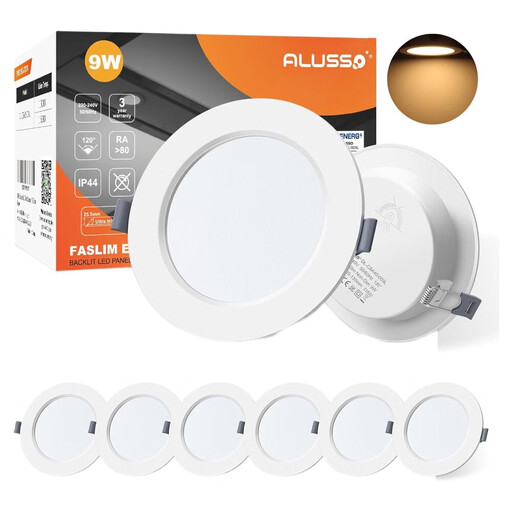
Why it suits this profile: This pack of six is ideal for renovations where you need several matching ceiling lights. Each 9 W spotlight produces 690 lm of warm white light at 3000 K.
The required cut-out of 115–135 mm and installation depth of 25.5 mm are clearly specified. The lights are not dimmable, so there’s no need to choose a dimmer that may not be compatible.
Pack of six, 230 V connection with no transformer required, and IP44 protection for suitable damp areas.
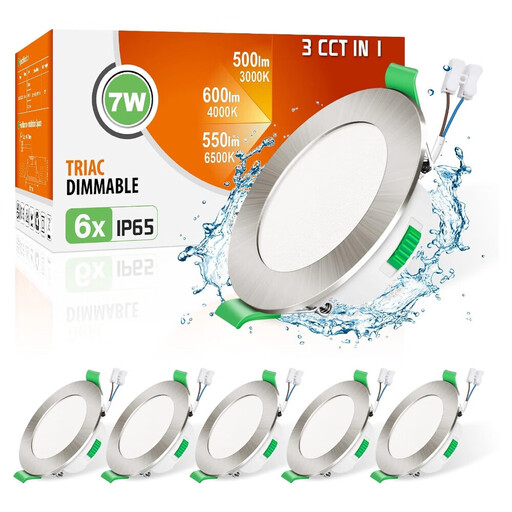
Why it suits this profile: This set combines a compact design with a 3CCT choice, dimmability and IP65 protection. It’s suited to buyers who value technical flexibility over a fixed colour temperature.
The IP65 rating is clearly stated. The product also specifies 3000, 4000 and 6500 K, plus a dimming range of 10–100% with a compatible trailing-edge dimmer.
Pack of six, 500–600 lm depending on the setting, 29 mm installation depth and direct 230 V supply.
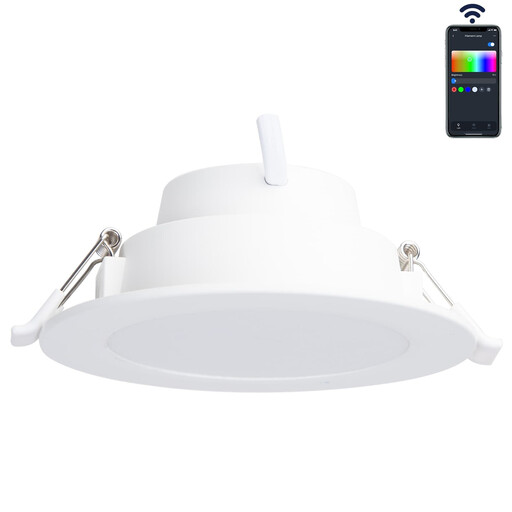
Why it suits this profile: This smart spotlight is designed for people who want to control colour temperature, RGB colours and brightness via an app or compatible voice assistant.
Control is via Bluetooth Mesh and an app, not an external wall dimmer. With an IP20 rating, it’s limited to dry indoor spaces.
780 lm, RGB plus 2700–6500 K, 120° beam angle, and gateway or voice control options.
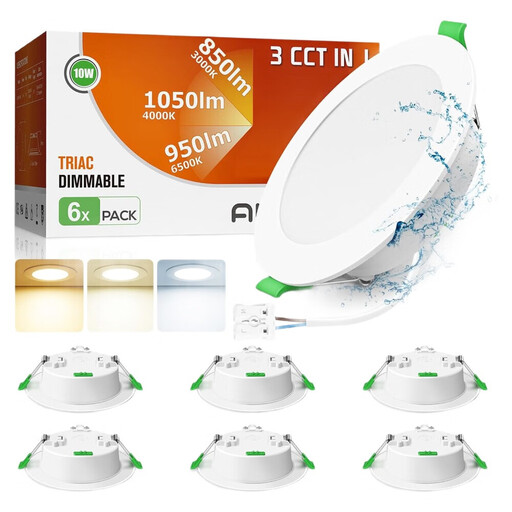
Why it suits this profile: This spotlight offers 1050 lm, three colour temperatures and a specified dimming range of 10–100%. The pack of six is suitable for several rooms or larger ceiling areas.
The required cut-out of 90–100 mm and installation depth of 34 mm are specified. Dimming requires a compatible trailing-edge dimmer.
1050 lm per spotlight, 3000/4000/6500 K, 120° beam angle and direct 230 V connection.
We’ve put together a complete, regularly updated list of products that meet these strict selection criteria and fully comply with the safety regulations in force in the EU.
Before installing permanently connected 220–240 V LED recessed spotlights, switch off the power at the circuit breaker. Electrical connections should be made by a qualified electrician in accordance with the applicable local regulations. Also ensure there is adequate ventilation, and do not cover the light with insulation unless the manufacturer specifically allows it.
Actual running costs depend on the wattage, daily usage and electricity tariff. A 9 W spotlight uses 0.09 kWh when run for ten hours a day. To calculate the cost accurately, multiply this figure by the number of lights and your current unit rate.
IP44 LED recessed spotlights may be suitable for appropriate areas of a bathroom, provided their installation position complies with the applicable installation zones. A higher IP rating may be needed where there is greater exposure to water. IP20 models are intended for dry indoor spaces only.
Product specifications often state a lifespan of 25,000 to 30,000 operating hours. These figures are provided by the manufacturer and depend, among other things, on temperature, ventilation, mains quality and switching cycles. A light that overheats or is installed incorrectly may fail prematurely.
No. Check the manufacturer’s details on the dimming method and compare them with your existing dimmer. Smart models are often dimmed exclusively via an app or voice control, while conventional dimmable LED recessed spotlights require a compatible wall dimmer.