
Lieferung heute & morgen

Qualitätsgarantie

Willkommens-Angebote freischalten: KOSTENLOSE Lieferung | Bis zu 80 % RABATT | Kostenlose 30-Tage-JoyPlus-Testphase
App herunterladen
LED recessed spotlights are suitable for living rooms, kitchens, hallways, bedrooms and bathrooms. They require little installation depth, can be used for targeted room lighting, and are available in various light colours, sizes and protection ratings. However, when buying, it is not just the wattage that matters. Cut-out size, installation depth, voltage, light colour and IP rating must all match your existing ceiling and the intended location.
Anyone simply searching for a cheap LED ceiling spot can easily overlook technical details. This can lead to costly rework, unsuitable brightness or an installation that simply does not fit.
An LED recessed spotlight must fit exactly into the existing ceiling opening. What matters is not just the outer diameter, but above all the specified cut-out or hole diameter. For the models featured here, the requirements range from 55–58 mm to 115–135 mm, for example.
Before ordering, you should therefore:
A shallow LED recessed spotlight can be useful for low ceilings. However, "shallow" does not automatically mean that every model will fit into a narrow ceiling cavity.
The IP rating describes the level of protection against the ingress of solid objects and water. IP44 indicates protection against solid objects larger than 1 mm and against splashing water from all directions. IP65 additionally offers protection against dust and water jets.
For a recessed spotlight in the bathroom, the relevant installation zone is decisive. An IP44 LED recessed spotlight may be suitable for certain areas in wet rooms, while an IP65 LED recessed spotlight offers a higher level of protection. However, the actual suitability still depends on the installation location, distance from water sources and the applicable electrical installation regulations.
Wattage describes power consumption, not directly brightness. For that, you need to look at the luminous flux in lumens. A model with 430 lm will light differently to one with 720 lm, even if both are sold as LED spots.
The light colour also affects the feel of the room:
A dimmable LED recessed spotlight also requires a compatible dimmer. The 7 W model in our selection is, according to the product details, designed for trailing-edge dimmers and can be adjusted between 10 and 100 per cent. Other models are explicitly non-dimmable or are controlled exclusively via an app.
230 V LED recessed spots are connected directly to a mains voltage of 220–240 or 230 V. According to the details, a separate transformer is not required for these products. This simplifies planning, but does not replace the need for a professional electrical installation.
12 V or 24 V models, on the other hand, require a suitable transformer. For the featured 4 W model, this is not included in the delivery. A direct connection to the mains voltage is not permitted for this product.
Check the stated luminous flux per spot, not just the total number of lights. With a 6-pack of LED spots offering 6 × 690 lm, the light distribution will be different to one with 6 × 430 lm. The CRI value describes how naturally colours appear under the light. A CRI of 80 is stated for several of the models featured here.
Aluminium can help with heat dissipation, while polycarbonate or PBT are often used for the trim and housing. However, the material specification alone is not a guarantee of a particular lifespan. For the selected products, an average lifespan of 30,000 hours is stated. This figure comes from the respective product information and should not be equated with a warranty.
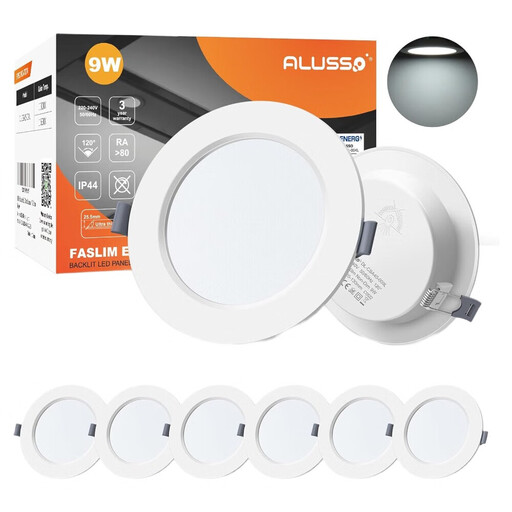
Why this product fits the profile: The 6-pack is designed for indoor spaces with limited ceiling height and offers a clearly defined light colour of 6500 K.
The installation depth of 25.5 mm and the stated cut-out of 115–135 mm are clearly listed. According to the product details, this model is not dimmable.
Direct connection to 220–240 V, 720 lm per light, IP44 and 6 lights per pack.
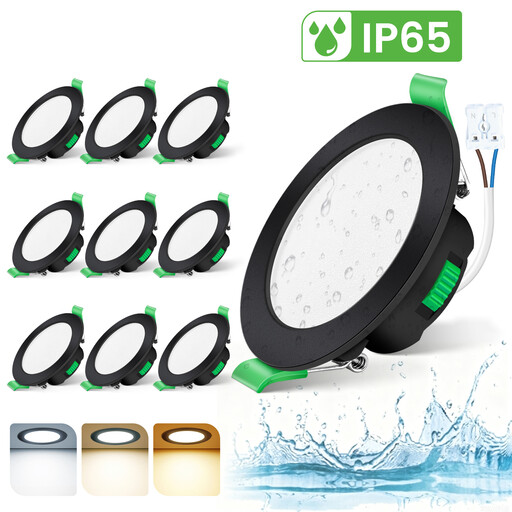
Why this product fits the profile: This model combines three selectable colour temperatures with a dimming function and a higher IP rating.
3000, 4000 and 6500 K can be selected via a switch on the light body. According to the details, the dimming function can be used with trailing-edge dimmers.
230 V connection, 500–600 lm depending on variant, IP65 and housing made from aluminium and polycarbonate.
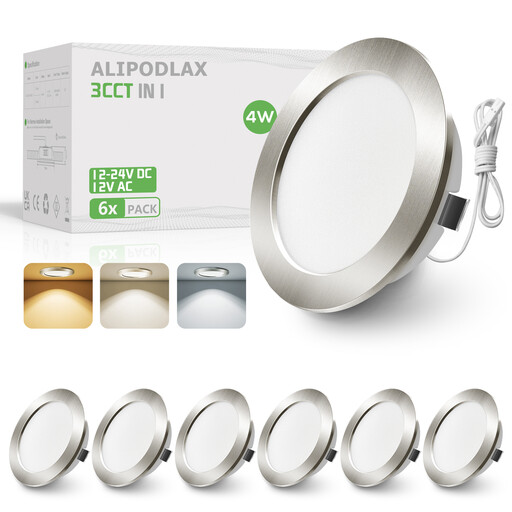
Why this product fits the profile: The compact design is ideal for furniture, kitchen under-cabinet units, caravans and installations with low-voltage supply.
The required 12–24 V supply is explicitly stated. This prevents accidental direct connection to 230 V.
14.5 mm build height, 55–58 mm cut-out, 270 lm and selectable light colours from 3000 to 6000 K.
We have put together a complete, regularly updated list of products that fully meet these strict selection criteria and the safety regulations in force in the EU.
Before installation, switch off the power at the fuse box. For a direct 230 V connection, the electrical installation should be carried out by a qualified professional. Also pay attention to:
An LED recessed spotlight for the bathroom should not be installed based solely on the product name. The protection rating, installation zone and installation conditions must all work together.
That depends on the room size, ceiling height and desired light distribution. For general lighting, several spots are usually distributed evenly. Therefore, compare the luminous flux per light and plan the number of spots based on the total floor area.
For several of the models mentioned here, an average lifespan of 30,000 hours is stated. The actual service life can depend on factors including operating time, heat dissipation, ambient temperature and mains conditions.
The running costs depend on the power, number of lights, daily operating time and electricity tariff. A 6 W spot consumes less energy over the same operating period than a 9 W spot. For a realistic estimate, you can multiply the total power of all lights switched on by the daily usage time.